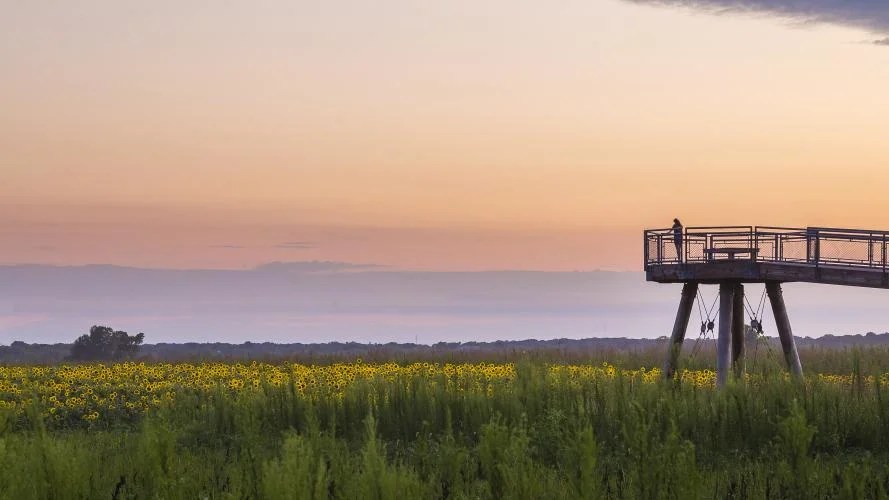
The Missouri Department of Conservation (MDC) is beginning construction of a new road on Columbia Bottom Conservation Area in Spanish Lake. When completed, the road will create a more direct connection from the area entrance to the boat ramp on the Missouri River. MDC estimates the construction project will be complete by spring 2025, depending on weather. The contractor will begin staging equipment on the area by the end of July.
The construction project will significantly improve public access to the boat ramp when completed. The current route to the ramp is six miles; more than half of the travel is on gravel roads. The new route will only be two-and-a-half miles long, with just one mile of gravel road.
“The new road will provide quicker access to the river for the public as well as emergency services. The current road will still be accessible for those wishing to access other parts of the area,” said Clinton Owenby, MDC Regional Resource District Manager.
The Missouri Rural Crisis Center (MRCC) is about fighting for rural people, according to Tim Gibbons. Motivated to fight injustice, Gibbons began working with MRCC in 2005, and now serves as director of communications.
“Our work is focused on farm and food justice,” said Gibbons. “We came out of the 1980s farm crisis as a collection of farmers who were already organizing in Missouri.”
The farm crisis Gibbons mentioned began in the late 1970s with an unprecedented economic and technological boom.
“Farmers were buying land and new technology,” Gibbons said. “But then we entered a rural recession. Farmers had loans they couldn’t pay for and the USDA, the dominant lender at the time, was foreclosing on farms.”
The Rise of Corporate Agriculture
By the 1980s, a new economic reality, in combination with new legal policy and industrialization of agriculture, began to discourage the family-farm model.
The Saint Louis Zoo WildCare Park released a new fly-through rendering video and an economic impact report projecting that the project will generate over $660 million in economic activity across the St. Louis region within the next 10 years.
“We are creating a place where endangered and threatened animals can thrive,” said Dwight Scott, Dana Brown President & CEO, Saint Louis Zoo. “But this report makes it clear WildCare Park will help the regional economy thrive too.”
WildCare Park, a safari park and conservation center under development in north St. Louis County, is expected to open to the public in 2027.
The economic impact report totals WildCare Park’s estimated operational expenditures, visitor spending both on and off site and the project’s larger impact on regional employment and wages, business sales and tax revenue through 2034.
The report estimates WildCare Park will generate:
– Average attendance of 421,900 guests each year after opening with approximately 65% of guests originating from outside St. Louis City and St. Louis County.
– WildCare Park guests will spend about $184 million at regional businesses outside of the safari park within the next 10 years.
– An annual average of 384 jobs, which includes positions at WildCare Park and in the region.
– A total of $97.3 million in governmental revenue, including $49.9 million in state and local tax revenues.
Jason Hall, CEO of Greater St. Louis Inc., applauded the combined economic impact of both the Saint Louis Zoo in Forest Park and WildCare Park in north St. Louis County, expected to total over $2.5 billion over the next decade.
“The Saint Louis Zoo alone already averages around $200 million of economic value annually, a number enhanced by its considerable cultural impact,” said Hall. “With the additional value WildCare Park brings to the metro, the Zoo will continue to act as an increasingly significant economic engine for our region.”
The development of WildCare park is estimated to cost $230 million funded through multiple sources, including philanthropy, external financing proceeds, which includes Zoo and Saint Louis Zoo Association cash reserves and tax revenue generated by Prop Z passed by St. Louis County voters in 2018. With the passage of Prop Z, St. Louis County residents will be able to experience WildCare Park admission-free.
“WildCare Park will bring with it a major tourism boost for our region and an economic boost for north St. Louis County,” said St. Louis County Executive Dr. Sam Page. “The Zoo is a favorite of locals as well as a national tourist destination and WildCare Park will join the list of must-sees when in the St. Louis region.”
The report estimates that guests to WildCare Park will generate significant spending in a wide range of local industries.
“This project is an amazing opportunity for businesses in north St. Louis County,” said Rebecca Zoll, President/CEO North County Inc. “With around $184 million in off-site guest spending over the next decade, hospitality, retail, transportation and entertainment sectors will all get a significant boost.”
Even before WildCare Park opens to the public, the organization is staffing up with quality full-time positions and will post the job openings on its website here: stlzoo.org/employment.
“We want WildCare Park to be a job creator within and beyond its gates for the region,” said Sabarras George, Saint Louis Zoo WildCare Park Director. “As we grow, I look forward to seeing our region’s businesses do the same.”
Tourism Economics and Canopy Strategic Partners prepared the WildCare Park economic impact report based on analysis from the economic impact model IMPLAN. The operational spending accounts for expenditures from 2021 through 2034, which includes planning and development (2021 through 2026) and the first eight years of operations (2027 through 2034). The guest spending impacts are for the eight-year period from 2027 through 2034. Impact modeling is based on an IMPLAN input-output (I-O) model for two regions: City of St. Louis/St. Louis County and St. Louis, MO-IL metropolitan statistical area (MSA).
The economic impact report and more updates on WildCare Park are available at stlzoo.org/wildcarepark.
About Saint Louis Zoo WildCare Park
Located in north St. Louis County with a target public opening of 2027, the Saint Louis Zoo WildCare Park features two completely different, but complimentary components. The first is what the public will experience: An outdoor adventure that sends guests on a safari through herds of animals roaming wild over gently rolling, grassy meadows and through native forests. The second component is the Kent Family Conservation and Animal Science Center, a dedicated conservation facility within WildCare Park designed to sustain endangered and threatened species, made possible by the generosity of the Jerry and Judy Kent Family. The 17 animals on site now live in the pastures and barns in this area, while the remainder of the barns and pastures are constructed.
Over the last two years, activity at WildCare Park has included demolition of a few older buildings, fence installation and grading around the perimeter of the property, restoration of 260 acres from golf course turf to native grasses, removal of honeysuckle and other invasive plant species, construction of barns and a utility building, and renovation of the headquarters building with a new observation deck.
The Zoo expects more than 250 animals will live on site by the public opening in 2027. For the public opening, the focus is on endangered ungulates — hoofed mammals such as Grevy’s zebra, addax, Somali wild ass, giraffe and white rhino — as well as kangaroos, birds and other threatened species.
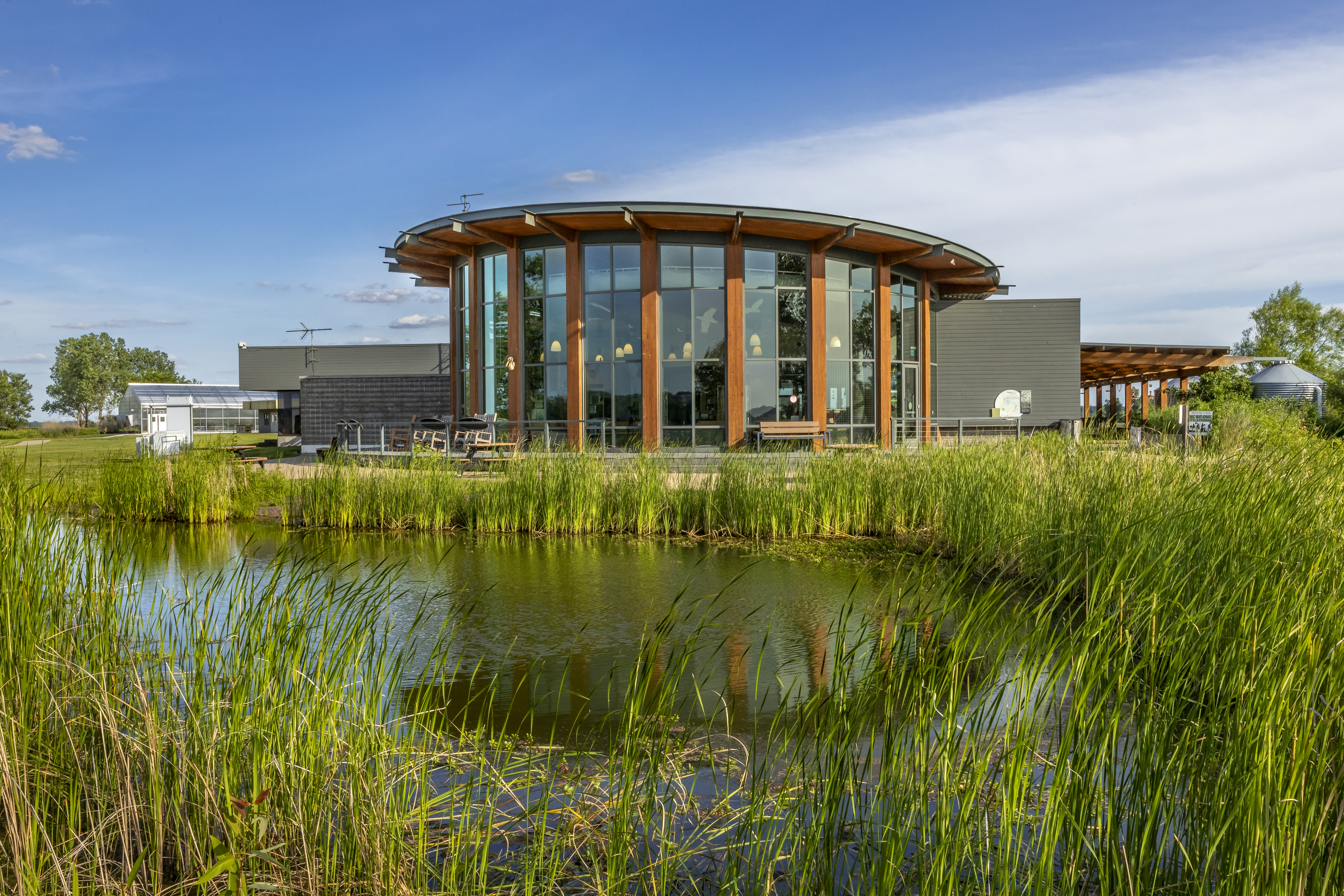
Nestled away in an eastern tendril of St. Charles County is avian education center that isn’t just for the birds. The Audubon Center at the Riverlands’ floor-to-ceiling windows display the tall, grassy banks of the Mississippi—a large variety of birds fluttering and gliding throughout the expansive green space.
Visitors can meander the 8.5 miles of hiking trails and learn about the importance of a premier migratory bird sanctuary. Throughout the seasons, more than 300 bird species can be found where this crucial piece of land meets river. The center even provides guests with seasonal checklists, so they know which flying friends to look for.
Natural beauty aside, The Audubon Center, directed by Ken Buchholz for the last eight years, is doing wonders for surrounding communities, Florissant and Ferguson, in particular.
The Center’s mission is “to connect people to the beauty and significance of the Mississippi River and the Great Rivers confluence, to inspire conservation of the river’s rich diversity in birds, wildlife, and other natural resources, and to support healthy, vibrant communities.” They’re doing just that.
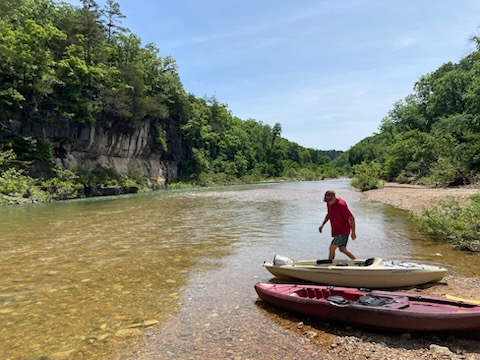
Most Missouri outdoor enthusiasts know the joy of a canoe, kayak or tubing trip down the clear, flowing, pristine rivers of the Ozarks. Did I mention that these Ozark waters are cold!
On a sweltering day, a short swim in the icy waters can shock a hot, sweaty body back to a much cooler reality. And, a river-cooled view of the world can last several hours – before another dunking is required.
Emery Styron, who once published The River Hills Traveler, sold the paper and now lives in Iowa City. Nevertheless, he comes back down to the heart of Missouri for a plunge in the Ozark rivers several times a year.
The cicada invasion has begun. Those who remember the last onslaught of these creatures in 2011 are telling war stories. Others have been preparing nets to protect plant life, and buying muffs to protect their ears.
Erin Tate of Rock Hill is no greenhorn when it comes to the insects crawling up her trees, laying some eggs, crawling out of their shells, buzzing away in the sky and dive-bombing the neighborhood.
“I remember their emergence in 2011 and it was pretty freaky,” said Tate. “The noise that they made was insane. And they were flying around in your face, and down your neck, and behind your ears.
“But the truth is that I really enjoy them,” added Tate. “It’s nature. It’s the sound of nature. My two kids are kind of sensitive to loud noises, so I do have ear buds and headphones for them so they can deal with it.”
North American cicadas are among the world’s loudest insects. They can produce sound levels ranging from 80 to 120 decibels. The aural intensity varies depending on factors such as environmental conditions and the individual cicada’s behavior.
At a distance of 20 inches away, a buzzing cicada can be as loud as a chainsaw. A steady audio intake of cicada noise production has been known to cause some temporary hearing loss.
“I’m less concerned about the noise, but actually more focused on what the cicadas might do to my plants and trees,” said Rock Hill’s Tate.
Spring is a great time to bring a few lawn chairs to any one of several riverside parks along the Meramec River. Take time to enjoy the sparkle on the water and longer days of sunshine.
My favorite spot is under a tree at Emmenegger Park, but there are more great river locations to kick back and take in the flowing water at George Winter, Unger, Greentree, Meramec Landing and Castlewood parks.
My idea of river fun on these days is to take a nap somewhere on the shoreline, but the Meramec remains a favorite destination for floating, boating, fishing and swimming.
Beyond its recreation potential, the Meramec supplies drinking water to approximately 70,000 households. It’s a top-ranked watershed in the Midwest, an irreplaceable freshwater resource, a key tributary to the Mississippi River.
The Meramec supports a variety of creatures, including 31 species of global significance. Several species are found nowhere else on Earth.
Fortunately, many environmental groups support river protection, such as the Sierra Club, Great Rivers Environmental Law Center, Meramec River Recreation Association, Nature Conservancy and more.
The Meramec River Recreation Association is currently slated to have a meeting and presentation about the river at 2:30 p.m., May 16, at the Wildwood City Hall. A zoom connection to the event may be possible.
Environmental Echo’s Don Corrigan calls a halt to his bike ride on the GRG Trail near the border of Kirkwood and Valley Park as the Meramec River floods over the trail.
Storms on May 8 closed hiking and biking trails and some roads along the Meramec River. Spring flash floods in the St. Louis area have had rivers rising, but not yet to the historic levels of 2008 or 2017.
More rains predicted for the week of May 12, and for later this month, could raise rivers closer to those record levels. The National Weather Service noted flooding at the time of the May 8 storms from Pacific to Valley Park.
Flooding was visible at Yarnell Road at Soccer Park and farther south to Fenton. In Pacific, water rescues have sometimes been necessary at Big Bend and Meramec Farm Valley roads.
Cars stall out in flash floods and drivers must be rescued by first responders. Drivers are constantly warned not to drive on roads that disappear into flood waters.
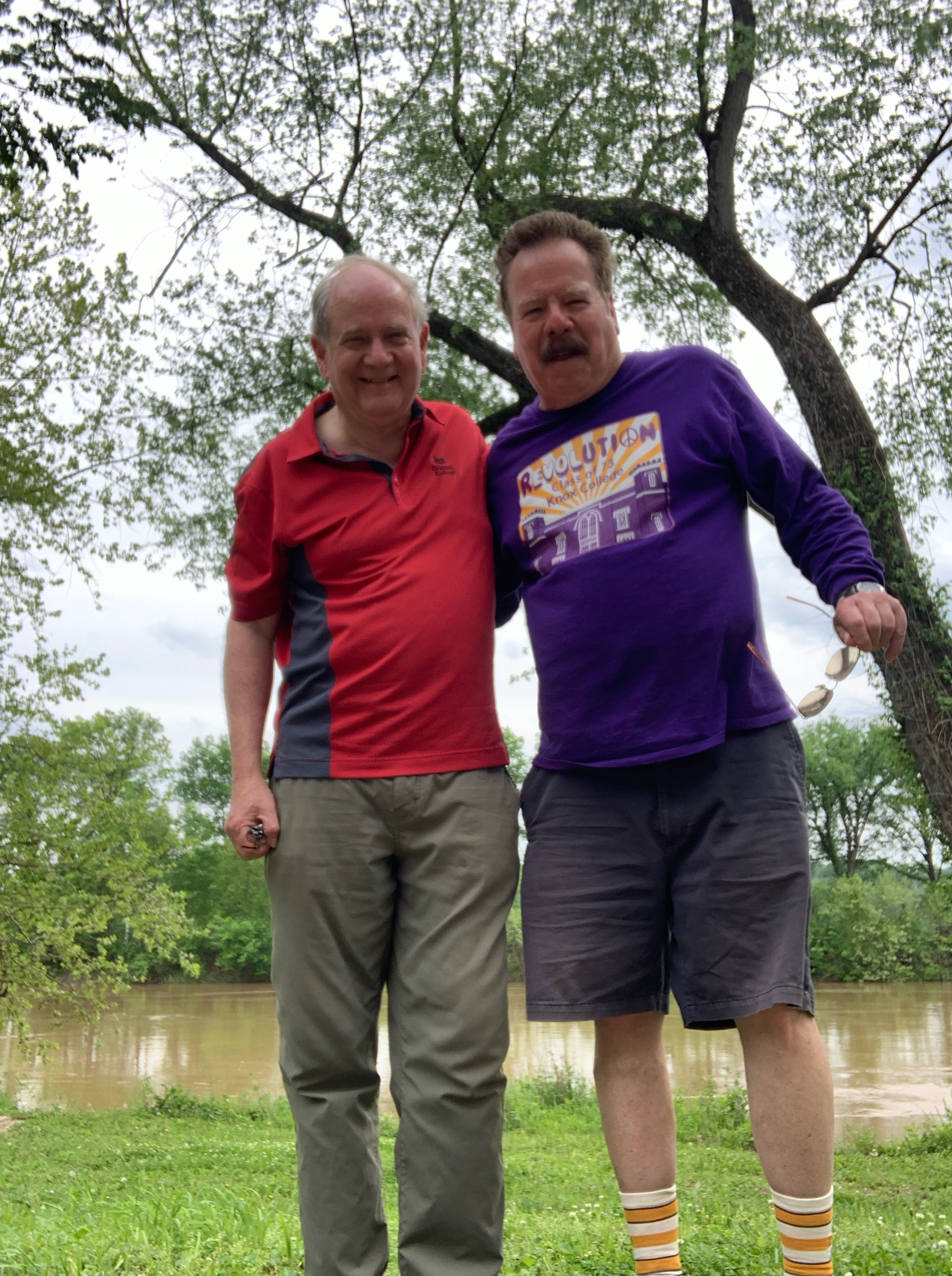
Mark Sableman (in red) and Don Corrigan (in purple) celebrate their good judgment in not riding into the flooding Meramec River. Storms on May 8 closed trails and roads.
Trails that occasionally disappear into flood waters are those along the Meramec, Missouri and Mississippi rivers. Bikers venture into the waters at their own risk.
The loop trail at Cliff Cave Park near the Mississippi River can close for weeks in spring and summer after periods of intense rain. However, trails higher up in the park will remain open.
The trails in Valley Park, Kirkwood and Fenton also can close for weeks in spring and summer after flooding rains. However, one half-loop trail that never closes when the Meramec River floods is the one atop the elevated Valley Park Levee.
It’s thanks to the Saint Louis Zoo’s Michael Dawson that spring peepers, chorus frogs, and cricket frogs are still on the map — literally. Dawson’s creation and maintenance of the FrogWatch chapter known as the Spring Peeper Program in St. Louis has put these small, but noisy creatures back on conservation radar.
Statewide, these critters are not near extinction, but Dawson explores the effects urbanization has had on their significant population loss in the St. Louis area, while also encouraging the community to get involved in reversing their decline.
“I started looking at data collected by citizen scientists, species by species. One of the patterns I recognized is that certain species were almost completely absent inside of I-270. Whereas you go three minutes outside of I-270, they show back up on the observation maps,” Dawson said. “Some frog species are unaffected by urbanization, but the spring peepers, chorus frogs, and cricket frogs all seemed to be.
“I wanted to see if the citizen-collected data was true, and the Zoo encouraged me to put a project together. So, I did. After getting it approved and funded, I started setting up acoustic surveying devices around the St. Louis area,” Dawson explained. “Over the last three years, I found that the citizen scientists were right.”
The Saint Louis Zoo FrogWatch program stems from an even larger effort, FrogWatch USA. The Akron Zoo manages the national program. The mission is to build a community to help the frog and toad populations across the United States. Thanks to smartphones, this has become even easier.
“If you’re out in the field and have a phone, you can record a frog’s call,” Dawson said. “Recording calls is even better than using photos because I can download it, put it through my software, and can determine what species it’s from. Plus, it’s timestamped and GPS coded. It’s no different than the recording devices I leave out on trees.”
Pictured: David Gunn. All photos by Ursula Ruhl, WKT.
by Don Corrigan
In anticipation of the nationally-designated tree holiday of April 26, the city of Webster Groves set aside Wednesday, April 17, for its formal Arbor Day Ceremony and Awards Celebration.
Prior to its official celebration on the evening of April 17, citizen volunteers and city team members planted 200 trees to honor Arbor Day. At 5 p.m., that day an awards ceremony commenced at Southwest Park Pavilion.
Tree Steward Lynnda Greene was posthumously granted a Tree of Distinction Award. Greene was a Master Gardener, and a member of the International Dark-Sky Association. She was praised for her love of nature, animals and the environment.
Greene was a member of the Webster Groves Garden Club and founding member of Webster Groves Greenkeepers. She assisted the city’s Greenspace Commission and one of her passions before her death in May 2023 was promoting the NO-MOW green movement to benefit pollinators.
The honor for Greene was followed with a tree tour given by David Gunn. An arborist certified by the International Society of Arboriculture, Gunn’s talents were enlisted by the city’s “Eco-Ed” program series.
Arborist’s Tree Walk
On the tree walk, Gunn pointed out some of the city’s most interesting trees in Southwest Park. He also spoke to the hikers on the basics of tree anatomy, soil structure, tree identification and his favorite park trees .
“I like the black locusts that reach down and touch the ground with their trunks,” said Gunn. “I love when we can see trees that are allowed to do their own thing, instead of always being managed to be neat and tiny.
“There’s also a great hackberry that I love,” noted Gunn. “What parks can do – that residences can’t do – is let trees age and fall apart a little bit. Let the woodpeckers and the raccoons add some character as well.”






 Environmental Echo