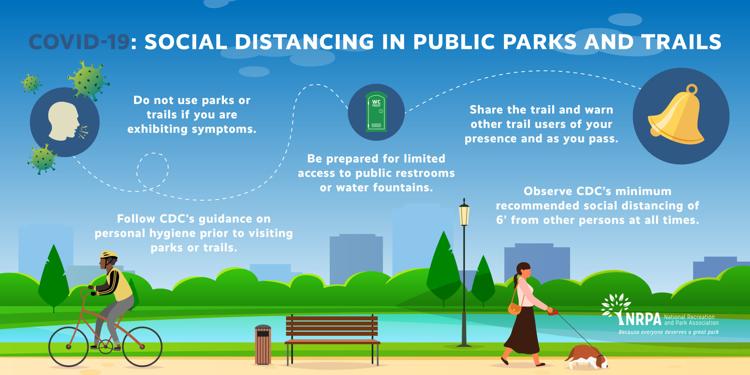
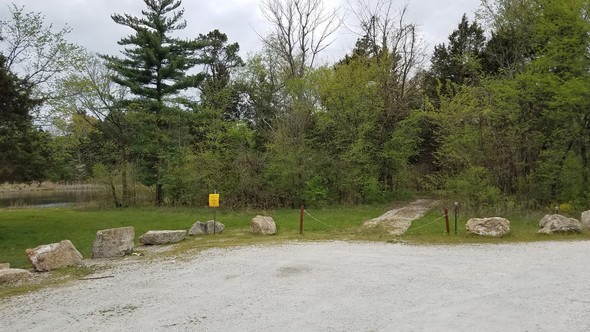
St. Louis County will reopen some public parks effective April 28. For a listing of what parks will be open and the parks that will remain closed CLICK HERE.
For a map of the open and continued closures of St. Louis County parks CLICK HERE.
Continue reading below for additional information from St. Louis County Parks and Recreation.
The discussion, and a few chuckles, stem from Don Corrigan’s latest book, “Nuts about Squirrels.” Corrigan, is a longtime journalism professor at Webster University, Editor-in-Chief of the Webster-Kirkwood Times, Inc. newspaper group and the author of noted outdoor and environmental books.
Spring and summer months bring both the buzz of lawnmowers and bees. These fuzzy flyers are important pollinators, playing a crucial role in the production of many favorite fruits and vegetables. The Missouri Department of Conservation (MDC) encourages the public to “bee-friend” these valuable native pollinators.
“Missouri is home to around 450 species of native bees, but it’s not uncommon for more to be identified each year,” said MDC Urban Wildlife Biologist Erin Shank. “There are several common bees Missourians will encounter, including the bumblebee, carpenter bees, sweat bees, and the leafcutter bee.”
Most native bees only live about one year. They emerge in the spring as adults, visiting flowers and buildings nests. Many species, such as bumblebees, make their nests underground, while others, such as leafcutter and mason bees, will set up shop in small cavities found in wood or in the pith of plant stems.
This is pitiful. It’s Earth Day Week. It’s Earth Day Month. And it’s dangerous to be outside and too dangerous to be too close to each other. A lot of us are sad and angry. We are angry because we are too smart for this. We were warned. We had time to prepare. We knew this could happen. We could have staved off the worst of this. We are sad, because we know this can and will happen again. Or will it? Maybe we will learn something. Or maybe we will point fingers and tear each other apart. So, it will be worse next time.
These songs are about degradation of the Earth. They are songs about losing our planet, because we did not take care of it. I think we need to face the music. I know there are those who will say that these songs are all too depressing. Why not, “The Sun Will Come Out Tomorrow” at a time of despondency and pandemic. Well, I don’t like Annie and her little dog, Toto, even after the witches have melted and there’s cotton candy at the baseball game. There’s not going to be cotton candy at a Cardinals’ game for a good while, so I am putting together my Top 10 songs about saving our planet. Some of them I listened to 50 years ago. I am not sure we are any closer to saving our earth, or ourselves, then in 1970. Isn’t that when the first Earth Day began?
Actor Zac Efron hosts THE GREAT GLOBAL CLEAN UP™ (premiering April 22 on the Discovery Channel.)
This year marks the 50th anniversary of Earth Day. It is a day that remains the largest collective call-to-action in human history. And each year since, people have flocked together by the millions to campuses, parks, beaches and town squares around the world to stand up and fight for the planet. The current health pandemic has made clear in recent weeks, our planet is more delicate than ever before.
On the 50th anniversary of Earth Day, Discovery Channel is bringing the world to you and celebrating our precious planet with a slate of programming that highlights the power of individuals and communities who work tirelessly to keep it healthy and strong. The Discovery Channel will go green with programming for the entire family.
The United States is facing a challenging time. The simple task of going to the grocery store has become stressful for many as bare shelves, empty meat cases and rationing have greeted frustrated shoppers.
But this is not the first challenge our society has faced when it comes to food and supply shortages. During World War II, our parents and grandparents faced even harder situations and within longer periods of time.
Ordinary citizens were encouraged to grow gardens in backyards, vacant lots, rooftops and any available unused accessible areas. They were dubbed “Victory Gardens” and according to a story in the Farmers’ Almanac, there were tens of millions of “Victory Gardens” planted during WWII, which produced millions of tons of fresh veggies and fruits to help combat food shortages.
Now, a slew of information is currently being published about a possible resurgence of interest in “Victory Gardens.”
Effective immediately, Ozark National Scenic Riverways is suspending all commercial services operations within the park and expanding the restriction on camping to include all gravel bar camping and camping along trails in support of federal, state, and local efforts to slow the spread of the novel coronavirus (COVID-19).
The suspension of commercial services includes operations by all authorized outfitters within the park boundaries, such as the park’s contracted float and shuttle concessions and guide services. This suspension remains in effect through at least May 10 and will be evaluated prior to that time to determine if there is a need for extension.
Camping closures have also been expanded to encompass all camping, including gravel bar camping and dispersed camping along the Ozark Trail within the park boundary. These closures will remian in effect until at least May 10 and may be extended beyond that date if necessary. All camping or pavilion reservations between April 15 and May 10 have been canceled through the recreation.gov website and visitors should expect refunds processed for those cancellations.
For more detailed information and specific camping and other destinations in the ONSR area impacted by the changes can be FOUND HERE.
The Missouri Department of Conservation (MDC) has confirmed the presence of emerald ash borer (EAB) in Chariton, Lafayette, and Moniteau counties, bringing the statewide total to 78 counties known to have the pest. EAB is a small, metallic green beetle native to Asia that attacks all species of ash trees, killing more than 99 percent of the trees it attacks.
According to MDC Forest Entomologist Robbie Doerhoff, one of the best ways to keep track of EAB and its march across Missouri is to look for bark blonding, a term that refers to woodpecker damage on ash trees.
Dear Friends, As the impact of Covid-19 continues to grow, it has become apparent to the Sustainable Backyard Network that we cannot in good conscience continue to plan for a June Sustainable Backyard Tour this year.
We are disappointed to have to make this decision, but the 10th Annual Sustainable Backyard Tour, originally set for June 14, 2020, has been cancelled.
The health and well being of our hosts and guests is paramount and with the future so uncertain in light of this pandemic, we have no plans to reschedule the tour this year.
We will be taking part in the Virtual St. Louis Earth Day Festival being produced by Earth Day 365 later this month, with a live video tour of a special backyard —details to follow soon. We hope you will join us for that. Continue reading →