Category Archives: Environment

EPA Region 7 Feature: A Town, a Flood, and Superfund: Looking Back at the Times Beach Disaster Nearly 40 Years Later

EPA Reg 7 Times Beach

Pictured: EPA Region 7 Website – Read this story by clicking the link below.

Most St. Louisans have heard the story of the Times Beach environmental disaster that made the small city a ghost town. This Environmental Protection Agency Region 7 (EPA) article gives a detailed timeline of how Times Beach, Missouri, became an environmental and public health warning spurring new laws and public awareness. Please read an excerpt from the EPA’s website and a link to read the full article, including the timeline of events surrounding the Times Beach demise. 

(Below excerpt from the EPA Region 7 Website.) 

EPA Region 7 Feature: By Jenn Little, Office of Public Affairs

The striking images above show one town, but two entirely different landscapes. On the left, abandoned homes dot the gridded street plan. On the right, 19 years later, trees have begun to cover the street lanes in the empty community.

This town, Times Beach, Missouri, was the site of one of the worst environmental disasters in our nation’s history. Nearly 40 years ago, an individual was paid to spray material on the roads to suppress the dust in this small Midwest town. What the town didn’t know was that he was spraying those roads with a mixture of the highly toxic chemical compound, dioxin, and waste oil. When the town was inundated by a terrible flood in December 1982, that toxic mix spread beyond the roads and covered the town.

As part of EPA’s 50th anniversary commemoration, we look back on the events surrounding the Times Beach disaster. Over its 50-year history, EPA’s enforcement and compliance work has played an integral and crucial role in protecting human health and the environment. The Times Beach tragedy was one of several like it at the time and helped spur the creation of the Superfund law, paving the way for countless cleanup and remediation actions at sites across the country.

Here is the story about that Times Beach tragedy.

Read the full article HERE

Image

Politics & Pandemic: Battle Looms in Mo. Farm Country

Family farms make a difference in animal welfare and the environment versus the impact of factory farms. Photo: LTD Photography.

UPDATE TO STORY:

The hog farm in Livingston County proposed by United Hog Systems has withdrawn its permit application. Read the story in the Kansas City Star newspaper HERE.

by Don Corrigan

There’s not always a lot  of common ground between environmentalists and landowners in rural red state Missouri. Property owners and farmers want freedom to use the land as they wish, while environmentalists favor regulations to protect land and water in the public interest.

That divide between environmentalists and landowners is mirrored in the general partisan divide between liberals and conservatives, Democrats and Republicans in Missouri. One place where the divide is bridged and agreement can be found is on the ill effects of expanding CAFOs (Concentrated Animal Feeding Operations).

Landowners worry that CAFOs, which are giant factory farms, will fill the surrounding air with the overwhelming odors from huge reservoirs of animal waste. They also worry that the pools of waste will breach, resulting in major contamination of groundwater as well as nearby lakes and streams.

Small family farms also feel threatened by the prospect of being taken over by well-financed corporate farm operations. These kill independent farms. Farmers worry their children may end up going to work as virtual sharecroppers for a giant company with headquarters out of state or even out of the country.

Continue reading

Department of Natural Resources Awards $41.2 million In Assistance To The Metropolitan St. Louis Sewer District

Mo DNR

Metropolitan St. Louis Sewer District will make collection system improvements

The Missouri Department of Natural Resources awarded a total of $41.2 million in financial assistance to the Metropolitan St. Louis Sewer District for upgrades to its collection system. The project is estimated to cost $43.2 million and is expected to be completed by January 2023.

The project is part of the sewer district’s Public Inflow and Infiltration Reduction Program to rehabilitate the existing collection system throughout the entire service area. This program is part of an ongoing effort to reduce the number and volume of overflows in the sewer district’s combined sewer and sanitary sewer systems.

Funding for the sewer rehabilitation project consists of a $40.2 million low-interest loan and a $1 million grant through the Clean Water State Revolving Fund. To complete the project, the sewer district will provide an additional $2 million in local funds. The department’s funding is estimated to save ratepayers $1 million in principal and approximately $8 million in interest over the loan’s 20-year term.

“Improving the key infrastructure that Missouri communities rely on every day continues to be one of our top priorities,” said Governor Mike Parson. “We are absolutely committed to doing all we can to assist with infrastructure improvement projects large and small.”

Continue reading

EPA & Partners Install Trash Traps in St. Louis, Maplewood and University City Streams

trash_trout_trash_trap_st_louis

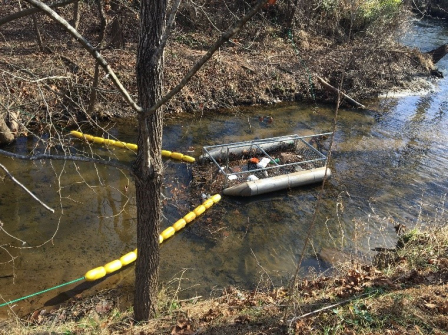
A “Trash Trout” trash trap floats on Deer Creek in Deer Creek Park in Maplewood, Missouri. (Photo credits: Missouri Confluence Waterkeeper, Ashville GreenWorks, and Trash Trout.)

The Trash-Free St. Louis Project to show how solving marine debris starts inland

EPA Region 7’s Trash-Free Waters program, along with Wichita State University’s Environmental Finance Center and the Missouri Confluence Waterkeeper organization, are working with local community groups on a project to install and maintain three trash traps in St. Louis area streams.

A stream trash trap is a mechanical system that includes a floating boom and net that funnel and gather floating debris near embankments, canals, or stormwater outfalls before it can reach  primary waterways like streams, rivers, lakes, and oceans.

Three different types of trash traps are being installed at the following locations: “Trash Trout” at Deer Creek in Maplewood, Missouri; “B2B Beaver” at Mackenzie Creek in St. Louis; and, “Litter Gitter” at River Des Peres in University City, Missouri.

“Stream trash traps, like the ones being deployed in St. Louis, help build awareness of this issue and make the amount and composition of trash more visible, all the while helping to clean up litter in waterways,” said Jeff Robichaud, EPA Region 7’s Water Division director. “St. Louis has the ability to influence change and reduce the impacts caused by trash in urban streams and rivers that feed into the Gulf of Mexico.”

St. Louis serves as an ideal location to launch the pilot project to study trash and litter, as it sits on the confluence of the two most prominent American rivers, the Mississippi and Missouri. Their watersheds combined form the largest single watershed in the United States and flow south to the Gulf of Mexico and Atlantic Ocean.

“The debris and trash that enters these two watersheds often makes its way through storm sewers and remains hidden until storms and rain empty the debris from storm sewers into small streams and larger rivers,” Robichaud said. “This is a positive step in helping to keep River Des Peres – and the Mississippi River it flows into – cleaner for both the animals that live there and humans who rely on it,” said Diane Bauhof, executive director of the St. Louis Aquarium Foundation.

Continue reading

Tree Book Inspires “Men and Women Who Plant Trees”

IMG_6818

By Don Corrigan

Both Kirkwood and Webster Groves have been designated individually as a Tree City USA. That classification reflects citizen appreciation for large leafy wonders. Now some local folks are extending their love of trees to the Katy Trail and the Missouri River Valley.

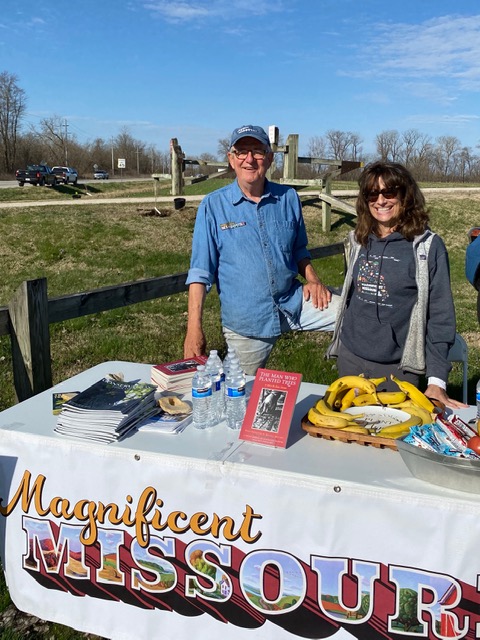
Among those involved are Bill Spradley of Kirkwood’s Trees, Forests and Landscapes and Mike Rood of Pea Ridge Forest. They are extending their arbor expertise to an area of the Katy Trail in eastern Missouri. Hikers and bikers will enjoy new trees in trail locations such as Marthasville, Peers and Treloar. In addition to beautifying the sites, the tree canopy will protect trail users from summer sun and stave off trail erosion problems. It’s all part of a partnership between Forest Releaf of Missouri and Magnificent Missouri to plant hundreds of trees along the trail over three years.

“The trees we are planting were grown in our Missouri River bottom nursery in Creve Coeur Park and will find permanent homes near the Missouri River,” said Meridith Perkins, executive director of Forest ReLeaf. She said the project covers the Katy Trail “between Hermann and St. Charles to provide habitat, erosion control and shade for generations of Katy Trail user.” To celebrate the launch of this effort, a special edition of the conservation book, “The Man Who Planted Trees,” has been printed. The celebrated fable captures how planting trees can transform a landscape. It has sold more than 250,000 copies.

The book is now available at Pedego Electric Bikes in Oakland near the north trailhead of Grant’s Trail. It also can be ordered at MagnificentMissouri.org.

“We hope that this project, and our special edition of ‘The Man Who Planted Trees,’ will inspire Katy Trail riders and others to become acquainted with the benefits of tree planting, especially Missouri native trees, and the many wonderful species that Forest ReLeaf grows,” said Dan Burkhardt of Magnificent Missouri.

Continue reading

University of Missouri Scientists Receive $4 Million Grant To Study COVID and Virus Variants Found In Community Waste Water.

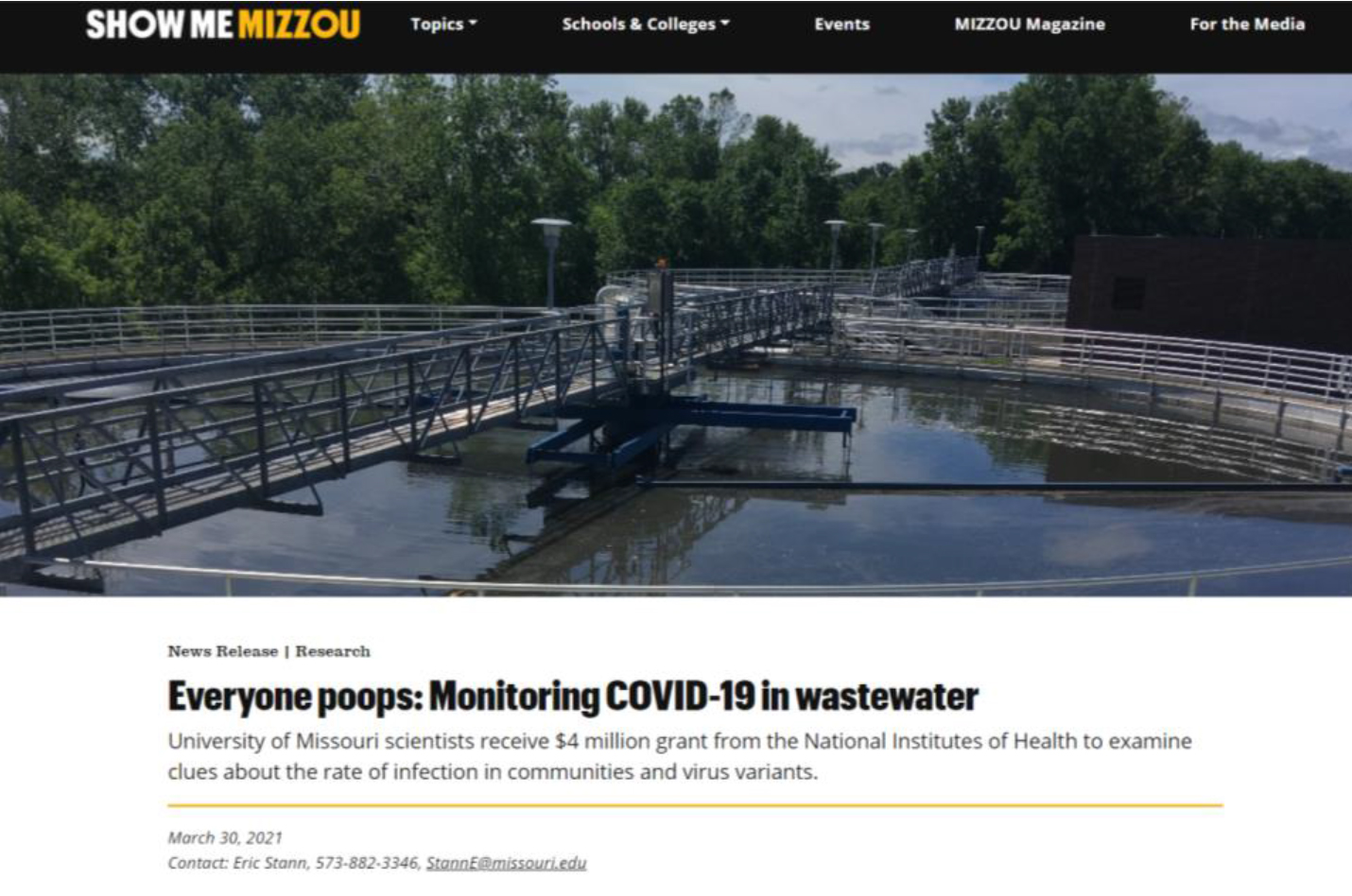
The University of Missouri (MU) recently published information announcing a two year study of the COVID virus and the virus variants found in community wastewater made possible by a $4 Million grant. Please read below for more from the MU press release and link to the article.

University of Missouri scientists receive $4 million grant from the National Institutes of Health to examine clues about the rate of infection in communities and virus variants.

Using the 2-year, $4 million grant from the National Institutes of Health, scientists at the University of Missouri are collaborating with the Missouri Department of Health and Senior Services, or DHSS, to figure out how differing levels of SARS-CoV-2 can appear in a community’s wastewater.

READ THE STORY FROM THE UNIVERSITY OF MISSOURI HERE.

Imagination, Creativity and the Arts In Service Of The Environment

by Don Corrigan

We are in a time of rebirth, resurrection and the revival of the creation. It’s spring. It’s also a time for renewal and the new energy of MICA, which happens at the First Congregational Church UCC in Webster Groves, a suburb of St. Louis.

What is MICA?

MICA is the Ministry of Imagination, Creativity and the Arts, a concept developed by the Rev. Cliff Aerie. That concept has inspired “Journey through the Creation,” a year-long program with an environmental emphasis funded through a Lilly Grant from Calvin Institute of Worship.

“Our first program on earth, art and faith, featured environmentalist Jean Ponzi and storyteller Valerie Tutson, and was held last September,” said Aerie. “We’ve had to push things back due to the pandemic, but our final program will be on June 13 and will feature the Oikos Ensemble in an afternoon concert, Earth Walk 3.0.”

A program put together on March 20 featured community artist Tia Richardson and Michael Smyer, an expert on gerontology and CEO of Growing Greener: Climate Action for an Aging World.

“These webinars and worship services all coincide with the changing of the seasons,” noted Aerie. “The June program will be the capstone. If the pandemic continues to wane, we expect a concert to be held live.

“The concert may be outside,” added Aerie. “If not, we will bring outside inside, which we’ve done before through the generosity of Rolling Ridge Gardens. They have let us borrow trees to transform our sanctuary into a forest. Either way we will be blending jazz, stories, poetry, dance with video vignettes from our two previous webinars.”

Members of First Congregational Church UCC have been critical to the efforts of “Journey through the Creation.” Members of the planning team include Jan Barnes, Chris von Weise, Halley Kim, Debbie Tolstoi, John Paci, Phil Shoulberg, Ian Didriksen, Elston McCowen, Leon Burke III and Dave Denoon. Aerie serves as project director.

Continue reading

Missourians Asked To Save Ticks and Mail To A.T. Still University For Scientific Research

MDC Tick

Photo by MDC Staff, courtesy Missouri Department of Conservation.

MDC and A.T. Still University are asking Missourians to save ticks they find and send them to the University for scientific research to learn more about ticks and pathogens they may carry.

Most people who have ventured through Missouri woods, fields, yards, and other outdoor environments have encountered ticks. These small, creepy crawlers climb on and cling to clothes and skin in search of a blood meal. Some tick species and the bacterial pathogens they carry can also cause illnesses in people.

The Missouri Department of Conservation (MDC) and A.T. Still University in Kirksville are asking people to save ticks they encounter and mail them to the University. The ticks will be used for a new scientific research study to help better understand the statewide distribution of tick species and the human pathogens they carry.

Continue reading

Image

From Classroom to Bookshelf: Publishing a DIY Guide to Local Environmental Issues

By DON CORRIGAN

A popular ad slogan for city tourism is “St. Louis has it all from A to Z.” That’s certainly true when it comes to hazardous waste issues or land, air and water pollution. It’s not hard to find environmental tales from the St. Louis region that grab my students’ attention and elicit incredulity.

A journalism professor in St. Louis can talk about dioxin at Times Beach, lead smelters in Herculaneum, a creek on fire across the Mississippi River near the Sauget chemical works, or the dangerous radioactive waste pile near a smoldering landfill west of Lambert International Airport.

Soon students will be asking these kinds of questions:

– How can a waste oil hauler get away with spraying roads of an entire town with a dioxin concoction?
-What prompts a state legislature to pass laws to immunize a lead company from contamination lawsuits?
-When does a landfill operator get sanctioned for allowing a landfill fire to smolder for months near a site containing radiation?

These are questions that can inspire students to research and write their own investigative stories. The local aspect of the stories propels a personal interest in the environmental issues. Knowing that these stories can be located in the students’ own backyards – sometimes literally – gives them a special urgency.

Continue reading

Image

Top Ten Environmental Issues In Missouri

Pictured: Rich Thoma of the Webster Groves Nature Study Society

by Don Corrigan

What are the Top Ten Environmental Issues that Missourians have coped with last century, from 1900 to 2000? Rich Thoma of the Webster Groves Nature Study Society (WGNSS) recently had a conversation about this. WGNSS members have been involved in a number of environmental battles. What quickly became apparent to me is that naming these Top Ten will depend in large part on what environmental groups you may have affiliation. St. Louis and Missouri have a number of such organizations that have been on the frontlines.

Here is one take on the Top Ten Environmental Issues in Missouri, but it is not definitive. Revisions and commentary on these are welcome. Additions and subtractions may be necessary to put an accurate list together.

1.)  Atomic City – radioactive waste issues in Weldon Spring, West Lake Landfill, Coldwater Creek.

2.) Lead Contamination – Lead smelter products poisoned people in urban center and the Leadbelt.

Continue reading