
Category Archives: Environment

Tree Book Inspires “Men and Women Who Plant Trees”

IMG_6818

By Don Corrigan

Both Kirkwood and Webster Groves have been designated individually as a Tree City USA. That classification reflects citizen appreciation for large leafy wonders. Now some local folks are extending their love of trees to the Katy Trail and the Missouri River Valley.

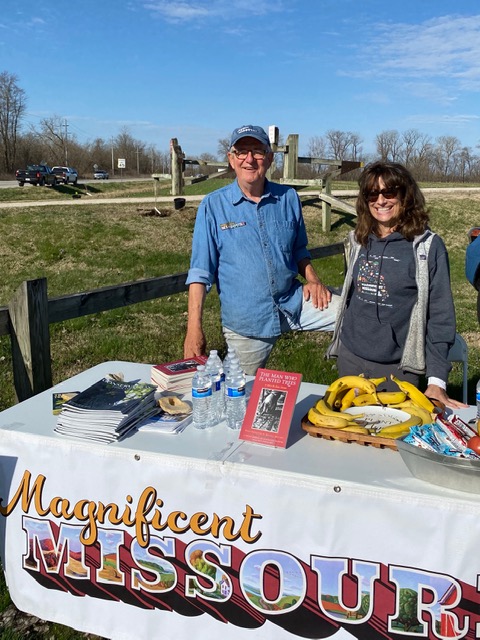
Among those involved are Bill Spradley of Kirkwood’s Trees, Forests and Landscapes and Mike Rood of Pea Ridge Forest. They are extending their arbor expertise to an area of the Katy Trail in eastern Missouri. Hikers and bikers will enjoy new trees in trail locations such as Marthasville, Peers and Treloar. In addition to beautifying the sites, the tree canopy will protect trail users from summer sun and stave off trail erosion problems. It’s all part of a partnership between Forest Releaf of Missouri and Magnificent Missouri to plant hundreds of trees along the trail over three years.

“The trees we are planting were grown in our Missouri River bottom nursery in Creve Coeur Park and will find permanent homes near the Missouri River,” said Meridith Perkins, executive director of Forest ReLeaf. She said the project covers the Katy Trail “between Hermann and St. Charles to provide habitat, erosion control and shade for generations of Katy Trail user.” To celebrate the launch of this effort, a special edition of the conservation book, “The Man Who Planted Trees,” has been printed. The celebrated fable captures how planting trees can transform a landscape. It has sold more than 250,000 copies.

The book is now available at Pedego Electric Bikes in Oakland near the north trailhead of Grant’s Trail. It also can be ordered at MagnificentMissouri.org.

“We hope that this project, and our special edition of ‘The Man Who Planted Trees,’ will inspire Katy Trail riders and others to become acquainted with the benefits of tree planting, especially Missouri native trees, and the many wonderful species that Forest ReLeaf grows,” said Dan Burkhardt of Magnificent Missouri.

Continue reading

University of Missouri Scientists Receive $4 Million Grant To Study COVID and Virus Variants Found In Community Waste Water.

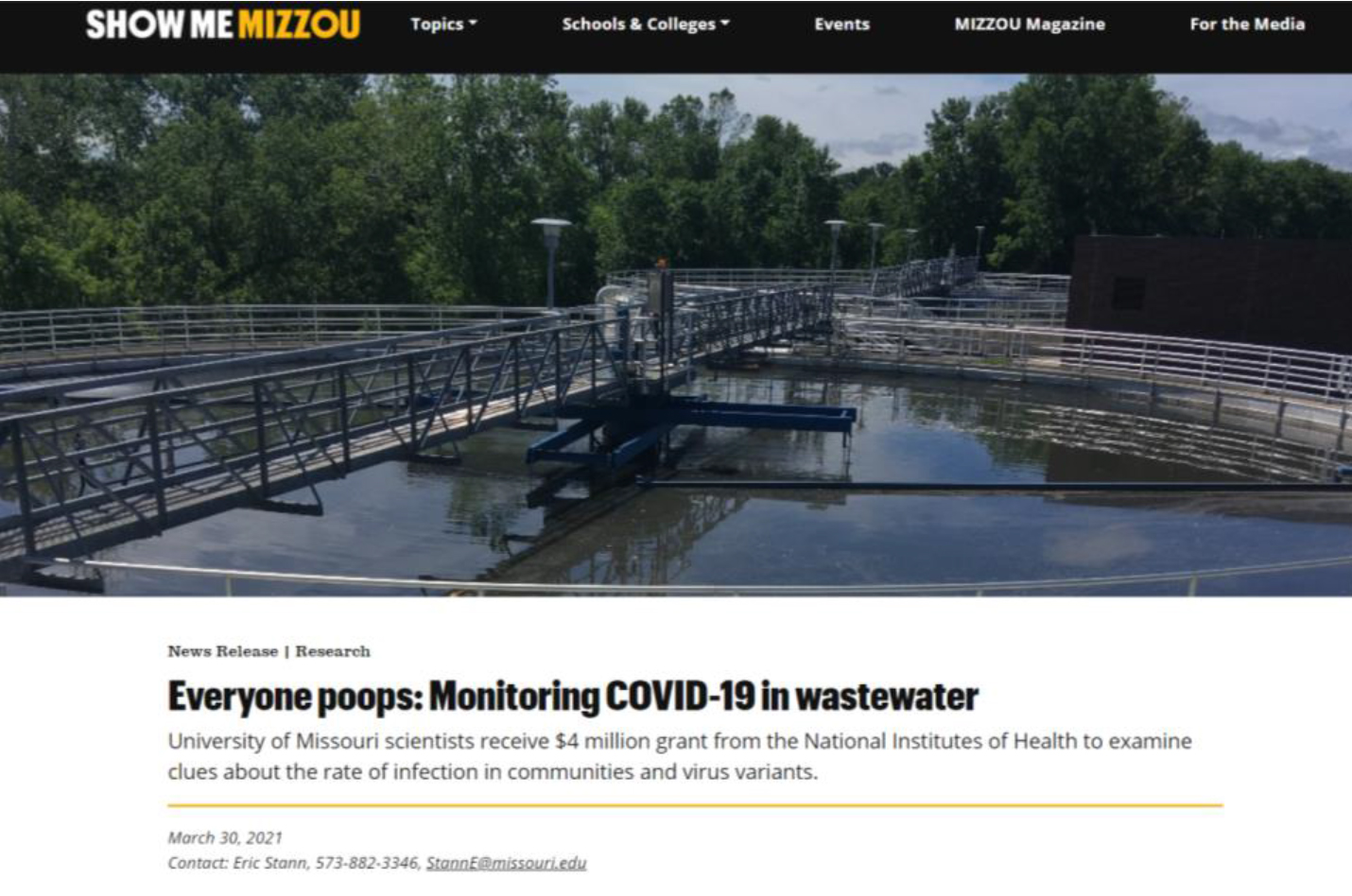
The University of Missouri (MU) recently published information announcing a two year study of the COVID virus and the virus variants found in community wastewater made possible by a $4 Million grant. Please read below for more from the MU press release and link to the article.

University of Missouri scientists receive $4 million grant from the National Institutes of Health to examine clues about the rate of infection in communities and virus variants.

Using the 2-year, $4 million grant from the National Institutes of Health, scientists at the University of Missouri are collaborating with the Missouri Department of Health and Senior Services, or DHSS, to figure out how differing levels of SARS-CoV-2 can appear in a community’s wastewater.

READ THE STORY FROM THE UNIVERSITY OF MISSOURI HERE.

Imagination, Creativity and the Arts In Service Of The Environment

by Don Corrigan

We are in a time of rebirth, resurrection and the revival of the creation. It’s spring. It’s also a time for renewal and the new energy of MICA, which happens at the First Congregational Church UCC in Webster Groves, a suburb of St. Louis.

What is MICA?

MICA is the Ministry of Imagination, Creativity and the Arts, a concept developed by the Rev. Cliff Aerie. That concept has inspired “Journey through the Creation,” a year-long program with an environmental emphasis funded through a Lilly Grant from Calvin Institute of Worship.

“Our first program on earth, art and faith, featured environmentalist Jean Ponzi and storyteller Valerie Tutson, and was held last September,” said Aerie. “We’ve had to push things back due to the pandemic, but our final program will be on June 13 and will feature the Oikos Ensemble in an afternoon concert, Earth Walk 3.0.”

A program put together on March 20 featured community artist Tia Richardson and Michael Smyer, an expert on gerontology and CEO of Growing Greener: Climate Action for an Aging World.

“These webinars and worship services all coincide with the changing of the seasons,” noted Aerie. “The June program will be the capstone. If the pandemic continues to wane, we expect a concert to be held live.

“The concert may be outside,” added Aerie. “If not, we will bring outside inside, which we’ve done before through the generosity of Rolling Ridge Gardens. They have let us borrow trees to transform our sanctuary into a forest. Either way we will be blending jazz, stories, poetry, dance with video vignettes from our two previous webinars.”

Members of First Congregational Church UCC have been critical to the efforts of “Journey through the Creation.” Members of the planning team include Jan Barnes, Chris von Weise, Halley Kim, Debbie Tolstoi, John Paci, Phil Shoulberg, Ian Didriksen, Elston McCowen, Leon Burke III and Dave Denoon. Aerie serves as project director.

Continue reading

Missourians Asked To Save Ticks and Mail To A.T. Still University For Scientific Research

MDC Tick

Photo by MDC Staff, courtesy Missouri Department of Conservation.

MDC and A.T. Still University are asking Missourians to save ticks they find and send them to the University for scientific research to learn more about ticks and pathogens they may carry.

Most people who have ventured through Missouri woods, fields, yards, and other outdoor environments have encountered ticks. These small, creepy crawlers climb on and cling to clothes and skin in search of a blood meal. Some tick species and the bacterial pathogens they carry can also cause illnesses in people.

The Missouri Department of Conservation (MDC) and A.T. Still University in Kirksville are asking people to save ticks they encounter and mail them to the University. The ticks will be used for a new scientific research study to help better understand the statewide distribution of tick species and the human pathogens they carry.

Continue reading

Image

From Classroom to Bookshelf: Publishing a DIY Guide to Local Environmental Issues

By DON CORRIGAN

A popular ad slogan for city tourism is “St. Louis has it all from A to Z.” That’s certainly true when it comes to hazardous waste issues or land, air and water pollution. It’s not hard to find environmental tales from the St. Louis region that grab my students’ attention and elicit incredulity.

A journalism professor in St. Louis can talk about dioxin at Times Beach, lead smelters in Herculaneum, a creek on fire across the Mississippi River near the Sauget chemical works, or the dangerous radioactive waste pile near a smoldering landfill west of Lambert International Airport.

Soon students will be asking these kinds of questions:

– How can a waste oil hauler get away with spraying roads of an entire town with a dioxin concoction?
-What prompts a state legislature to pass laws to immunize a lead company from contamination lawsuits?
-When does a landfill operator get sanctioned for allowing a landfill fire to smolder for months near a site containing radiation?

These are questions that can inspire students to research and write their own investigative stories. The local aspect of the stories propels a personal interest in the environmental issues. Knowing that these stories can be located in the students’ own backyards – sometimes literally – gives them a special urgency.

Continue reading

Image

Top Ten Environmental Issues In Missouri

Pictured: Rich Thoma of the Webster Groves Nature Study Society

by Don Corrigan

What are the Top Ten Environmental Issues that Missourians have coped with last century, from 1900 to 2000? Rich Thoma of the Webster Groves Nature Study Society (WGNSS) recently had a conversation about this. WGNSS members have been involved in a number of environmental battles. What quickly became apparent to me is that naming these Top Ten will depend in large part on what environmental groups you may have affiliation. St. Louis and Missouri have a number of such organizations that have been on the frontlines.

Here is one take on the Top Ten Environmental Issues in Missouri, but it is not definitive. Revisions and commentary on these are welcome. Additions and subtractions may be necessary to put an accurate list together.

1.)  Atomic City – radioactive waste issues in Weldon Spring, West Lake Landfill, Coldwater Creek.

2.) Lead Contamination – Lead smelter products poisoned people in urban center and the Leadbelt.

Continue reading

Video

Invasive Asian Carp Global Malnutrition Solution?

The University of Missouri published a news release entitled, “Asian carp could pulverize world hunger, MU researcher finds: Powdering Asian carp could address an environmental problem and a global malnutrition crisis.”

The article and video give valuable information about the ongoing fight against the invasive Asian carp and the destructive impact the species have on our rivers and lakes. Please take a few moments to read the article and watch the video to learn more about the efforts to reduce damage caused by the Asian carp and to also help the “global malnutrition crisis.”

Read the article HERE. See the video below.

“These fish are a delicacy in China, where they are native, but Americans tend to dislike them,” said Mark Morgan, an associate professor in the School of Natural Resources. “Why eat bony, ugly carp when we can have trout and salmon, instead? But taken as a nutritional supplement, these fish, which have high amounts of macro and micronutrients, could have an incredibly positive impact on society while we loosen their hold on our waterways at the same time.”

Image

February Polar Vortex Knocked Out Electricity in Texas; Utility Experts Say “Green New Deal” Is Not To Blame

Photo: Michal Dziekonski

By Don Corrigan

The worst polar vortex event of the winter has faded quickly for St. Louis residents. The memory of the bitter cold and snow storm have melted away. Not so in Texas, where electrical outages, burst pipes and critical equipment failures continue to plague the Lone Star State.

Texas towns suffered weather-related fatalities and millions of dollars in damage from one of the costliest weather disasters in U.S. history. Could the St. Louis area and Midwest suffer a similar fate in a brutal winter storm and extended cold snap?

Mark Petty, Kirkwood Electric Director, who said his job “is to keep the lights on,” does not foresee any such utility catastrophe for his suburban city. Kirkwood is the only municipality in the St. Louis region with its own electric department.

Continue reading

Image

Missouri Prairie Foundation Earns National Recognition

Missourians strongly support protecting the open spaces they love. Since 1966, the Missouri Prairie Foundation has been doing just that for the people of Missouri. With its 25 properties across the state, which are open to the public to enjoy, the Missouri Prairie Foundation is protecting extremely biologically diverse and rare original, unplowed prairie, which is one of the most imperiled ecosystems on the planet, as well as expanding prairie habitat with native grassland plantings.

Today, the Land Trust Alliance announced that the Missouri Prairie Foundation has achieved national accreditation—joining a network of accredited land trusts across the nation that have demonstrated their commitment to professional excellence and to maintaining the public’s trust in their work. There are currently 1,363 land trusts across the United States according to the Land Trust Alliance’s most recent National Land Trust Census, and more than 400 of them are accredited.

Continue reading

Image

Cockroaches Are Getting A Makeover, But They Aren’t Incredible or Edible Yet!

by Don Corrigan

In any insect popularity contest, cockroaches always are near the bottom of the barrel. Cockroaches may rate more favorably than black widow spiders or tsetse flies, but they are generally loathed by most Americans.

All is not lost for the lowly cockroaches, however. Recently they have gained some cachet as lead characters in promotions, benefits and charitable causes. Celebrity cockroaches have arrived, like it or not.

Continue reading