
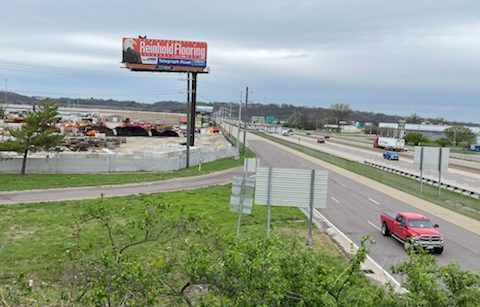
Billboards on interstates 44, 55, 70 and 65 are ubiquitous with the roadway on I-65
between Springfield and Branson being one of the most cluttered in the nation.
by Don Corrigan
Missouri’s rank as 6th among states with the most billboards is once again drawing scrutiny. Concern comes as state officials eye the continuing $2.8 billion project to widen Interstate 70 between Wentzville and Kansas City.
Scenic Missouri President John Hock is urging legislators to commit to a serious study on safety issues, as well as the aesthetic impact of so many billboards along the 250-mile highway from St. Louis to Kansas City.
Hock notes that I-70 is called the “Main Street of Missouri” as part of the vital 2,200-mile interstate. I-70 has a significant footprint in nine states. Missouri has 3.64 billboards per mile along its I-70 corridor.
This is 2.5 times the average of its adjacent neighbors. Missouri has a billboard problem, according to Hock. He said Missouri’s “Main Street” travelers are not only deprived of natural beauty, but distracted driving caused by billboards puts them in danger.

John and Marilyn Hock are in the fight against highway billboards for the long haul.
Several legislators, both Democrat and Republican, agree with Hock that now is an opportune time to take a look at billboard clutter in the state. Proposals include a moratorium on the signage and hikes in billboard placement fees.
Billboard companies and the Missouri Outdoor Advertising Association are telling legislators that a commission to study the issue is a waste of taxpayer money. They also question any studies suggesting billboards could present traffic safety hazards.
Many Missouri legislators have spent thousands of election dollars on their own billboard advertising to improve their facial recognition among voters. Some state politicians are sympathetic to the billboard industry as a force promoting the local economy.
Hock said his organization, Scenic Missouri, has seen this rodeo before. His group tangled with the billboard industry over a Nov. 7, 2000 ballot issue. The ballot Proposition A was identified for voters as, “Save Our Scenery 2000.”
Save Our Scenery
Proposition A would have ended construction of most new billboard advertising along highways; granted authority to local governments to regulate existing billboards within their communities; halted the practice of allowing billboard companies to cut down trees on public land next to highways.
Prop. A’s “Save Our Scenery 2000” was a coalition of over 70 different business, environmental and professional organizations from across Missouri. It was placed on the ballot by 130,000 citizens who signed petitions across the state.
Opponents of Prop. A were led by the Citizens Against Tax Waste Committee. The group said Prop. A would raise taxes and effectively kill small businesses relying on outdoor advertising to attract customers.
Citizens Against Tax Waste Committee also claimed that requirements for compensation to landowners and sign owners after billboard removal would cost the state $500 to $600 million.
Supporters of Prop. A fired back that the Tax Waste Committee was simply a tool for the Missouri Outdoor Advertising Association. They also said the billboard industry was attempting to mislead voters with “ridiculous” figures of up to $600 million in reimbursements required.
In the end, state voters chose to side with the billboard industry in the 2000 election. The margin was as close as could be: 51% to 49%. At the time, Scenic Missouri spokesperson Karl Kruse lamented the state had about three times as many billboards per mile as its eight neighboring states.
Kruse said Missouri was 40 years behind the times in its laws regulating billboards. Four states, Maine, Alaska, Hawaii and Vermont, have complete bans on billboards along primary highways. About 20 states have laws prohibiting new billboard construction along interstates.
Today, Scenic Missouri’s John Hock can say the Show-Me State is now 65 years behind the times in its laws regulating billboards. Hock will also insist that the organization, Scenic Missouri, has not given up the fight against billboard clutter he says distorts the natural beauty of Missouri.


 “We have had white squirrels in our back yard for about five or 6 years now, but not always the same ones,” said Hoessle. “The first one I named ‘Spirit.’ He was a daily visitor to my patio bird feeder.”









 Environmental Echo