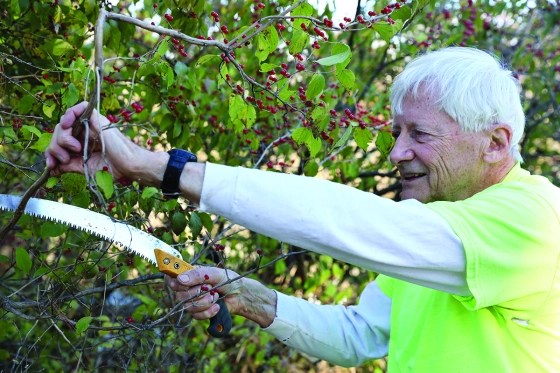
Alan Hopefl of Kirkwood, who has earned a nickname as the “Honeysuckle Slayer,” said he cannot understand why any state legislator would support nurseries selling harmful invasive plants.
by Don Corrigan
This past fall youngsters volunteered with Back To Nature STL to hack out invasive bush honeysuckle in St. Louis suburbs. Volunteers have an uphill fight, in part, because state nurseries continue to sell invasive plants.
“Volunteers can take heart now because there is legislation in Jefferson City to stop the sale of these plants,” said Bonnie Harper of Open Space St. Louis, which had 45 “Honeysuckle Hack” events in 2024 with its Back To Nature STL program.
“Honeysuckle Hack” events had their origin under the Open Space Council in Kirkwood, an organization renamed as Open Space St. Louis with a new headquarters in Sunset Hills. Regardless of name or headquarters location, the hacking continues.
“We have ‘Honeysuckle Hack’ events scheduled to summer now, with the most recent in January at Jefferson Barracks,” said Harper. “Hacking out invasives is labor intensive work, so it’s great to learn that the legislature may end their sale at nurseries.”
Rep. Bruce Sassmann, R-Bland, is sponsor of HB60. Sassman said honeysuckle hackers should take heart, but he said his proposed law is just a small step in the right direction on a big problem.
“Every day invasive species are threatening the health of our nation’s vital agricultural and natural lands,“ said Sassman. “Forests are being infested, cropland production is being impacted, streams are being impacted, wildlife is losing habitat.”
The U.S. Department of Agriculture defines an invasive species as one whose introduction causes economic harm, environmental harm, or harm to human health.
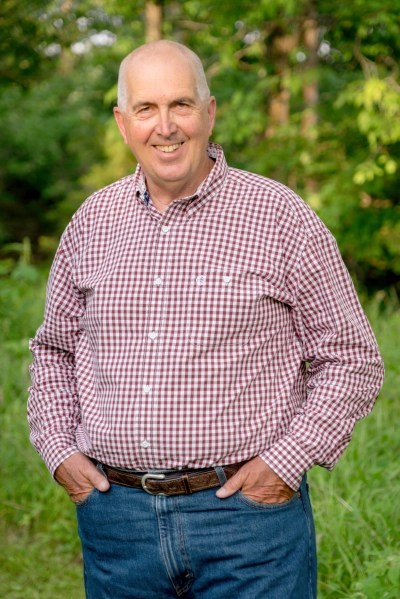
Rep. Bruce Sassmann, R-Bland, is sponsor of HB60, which is getting support from St. Louis area residents who want honeysuckle plant sales banned at state nurseries.
Under Sassmann’s bill, nurseries and nursery dealers in the state must submit to the Department of Agriculture an affidavit that they will not knowingly or intentionally import, export, buy, sell, transport, distribute or propagate a select group of invasive plants.
Among the plants covered are all varieties of Japanese honeysuckle, Callery pear, Burning bush, Wintercreeper, all varieties of Sericea Lespedeza.
Local Honeysuckle Warriors
“To tell you the truth, it shocks me that nurseries are still selling this stuff,” said Daniel Appelbaum of Webster Groves. “After I bought some land in south central Missouri, I became aware that honeysuckle is everywhere.
“I know how people in Webster Groves are into the environment and the outdoors, but along our portion of I-44 it’s all over,” said Appelbaum. “It’s not a very good introduction to Webster to have this stuff all over and I’ve contacted officials about it.”
Appelbaum admits he was once part of the problem. He said that back in the 1970s as a Boy Scout, he was planting invasives by roads because they were considered good buffers and it was thought that the red berries were great food for the birds.
“Those red berries have no nutritional value – zero,” said Appelbaum. “And they crowd out good native plants and kill ground cover leading to erosion and a host of other problems. We’ve learned honeysuckle is a problem.”
Alan Hopefl of Kirkwood, who has earned a nickname as the ‘Honeysuckle Slayer’ for his personal efforts to eradicate it in parks, said he’s pleased something is coming out of the legislature that will support the environment.
Hopefl’s technique slaying honeysuckle involves a small saw, a brush and pot containing glyphosate. After he’s done cutting, he paints honeysuckle stumps with glyphosate which can keep the plants from re-sprouting.
“I hack away at the stuff, whether it has sweet-smelling flowers in May or pretty red berries in December,” declared Hopefl. “It’s a problem any time of the year – and it needs be cut down.”
“I think the bill in the legislature is a positive step,” said Hopefl. “I can’t believe nurseries are still selling it. And I can’t understand why any legislator would oppose trying to stop the spread of honeysuckle.”
Bills Have Opposition
Sassmann said Sen. Mike Bernskoetter, R-Jefferson City, has introduced a companion bill, SB105, in the state Senate to address honeysuckle. Bernskoetter and Sassmann have enlisted the support of conservation groups and hundreds of individuals to fight invasive honeysuckle.
“Bernskoetter has received calls from Webster Groves in support of the bill,” said Sassmann. “We have support from Democrats, but it’s a mystery to me as to why we have opposition from some far-right Republicans.
“They say the bill is just more over-regulation,” said Sassmann. “One objection is that some nursery businesses support themselves by selling Bradford pear trees and honeysuckle, so the bill is anti-business.
“Opponents also say customers will just go to the internet and have the invasives delivered to their doors. So, it will hurt bricks-and-mortar businesses if invasives are banned at nurseries,” Sassmann added.
Bonnie Harper of Open Space St. Louis said she’s skeptical that frustrated nursery customers will turn to the internet to get their invasives. She also said the bills ought to get support from Democrats and Republicans.
“I don’t see this as a partisan issue,” said Harper. “I don’t know that we need a ‘honeysuckle hacker rally’ in the Jefferson City capitol rotunda to get action on this, but I bet groups would organize and show up for it.”
Webster’s Appelbaum said he is sympathetic to the arguments about over-regulation. He said it would be best if people just got a good explanation on why honeysuckle is bad, and then they got rid of it in their own backyards.
“On the other hand, this honeysuckle growth is a harmful infestation in Missouri,” said Appelbaum. “This is a foreign invasion. Don’t we need border control?”

