This French statue depicts the American “New World” as a young woman propping up a sickly old woman – France. The grateful French erected it at Montpellier in gratitude for U.S. help in defeating phylloxera, a parasite destroying French vineyards. Photo courtesy of Robert Scheef
by Don Corrigan
Americans visiting wine country in France often express surprise when coming upon an intriguing statue in Montpellier. It depicts a younger woman holding and soothing an older woman.
The statue is a representation of France and America helping one another with viticulture. When France’s vineyards were dying from the pest, phylloxera, in the 1800s, Missourians came to the rescue.
Missouri vineyard experts gave French winemakers American rootstock, which is resistant to the parasite. The trick involved grafting the majority of France’s grape plants with hearty American rootstock.
The “Wine Ladies” statue celebrates this curative. An older woman depicts France as ill and dying, whereas the younger woman illustrates America coming to help and soothe. It is a very touching story.
Missouri Wine Country gave a vineyard gift not only to France, but to the world. The Missouri Botanical Garden’s Henry Shaw was a lover of grapes, a wine enthusiast, and he consorted with Missouri’s viniculture experts.
Shaw’s cadre of viniculture specialists included George Engelmann, Charles V. Riley, George Husmann and Hermann Jaeger. When the parasite known as phylloxera began destroying Europe’s wine industry in the 1870s, Shaw’s experts reacted.
Engelmann and other Missouri horticulturalists, including Husmann and Jaeger, developed and organized a shipment of phylloxera-resistant American grapevines to send to France.
The shipped grapevines were used as hardy root stocks to which European vines were grafted. The grafting enabled the French vines to withstand the deadly attack and Europe’s wine industry was saved.
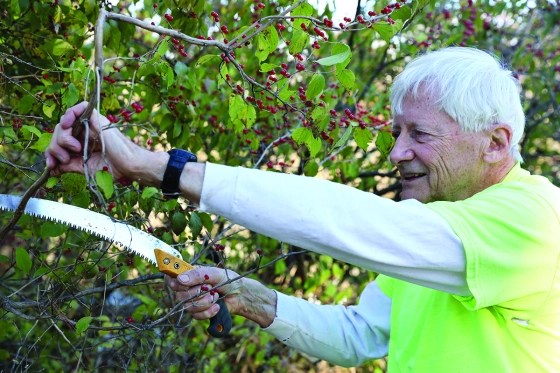
Alan Hopefl of Kirkwood, who has earned a nickname as the “Honeysuckle Slayer,” said he cannot understand why any state legislator would support nurseries selling harmful invasive plants.
by Don Corrigan
This past fall youngsters volunteered with Back To Nature STL to hack out invasive bush honeysuckle in St. Louis suburbs. Volunteers have an uphill fight, in part, because state nurseries continue to sell invasive plants.
“Volunteers can take heart now because there is legislation in Jefferson City to stop the sale of these plants,” said Bonnie Harper of Open Space St. Louis, which had 45 “Honeysuckle Hack” events in 2024 with its Back To Nature STL program.
“Honeysuckle Hack” events had their origin under the Open Space Council in Kirkwood, an organization renamed as Open Space St. Louis with a new headquarters in Sunset Hills. Regardless of name or headquarters location, the hacking continues.
“We have ‘Honeysuckle Hack’ events scheduled to summer now, with the most recent in January at Jefferson Barracks,” said Harper. “Hacking out invasives is labor intensive work, so it’s great to learn that the legislature may end their sale at nurseries.”
Rep. Bruce Sassmann, R-Bland, is sponsor of HB60. Sassman said honeysuckle hackers should take heart, but he said his proposed law is just a small step in the right direction on a big problem.
“Every day invasive species are threatening the health of our nation’s vital agricultural and natural lands,“ said Sassman. “Forests are being infested, cropland production is being impacted, streams are being impacted, wildlife is losing habitat.”
The U.S. Department of Agriculture defines an invasive species as one whose introduction causes economic harm, environmental harm, or harm to human health.
Statistics show the average life of a blog is less than two years. There are literally hundreds of millions of abandoned blogs on the worldwide web. In 2023, there were 600 million active blogs worldwide.
If each of those blogs had as many hits as EE has had over its 10 years, we would be talking 36,000,000,000,000 hits. Environmental Echo is happy to report it will celebrate 10 years this October! Hurray for us! The blog started as a class project in an environmental communications class at Webster University in October 2014.
MDC needs experienced birders to help with the National Audubon Society’s 125th Christmas Bird Count between Dec. 14 and Jan. 5. Go out over a 24-hour period on one calendar day to count birds, such as these eastern bluebirds.
Become citizen scientists by helping with the National Audubon Society’s 125th Christmas Bird Count between Dec. 14 and Jan. 5.
The Missouri Department of Conservation (MDC) encourages experienced Missouri birders to become citizen scientists by helping with the National Audubon Society’s 125th Christmas Bird Count (CBC) between Dec. 14 and Jan. 5, 2025.
The CBC is an annual bird census where thousands of volunteers across the U.S., Canada, and other countries go out over a 24-hour period on one calendar day to count birds between Dec. 14 and Jan. 5. The data on winter bird populations helps track the long-term status of species and large-scale trends. Each CBC has a coordinator who assigns portions of a 15-mile diameter count circle to participants to count all birds seen and heard over a 24-hour period.
Missouri has reported a number of deaths over the past decade from mosquito-borne West Nile virus. Health officials recently warned that the potentially lethal virus has been found in biting mosquitos St. Louis County.
In late July, Saint Louis County Department of Public Health recorded its first instances of West Nile virus positive mosquitoes this year. The detected virus serves as a heads up that mosquito prevention remains critical, especially with this summer’s heavy rains.
“The presence of West Nile virus positive mosquitoes in our area is a reminder that preventive measures are very important,” said Dr. Kanika Cunningham, county health department director. She said measures can be taken by the county, its municipalities and informed citizens.
West Nile virus is the leading cause of mosquito-borne disease in the continental United States. It’s most commonly transmitted to humans by infected mosquitos during the summer months.
Most people infected by the virus do not feel sick, although about 1 in 5 people who are infected develop fever or other symptoms. The symptoms can include headache, body aches, joint pain, vomiting, diarrhea, or rash.
Missouri Environmentalists and Nature Lovers are elated that Hermann’s Stone Hill Hellbender Red Is a Governor’s Cup Finalist in the annual state wine competition. The wine is among the top 11 Best of Class Honorees.
The final winner of the cup was another Stone Hill selection, the Dry Red 2022 Cross J Norton. However, the Semi-Dry Red Stone Hill 2022 Ozark Hellbender followed close on its heels in the competition held in July.
Other wines in the 11 Best of Class Honorees included a Riefenstahler from Adam Puchta Winery; a Traminette from Defiance Ridge Vineyards; a Semi-Dry Rosé from Montelle Winery; and, a Sparkling Brut from Les Bourgeois Vineyards.
Missourians have cheered the St. Louis Zoo’s work to save the endangered Ozark hellbender. The amphibians’ fans can make a toast to the zoo scientists’ efforts now with a glass of award-winning Hellbender from Stone Hill Winery.
“I fell in love with Ozark hellbenders a few years ago when I ran across them at the Saint Louis Zoo,” Stone Hill Winery’s Nathan Held told EE in 2023. “I’ve always loved animals and conservation, so making a new wine dedicated to hellbenders seemed to make sense.”
The Missouri Department of Conservation (MDC) is beginning construction of a new road on Columbia Bottom Conservation Area in Spanish Lake. When completed, the road will create a more direct connection from the area entrance to the boat ramp on the Missouri River. MDC estimates the construction project will be complete by spring 2025, depending on weather. The contractor will begin staging equipment on the area by the end of July.
The construction project will significantly improve public access to the boat ramp when completed. The current route to the ramp is six miles; more than half of the travel is on gravel roads. The new route will only be two-and-a-half miles long, with just one mile of gravel road.
“The new road will provide quicker access to the river for the public as well as emergency services. The current road will still be accessible for those wishing to access other parts of the area,” said Clinton Owenby, MDC Regional Resource District Manager.
The Missouri Rural Crisis Center (MRCC) is about fighting for rural people, according to Tim Gibbons. Motivated to fight injustice, Gibbons began working with MRCC in 2005, and now serves as director of communications.
“Our work is focused on farm and food justice,” said Gibbons. “We came out of the 1980s farm crisis as a collection of farmers who were already organizing in Missouri.”
The farm crisis Gibbons mentioned began in the late 1970s with an unprecedented economic and technological boom.
“Farmers were buying land and new technology,” Gibbons said. “But then we entered a rural recession. Farmers had loans they couldn’t pay for and the USDA, the dominant lender at the time, was foreclosing on farms.”
The Rise of Corporate Agriculture
By the 1980s, a new economic reality, in combination with new legal policy and industrialization of agriculture, began to discourage the family-farm model.
The Saint Louis Zoo WildCare Park released a new fly-through rendering video and an economic impact report projecting that the project will generate over $660 million in economic activity across the St. Louis region within the next 10 years.
“We are creating a place where endangered and threatened animals can thrive,” said Dwight Scott, Dana Brown President & CEO, Saint Louis Zoo. “But this report makes it clear WildCare Park will help the regional economy thrive too.”
WildCare Park, a safari park and conservation center under development in north St. Louis County, is expected to open to the public in 2027.
The economic impact report totals WildCare Park’s estimated operational expenditures, visitor spending both on and off site and the project’s larger impact on regional employment and wages, business sales and tax revenue through 2034.
The report estimates WildCare Park will generate:
– Average attendance of 421,900 guests each year after opening with approximately 65% of guests originating from outside St. Louis City and St. Louis County.
– WildCare Park guests will spend about $184 million at regional businesses outside of the safari park within the next 10 years.
– An annual average of 384 jobs, which includes positions at WildCare Park and in the region.
– A total of $97.3 million in governmental revenue, including $49.9 million in state and local tax revenues.
Jason Hall, CEO of Greater St. Louis Inc., applauded the combined economic impact of both the Saint Louis Zoo in Forest Park and WildCare Park in north St. Louis County, expected to total over $2.5 billion over the next decade.
“The Saint Louis Zoo alone already averages around $200 million of economic value annually, a number enhanced by its considerable cultural impact,” said Hall. “With the additional value WildCare Park brings to the metro, the Zoo will continue to act as an increasingly significant economic engine for our region.”
The development of WildCare park is estimated to cost $230 million funded through multiple sources, including philanthropy, external financing proceeds, which includes Zoo and Saint Louis Zoo Association cash reserves and tax revenue generated by Prop Z passed by St. Louis County voters in 2018. With the passage of Prop Z, St. Louis County residents will be able to experience WildCare Park admission-free.
“WildCare Park will bring with it a major tourism boost for our region and an economic boost for north St. Louis County,” said St. Louis County Executive Dr. Sam Page. “The Zoo is a favorite of locals as well as a national tourist destination and WildCare Park will join the list of must-sees when in the St. Louis region.”
The report estimates that guests to WildCare Park will generate significant spending in a wide range of local industries.
“This project is an amazing opportunity for businesses in north St. Louis County,” said Rebecca Zoll, President/CEO North County Inc. “With around $184 million in off-site guest spending over the next decade, hospitality, retail, transportation and entertainment sectors will all get a significant boost.”
Even before WildCare Park opens to the public, the organization is staffing up with quality full-time positions and will post the job openings on its website here: stlzoo.org/employment.
“We want WildCare Park to be a job creator within and beyond its gates for the region,” said Sabarras George, Saint Louis Zoo WildCare Park Director. “As we grow, I look forward to seeing our region’s businesses do the same.”
Tourism Economics and Canopy Strategic Partners prepared the WildCare Park economic impact report based on analysis from the economic impact model IMPLAN. The operational spending accounts for expenditures from 2021 through 2034, which includes planning and development (2021 through 2026) and the first eight years of operations (2027 through 2034). The guest spending impacts are for the eight-year period from 2027 through 2034. Impact modeling is based on an IMPLAN input-output (I-O) model for two regions: City of St. Louis/St. Louis County and St. Louis, MO-IL metropolitan statistical area (MSA).
The economic impact report and more updates on WildCare Park are available at stlzoo.org/wildcarepark.
About Saint Louis Zoo WildCare Park
Located in north St. Louis County with a target public opening of 2027, the Saint Louis Zoo WildCare Park features two completely different, but complimentary components. The first is what the public will experience: An outdoor adventure that sends guests on a safari through herds of animals roaming wild over gently rolling, grassy meadows and through native forests. The second component is the Kent Family Conservation and Animal Science Center, a dedicated conservation facility within WildCare Park designed to sustain endangered and threatened species, made possible by the generosity of the Jerry and Judy Kent Family. The 17 animals on site now live in the pastures and barns in this area, while the remainder of the barns and pastures are constructed.
Over the last two years, activity at WildCare Park has included demolition of a few older buildings, fence installation and grading around the perimeter of the property, restoration of 260 acres from golf course turf to native grasses, removal of honeysuckle and other invasive plant species, construction of barns and a utility building, and renovation of the headquarters building with a new observation deck.
The Zoo expects more than 250 animals will live on site by the public opening in 2027. For the public opening, the focus is on endangered ungulates — hoofed mammals such as Grevy’s zebra, addax, Somali wild ass, giraffe and white rhino — as well as kangaroos, birds and other threatened species.
Nestled away in an eastern tendril of St. Charles County is avian education center that isn’t just for the birds. The Audubon Center at the Riverlands’ floor-to-ceiling windows display the tall, grassy banks of the Mississippi—a large variety of birds fluttering and gliding throughout the expansive green space.
Visitors can meander the 8.5 miles of hiking trails and learn about the importance of a premier migratory bird sanctuary. Throughout the seasons, more than 300 bird species can be found where this crucial piece of land meets river. The center even provides guests with seasonal checklists, so they know which flying friends to look for.
Natural beauty aside, The Audubon Center, directed by Ken Buchholz for the last eight years, is doing wonders for surrounding communities, Florissant and Ferguson, in particular.
The Center’s mission is “to connect people to the beauty and significance of the Mississippi River and the Great Rivers confluence, to inspire conservation of the river’s rich diversity in birds, wildlife, and other natural resources, and to support healthy, vibrant communities.” They’re doing just that.