Category Archives: Environment

Image

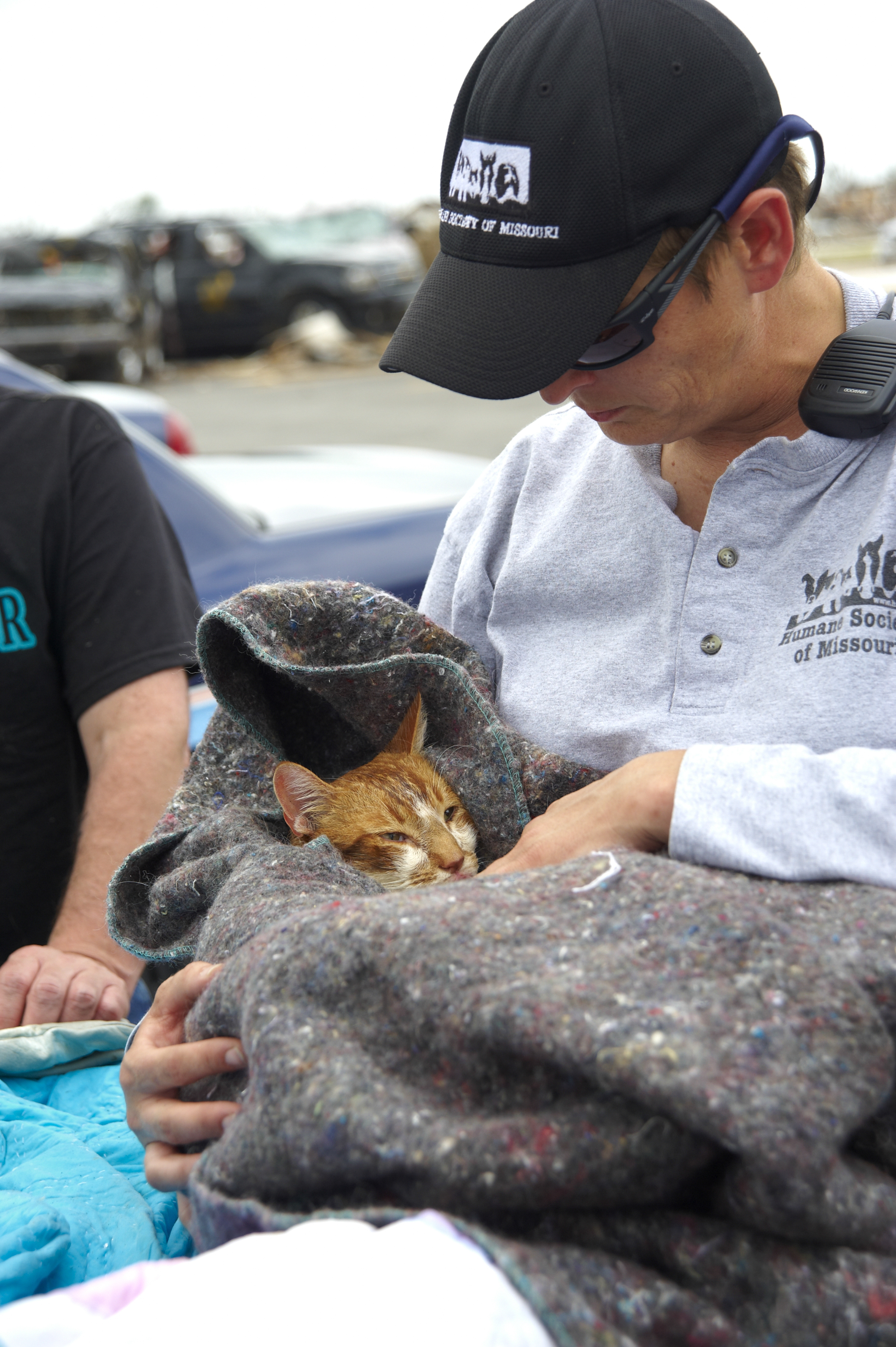
Tornado Season Tips: Have A Plan For “Toto” When Storms Bring High Winds

Photos curtesy the Humane Society.

by Don Corrigan

Aunt Em and Uncle Henry could have done a much better job protecting Dorothy and her little dog, Toto, when that terrible Kansas tornado hit in 1939. The infamous storm launched the beloved twosome to the Land of Oz.

Your little Toto could fare much better in 2023. That’s because today’s weather experts excel at predicting and tracking tornadic storms. Also, animal care experts now offer plenty of tips for protecting pets when storms hit.

A severe storm in April dropped several tornados in the St. Louis area, including one in Fenton that was briefly headed toward Kirkwood. The recent outbreak prompted the Humane Society of Missouri to issue a tip sheet on storms and pets.

“With the recent tornado warnings across the state, the Humane Society decided to take time to remind pet owners of several essential tips to ensure the safety of their furry friends, and all their pets, said veterinarian Nicole Fulcher, director of the Animal Medical Center of the Missouri Humane Society.

“Weather in Missouri can be frightening, but by taking steps for proper preparation, we can ensure our pets remain protected during tornadoes and extreme weather events,” said Fulcher.

Fulcher said a good first step would be to make sure your pet is microchipped and a visit to AMCMA.org to schedule an appointment can help get that accomplished.

“One thing we learned from the 2011 tornado in Joplin is that many, many pets will run away and be lost for days and even weeks after such a horrific event,” said veterinarian Jennifer Pearl of the Humane Society’s Animal Medical Center.

Continue reading

Image

Class On Environmental Issues Debuts At University College In St. Louis

Pictured: John Hickey

Tornadic storms, periodic droughts, flash floods, erratic temperature shifts and unprecedented windy conditions have left many Americans wondering whether climate change is to blame.

The scientific consensus is that human beings must cut carbon pollution in order to avoid even worse impacts from climate change.  The good news is that there is broad public support for climate action now and policies to address climate change.


What might those policies look like? Among the possibilities:

– Protecting more forests and prairies to sequester carbon from the air.

– Updating state policies in order to encourage solar panels on commercial rooftops.

– Adopting building codes that require the use of modern energy efficiency standards.

– Building an extensive charging network to support transition to electric vehicles.

– Restoring the tree canopy in urban parks and neighborhoods.

The practical measures required to address climate change are available to be implemented now. According to John Hickey, the missing ingredient is trained activists who can lead these policy efforts.

Continue reading

Image

Bridge Demolition Leads To Pollution Of Deer Creek, River Des Peres, And More Downstream

In early March, a contractor demolishing a bridge over Deer Creek released polystyrene (Styrofoam) into the waterway. | photo by Roy Lohmann

Webster Groves resident documents debris being released into creek following the demolition of bridge located in Brentwood

By Colin Suchland (Story courtesy of the Webster-Kirkwood Times)

Demolition of a bridge spanning Deer Creek has incited the ire of watchful Webster Groves residents and resulted in violations from state authorities over foam-plastic pollution in the waterway.

Beginning in early March, a contractor working for the city of Brentwood, KCI Construction, began removing the bridge on Breckenridge Industrial Court, immediately south of Manchester Road and west of South Hanley Road. Deer Creek runs along the borders of Brentwood, Maplewood and Webster Groves where it abuts residential, commercial and recreational areas.

Deer Creek forms a natural corridor that includes parks and pedestrian greenways serving several communities as it flows toward the River Des Peres. The bridge replacement is part of a larger “Brentwood Bound” project that promises both commercial and recreational improvements. Flood mitigation along Deer Creek is also a goal of the project.

The large, scattered mass of polystyrene pollution, commonly known as Styrofoam, released into the waterway by the bridge demolition immediately drew the attention of Webster Groves resident Roy Lohmann.

Continue reading

Image

Save Bangert Island! Criticism Grows Over St. Charles’ Riverpointe Development

Photos provided by Scott George,
Environmental Science Consulting.

by Don Corrigan

A multi-million dollar plan for an entertainment and retail district, south of the St. Charles Historic District and along the Missouri River, has stirred up opposition from a number of key constituencies.

Many of the objections come from plans to alter the wooded Missouri River wildlife area known as Bangert Island. Developers hope to make the island more attractive for visitors and to elevate adjacent ground out of the floodplain.

Among the concerns of the U.S. Army Corps of Engineers are the impacts to the forested wetland. A natural wetland system would be replaced by an engineered system, likely requiring high maintenance.

Missouri River floods have previously deposited huge volumes of sediment and woody debris, which require removal and dredging maintenance, according to the Corps.
Scott George, a naturalist and biologist with Environmental Science Consulting, said floodplain loss will inevitably result in increased damage to property when the Missouri River floods. Taxpayers will be on the hook.

“Any additional floodplain filling and removal of native vegetation is going to increase local flooding,” said George. “The forested wetlands, which slow flood velocities and transpire tons of water, will be filled. It’s death by a thousand cuts.”

Continue reading

Image

Battling Light Pollution: IDA Group Says Everyone Suffers When Stars Don’t Twinkle

Pictured: Jake Ronecker at Powder Valley Conservation Area.

By Don Corrigan

Jake Ronecker of Webster Groves recalls a night sky full of twinkling stars when he was a youngster. Much of that twinkling has disappeared. The dedicated naturalist is working to bring some celestial beauty back for kids of the future.

Ronecker and other members of the Missouri chapter of International Dark-Sky Association (IDA) will tell you that working to reduce light pollution can bring back twinkling stars, but it’s also all about bringing back a healthier planet.

“It’s sad that more than 80% of Americans can no longer look up and see the Milky Way where they live,” said Ronecker. “What’s even more worrying, though, is what light pollution is doing to our health, and the well-being of other creatures on the planet.”

Consider the birds of the air, as a prophet of old once told us. Birds are having a tough time migrating and surviving. They no longer can see the stars that might guide them to where they need to fly, but they do see plenty of lights.

According to Ronecker, the Mississippi River Flyway is an important sky-high highway for birds. The lights of St. Louis and those on the Gateway Arch have disrupted the flight patterns and bird migrations for years.

Continue reading

Image

Radioactive Nightmare Continues: Never-Ending Story Of How St. Louis Pays For Atomic Age

“We need not even make war; only by preparing, by playing with our new weapons, we poison the air, the water, the soil of our plants, damage the health of the living, and weaken the chances of the newborn.”   —  Martha Gellhorn, War Correspondent

By Don Corrigan

A new book published at the end of 2022 explains the complex and  traumatic legacy of the atomic age in the St. Louis region. Given the half-life of radioactive materials, it seems no book can ever be the last word on what is a continual crisis.

Many American baby boomers can recall their fathers explaining to them that the atomic bomb was necessary to end World War II; that the human loss would have been much worse without it; that the legacy of the bomb was likely a Pax Americana and a lasting peace.

The baby boomers’ fathers had it wrong. They did not realize how atomic weapons would proliferate; how they would become more lethal; and, how the contaminant byproducts of the first bombs would endlessly plague the “Gateway City” of the American Midwest.

Continue reading

Image

Environmentalists Defend Initiatives: State Legislators At Odds With ‘Will Of The People’

By Don Corrigan

Environmentalists are among those opposed to actions by the Missouri legislature to cripple the initiative process in the state. They say the initiative process is often the only way to get environmental protections enacted in Missouri.

In the past, environmental groups have used the process on issues such as renewable energy and the financing of nuclear power facilities. In Missouri, these groups have included the Missouri Coalition for the Environment and the Sierra Club.

The initiative process has been dubbed as a “will of the people” mechanism. That’s because measures are approved by a statewide majority of voters, rather than passed by lawmakers in the statehouse where they can be beholden to special interests..

In this year’s session in Jefferson City, lawmakers have seemed determined to codify their disdain for the grassroots democracy of initiatives placed on the ballot by petition.

Continue reading

Image

Environment At Fault? Hey, Valentine, Statistics Show Loss Of Courting, Romance

Happy Valentine’s Day!

By Don Corrigan

Do couples go courting anymore? Is dating an obsolete art? Is real romance dead on arrival? Do we now just “Do It In The Road,” if at all, as Beatle John Lennon used to sing?

Some alarming national statistics show that fewer Americans are courting, dating and marrying. Romancing is just something that old people talk about when recalling their favorite “make-out sites” or their necking at drive-in movies.

Census data shows extremely low marriage rates among millennials and Gen Z-ers ­– only 29 percent of 18-to-34-year-olds were married in 2018, compared to 59 percent of young people of comparable age in 1978.

Dour statistics on courting and marriage have beget screaming headlines about the “marriage crisis,” “rudderless young men” and “the end of marriage” in national magazines.

Liberals blame the demise of love on social media and Tinder. Young people use Apps to hook up for one-night stands with no end-game. They are looking for love in all the wrong places. Actually, they aren’t looking for love at all.

Conservatives blame a liberal culture that promotes same-sex relationships rather than traditional marriage; and, a culture that conditions young men to avoid responsibility and steady jobs that could support marriage and family.

Conservative U.S. Senator Josh Hawley of Missouri says young men are taught in school that the male gender is toxic, so they are demoralized. Hawley has vowed to address the situation with a new book, slated to come out in May, to be titled, “Manhood: The Masculine Virtues America Needs.”

In fact, the decline in courting, dating and marriage may not have much to do with politics at all, so hold off on the blame games and political finger-pointing. Some experts advise looking at science for an explanation.

Continue reading

Image

Environmentalists Blast Sand Mining Plan In Ste. Genevieve Area

By Don Corrigan
Not since the Holcim Cement Kiln proposal in 2006 have environmentalists in Eastern Missouri been as concerned about a proposal for industrial land use in St. Genevieve.  At issue now: A NexGen Silica mining plan.
On March 4, 2022, Nexgen Silica submitted to the Missouri Department of Natural Resources Land Reclamation Program, an application for a permit for a sandstone mine in Ste. Genevieve County along Highway 32 for 249 acres.

Continue reading

Image

Coloring Book’s “Smart Bird” Gives Kids Road Safety Tips

Just in time for the holidays, Terry the Turkey Vulture swoops down to give children smart tips on keeping safe around roadways. Terry’s advice also applies to children’s pets, who do need a little “coloring” in the book.

According to the Centers for Disease Control, one in every five children under the age of 15 killed in traffic crashes was a pedestrian. Kids are at risk of crash injuries, even when they are not inside a vehicle. Adults can help protect their young ones with tips about road safety.

Terry says: “Let’s All Be Safe on Roadways.” The coloring book’s message is that motorists must drive defensively and walkers must walk defensively. When you’re at a marked crosswalk, don’t assume that oncoming drivers will stop.

In 2022, St. Louis was shocked when residents were killed trying to cross Chippewa Street to get to a popular city custard stand. Pedestrian deaths are a concern for everyone. St. Louis suburbs also have lost residents to crosswalk accidents and curbside collisions.

Continue reading