
By Don Corrigan
When Carolyn Mueller Kelly was age 8, she dreamed of having every birthday party at the St. Louis Zoo; and attending Zoo Camp; and of becoming a zookeeper. Kelly found that, like fairy tales, dreams can come true.
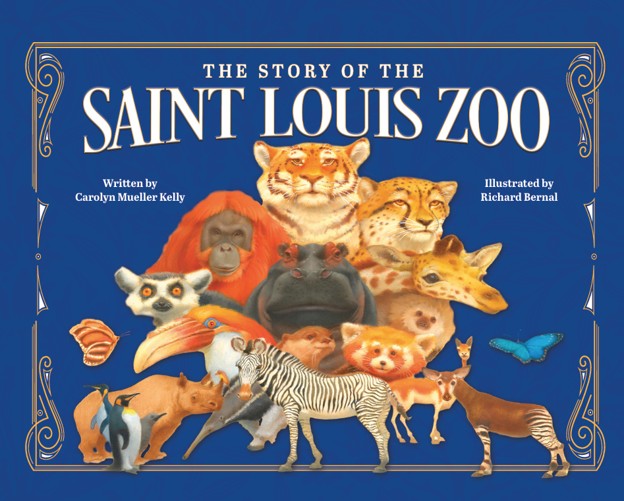
Kelly’s many Zoo dreams continue to come true. The latest dream coming to fruition has a title: “The Story of the St. Louis Zoo.” It’s a book that’s well-suited for any 8 year-old today, but it’s also sure to please any 80 year-old Zoo fan with fun memories.
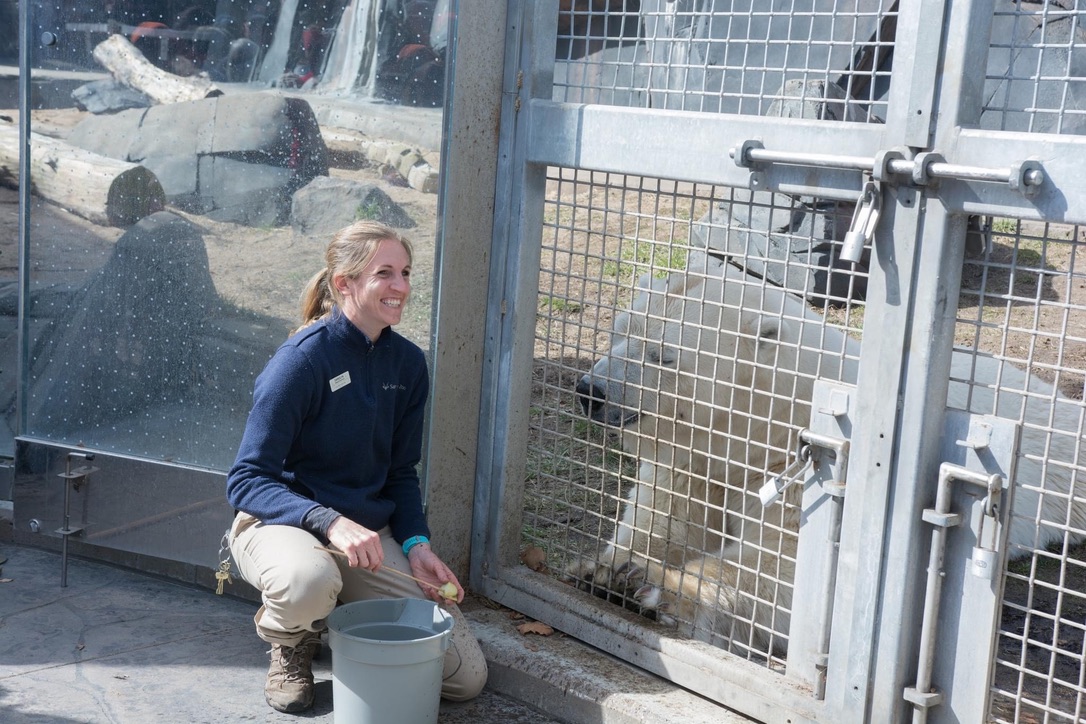
Carolyn Mueller Kelly with Kali at the Saint Louis Zoo.
“The book celebrates a special, magical place in our community and will teach readers about amazing animals – and the Zoo’s conservation work,” said Kelly. “My goal was to capture the Zoo magic, and Richard Bernal definitely made that happen with his beautiful illustrations.”
Ask Kelly about her favorite magical animals, past and present, and she goes totally gaga. She gushes over Zoo legends like Phil the gorilla, Miss Jim the elephant and Kali the polar bear.
Kelly also has more contemporary creature heroes – with species like the scimitar horned owl, the amazing Aldabra tortoise and the hard-working leaf-cutter ant. They’re all part of a magical menagerie.
“When the Saint Louis Zoo bought that beautiful elephant, she was renamed ‘Jim’ after James Harper, then president of the St. Louis Board of Education,” explained Kelly. “The “Miss’ was added so that people would know she was a female.
“St. Louis school kids made it possible to have an elephant by saving up their pennies to purchase Miss Jim,” added Kelly. I have a co-worker whose great grandmother was one of those kids. She still has a certificate from the Zoo to prove it.”
The furry fellow named Kali was the first polar bear to live at the Zoo’s Polar Bear Point. He was an orphan in the wild before he came to the Gateway City, according to Kelly. He now has matriculated to the Detroit Zoo, but Kali remains a legacy of the Lou.
“Phil the gorilla will always be a legend and a superstar,” said Kelly. “He is an animal that generations remember and he’s memorialized with a bronze statue. But even so, he is not the official mascot at the Zoo.
“The official mascot is the lesser kudu and I absolutely love that,” said Kelly. “I love lions and gorillas, but it’s neat that we feature an animal that’s not so familiar to the public. Our mascot inspires guests to learn about an animal they may not know much about.”
Zoo visitors may come to learn that the Lesser kudu is a “near-threatened” antelope species. They may also find that these animals are gorgeous.
Lesser Known Creatures
Some lesser known creatures that Kelly also champions in her book are the tortoises, some bugs and beetles, and the scimitar-horned oryx. The huge tortoises that she so admires are over a century old.
“I love telling our guests that the Aldabra tortoises are 100 years-old,” said Kelly. “They’ve lived at our Zoo since the ’60s. I like to think about the changing fashions of humans walking past their habitat during all that time.”
The Bayer Insectarium is one of only a handful of such exhibits in North America dedicated solely to bugs. It hosts more than 20 major exhibit areas, with more than 100 species of live insects.
“One of my favorite tours is called ‘Planet Protectors’ and it highlights the Insectarium. The keepers are experts in their field, and they do a really great job of sharing their knowledge and connecting guests to our six-legged and eight-legged friends,” Kelly said.
“My favorite insects in the insectarium are the leaf-cutter ants. They’re so cute and industrious. I love watching them work. Sometimes keepers give them tiny hearts to carry on Valentine’s Day, and it’s amazing to observe,” she said.
In 1991, the scimitar-horned oryx became extinct in the wild. After years of research and breeding efforts in zoos, this desert antelope species was released back into its native habitat in 2007.
“Today, the scimitar-horned oryx is still classified as ‘Endangered,’ but is no longer known as ‘Extinct in the Wild.’ That’s a conservation success story,” said Kelly. “Zoo conservationists are working to help animals in our own state, but also on the other side of the world.”
Inanimate Magic Things
Not all the magical things about the Zoo are critters. Kelly pays homage to the Zooline Railroad in the book and describes how its conductors have been shouting “All Aboard” for decades.
“St. Louis is definitely a train hub town and the Zooline Railroad adds to that culture for sure,” said Kelly. “The Zooline Railroad opened in 1963, and today it is one of the largest miniature train operations in the country.
“One big change in train ride scenery occurred when River’s Edge opened,” Kelly noted. “It’s fun to wind through tunnels of bamboo and see the back of the cheetah and hyena habitats on a ride. But the original tunnels remain delightful, and nostalgic as well.”
The Zooline Railroad gets ink in the Appendix of Kelly’s book as does the Flight Cage. It’s one of the only remaining permanent structures in Forest Park left from the 1904 World’s Fair, so there’s a lot of legacy there.
“The cage itself helped determine where in the park the Zoo would be located, and I love that it has evolved over time,” said Kelly. “Today it is a Cypress Swamp habitat where people can learn about some of the unique habitats and bird species in Missouri and Illinois.”
An added unique bonus to Kelly’s work is that it’s a poem tome – a rhyming book. The synchronous syllabic fun should amuse both adults and children.
A 2005 graduate of Nerinx Hall High School in Webster Groves, Kelly has given presentations on some of her previous books at her alma mater. It’s likely she’ll be waxing poetically for students about the Zoo soon as she makes the rounds with: “The Story of the St. Louis Zoo.”

