
 By Don Corrigan
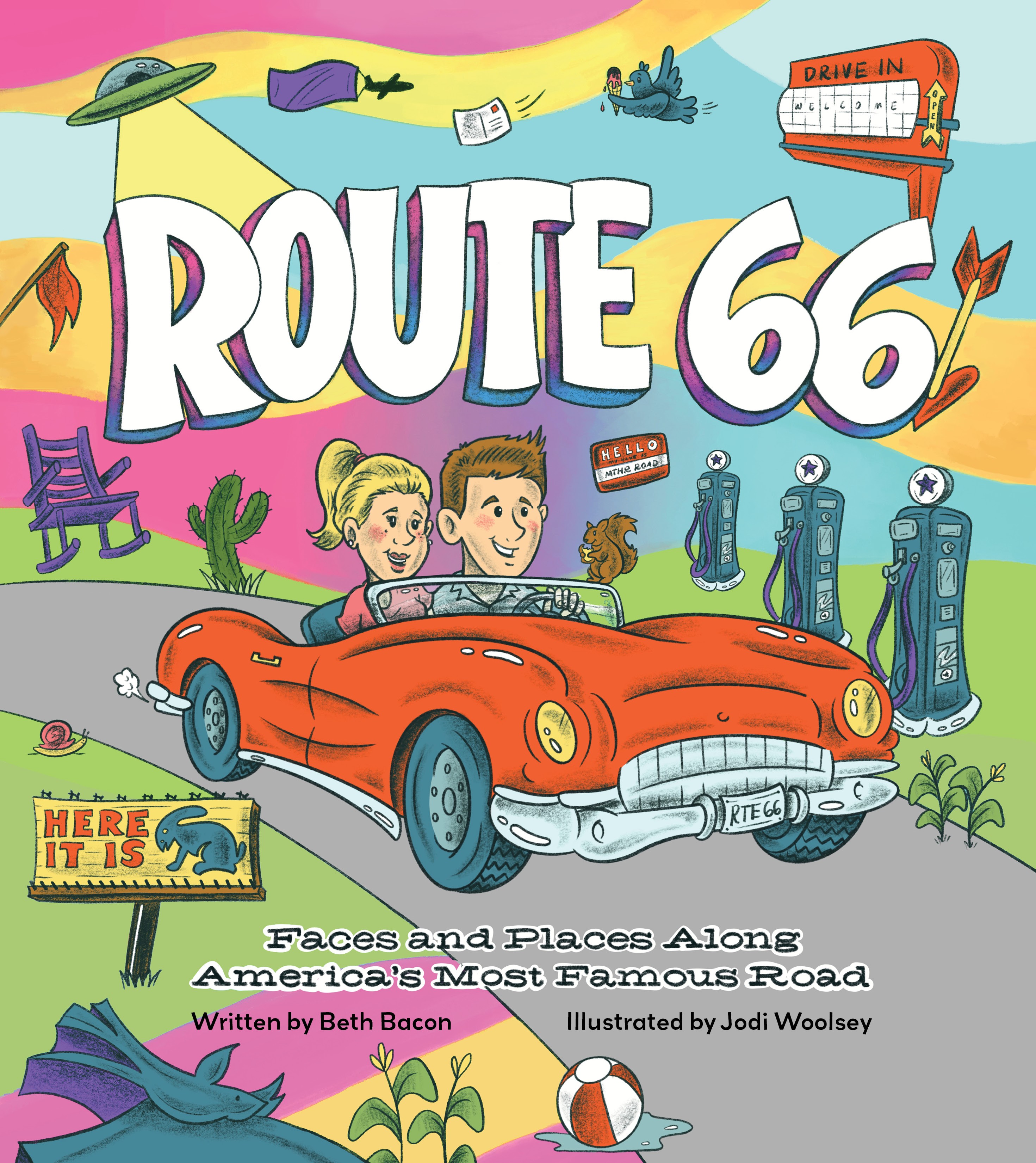
The official 100th birthday of Route 66 is Nov. 11. Beth Bacon and Jodi Woolsey are making sure kids get in on the party with their new children’s book: “Route 66: Faces and Places Along America’s Most Famous Road.”
November is the month when the Association of State Highway Officials approved the designation for Route 66. So, it’s appropriate the dynamic duo will tell the Kirkwood Historical Society about their book on Nov. 7.
They’ll also be hitting the road with their book well before the Kirkwood trip, with pit stops at Betty’s Books in Webster Groves in October and the Fenton Barnes and Noble in September. They call their book “unique.”
“It’s unique because there aren’t many books about Route 66 that are designed just for kids,” explained Bacon. “Recently, two other picture books about Route 66 did appear, but they aren’t picture books for grades 1 to 4 like this book.
“A picture book for today’s elementary school kids is unique – it‘s a needed resource about our country’s cool Route 66 history,” Bacon said.
The book’s subtitle emphasizes “Faces and Places.” Bacon said there are plenty of landmarks on the great road that make it great. However, the real greatness is in the stories that come from people along the route.
The book has short accounts of their dreams, their creativity, their unique actions – and their lasting relationship with the road itself. That’s what’s captures the spirit of the book’s “faces and places” subtext.
For example, there are short vignettes about: a boy who dreamed of a road stretching across America; a songwriter who turned a road trip into a hit tune; a kid who wanted to serve frozen treats on Route 66; a cartoonist who was inspired by the desert sands.
What’s Missing?
 Author Bacon cautions that the book is not a chronological story. It doesn’t start in 1926, and then move onto our current times. The book is organized state by state and covers unusual geographical sites.
Some of those destinations include the ghost towns in Texas, national parks in Arizona and New Mexico. Bacon includes a timeline noting when superhighways were built, bypassing the smaller towns of Route 66.
“The superhighways ultimately made Route 66 ‘historic,’ instead of relevant today,” said Bacon. “Americans just kept moving faster and farther, so the history of Route 66 is an ultimate American story.”
Bacon said there’s so much U.S. history about Route 66, but a children’s book doesn’t afford an opportunity to really dig into things like the “Oakies” moving west from the Dust Bowl, or the war factories built along Route 66 for World War II.
Nor does the book cover the famous “fight” covered by the Webster-Kirkwood Times last century, when Kirkwood Chamber of Commerce members claimed Manchester Road was the real original Route 66.
Sunset Hills-Crestwood Chamber members begged to differ and claimed Watson Road was the original Route 66. Both communities came up with their own “66” signs. History shows both sides were right – for a time.
“Well, Route 66 was not a single road, not the way today’s highways are one uninterrupted road,” explained Bacon. “Route 66 was created by linking together a bunch of existing roads and joining them together with new roadways.”
Another Route 66 legacy not covered in the book – and probably for the better as a children’s book – is the highway animal carnage from the increasing traffic along the route. Some entrepreneurs in the restaurant business have tried to capitalize on that macabre roadway facet.
An example is the Roadkill Café & O.K. Saloon in tiny Seligman, Arizona, along the route. Many species of wildlife hang stuffed on the walls of the O.K. Saloon near the back of the eatery.
In the restaurant itself, the menu includes such roadway offerings as “Rigor Mortis Tortoise,” “The Chicken That Almost Crossed the Road,” “Rack of Raccoon,” and “Long Gone Fawn.” A kids’ menu includes “Poached Bambi Burger,” “Barney Con Carne,” and “Donald Forgot to Duck.”
Perhaps a day will come when all this tongue-in-cheek ribbing about faux raccoon and squirrel plate specials will no longer be viewed as comical. Naturalists and environmentalists sure hope so.
An adult study, “American Roadkill: The Animal Victims of our Busy Highways” by Don Corrigan, examines growing revulsion over the slaughter on U.S. roadways. The book also looks at today’s roadway remediation to allow creatures safe passage at highway sites.
66 Kicks R For Kids!
Route 66 has so many interesting moving parts and stories. That’s why the book has a special “Did you know?” section. This allows for anecdotes that will resonate with children in particular.
Among kid-friendly anecdotes: Ferris wheels can be found where the road begins and where it ends; a McDonald’s first sprung up on Route 66; the Pixar movie “Cars” is based on people, places and things on Route 66.
 Book artist Woolsey said she had great fun illustrating the book. A resident of Maplewood, she has a BFA in graphic arts from Webster University and an MFA in illustration and visual culture from Washington University.
“It was so much fun bringing this book to life,” said Woolsey, now on the faculty of the University of Missouri-St. Louis in design and animation. “This project was a natural fit with my interest in rural and nostalgic themes.”
Woolsey and Bacon both have powerhouse academic credentials. A Tower Grove South resident, Bacon holds an MFA from Vermont College of Fine Arts, an MA from New York University and a BA from Harvard University.
Bacon has published several graphic novels and has a podcast called “A, Z And Everyone In Between.” Woolsey and Bacon both have more books in the making, but right now they are getting their kicks on Route 66.

