 by Don Corrigan
Cats have a long history at Kirkwood’s National Transportation Museum. In the early years, the felines found favor with museum officials in ridding rodents from locomotives, rail cars, and caboose displays.
Cats as “mousers” have always been preferable to poisons in keeping mice and rats at bay – and off the rails. Cats excel at deterring mice through scent and stress, as well as outright confrontations with the little beasts.
In contrast, rodent poisons carry a high risk of secondary poisoning to pets and predatory birds. Owls in particular suffer from eating poisoned rodents. Poisoned rodents die inside walls and insulation causing severe odor.
Even before environmental sensitivities cautioned against the use of toxic chemicals for rodent control, the transport museum wisely employed Felix the Cat and the ubiquitous Garfield to manage the rodent population.
A new book by William Matteson Schaberg of Kirkwood entitled, “Origins” covers the founding of the museum and its early years from 1941-1955. He includes a Chapter 13 headlined, “The Cat Chronicles.”
Among its entries:
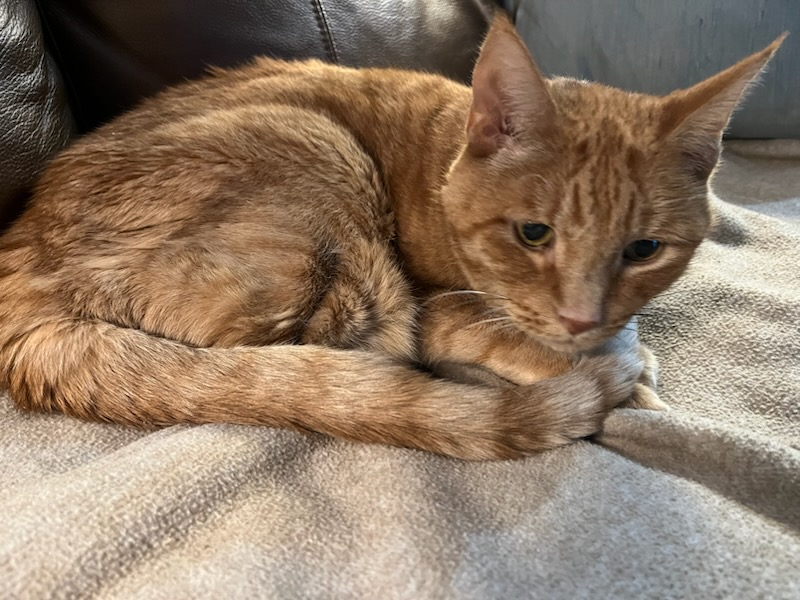
• They have been quite useful at doing what cats do … catching rats, mice, and other critters. The museum daily log chronicles feline activities between 1952 and 1955.
• 19 July 1952 – The Roberts’ new cat is doing fine after being with them (at the museum) for 1-1/2 weeks. Another cat they got is from the Lesperance Street Yards.
• 06 January 1955 – A cat survey was taken today … newest addition is a baby Maltese cat found in the East St. Louis train yards of the CB&Q after the arrival of a freight train.
• 23 May 1955 – We now have 56 cats consuming 40 pounds of horse meat and a half case of Puss & Boots cat food per week.
The Roberts consisted of the couple, John and Mary Roberts, who oversaw activities at the transport museum in its early years. He was a prominent psychiatrist who enlisted volunteers to establish the institution founded eight decades ago.
An Ambitious Idea
The esteemed psychiatrist, Dr. John Roberts, had an ambitious idea for a museum celebrating transportation. He was joined by doctors, lawyers, engineers and other professionals who gave up weekends to work to fulfill a dream.
Today, that dream is a reality. It’s encompassed in a private, 42-acre National Museum of Transport (TNMOT) in Kirkwood. Officially founded in 1944, it restores, preserves and exhibits vehicles from the late 1940s to the present.
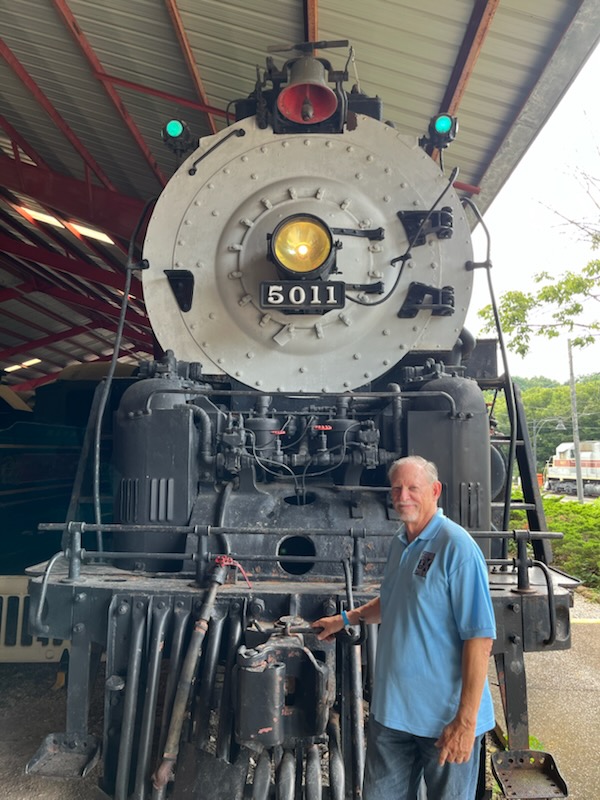
The most visible displays are locomotives and railroad equipment, but the museum also boasts cars, trucks, aircraft, a boat and more. TNMOT also
contains a research library of transportation-related memorabilia and documents.
A Kirkwood man who spent months in that library is William Schaberg of Kirkwood. He used his research to publish the book, “Origins,” which covers the activities at TNMOT in its early years.
“I have been visiting TNMOT since an early age,” said Schaberg, 74, who has lived in four different houses in Kirkwood. “I’ve always had a real soft spot for the museum and wondered about its early days and history.
“I am a person interested in the origin of things, so I had to find out more,” Schaberg said. “I had heard tales of the early days, and it just sparked my curiosity. There just didn’t seem to be much information available.”
Schaberg, an architect by profession, took the information available and put together 13 chapters and a final interview with a founder. He is Earl Finger, a former Cotton Belt Railroad employee, who is a few years short of 100.
Old Earl Finger told Schaberg that Dr. Roberts was the backbone of the museum’s founding. He said the unusual psychiatrist treated all the early young museum members as equals, even though he was a score of years older than them.
Finger said many volunteers were too young to drive. They got to the museum
by Kirkwood streetcar. At the end of the line, they took a shortcut through Missouri Pacific Railroad company property to get to the museum grounds.
The Daily Log
Much of Schaberg’s book relies on the “Daily Log,” which was kept to keep track of “goings-on” at the museum. It includes stories of the young men who rode streetcars and their bikes to get to the museum.
“The Daily Log shows how these transport enthusiasts scavenged parts and pieces of rail, tools, and supplies all over the city,” said Schaberg. They were a devoted bunch, working weekends and holidays to keep the museum moving forward.”
Schaberg introduces some of the early movers and shakers at TNMOT in his book. However, he is even more interested in introducing us to artifacts and rolling stock that now stand still in the museum yards.
Many of today’s visitors come away from TNMOT talking about the Bobby Darin sports car or the Coral Courts Motel remnant on display. Schaberg points out some other “quirky” things to be found there.
“One of the unique artifacts is the Reading Railroad ‘Black Diamond’ inspection locomotive – recently beautifully restored,” he said. “This tiny steam engine was used by railroad officials to inspect the track or facilities, instead of using a whole steam engine and train.
“Also, there’s a ‘horsecar,’ Bellefontaine No. 33, one of the first acquisitions,” Schaberg said. “This car predates electric streetcars. It was pulled by horses or mules and traveled the muddy streets of St. Louis to make travel more pleasant. Hardly any of these still exist.”
Schaeberg is also impressed by a quirky item known as the Milwaukee Road’s “bipolar” electric locomotive. It’s not a reference to mental health. It had electric motors on the axles that could move the locomotive in both directions. It’s the only one of its type remaining.
Schaberg’s book also shows photos of past locomotives headed to the “scrap pile.” Many valuable pieces of rolling stock were lost to that pile.
“To the railroads, they were obsolete equipment that they had to pay taxes on, so getting value for the metal was the important thing,” said Schaberg. “They were ‘just a bunch of old steam engines,” not shiny new streamlined diesels coming out in the 1940s and 1950s.
Streetcars & Cats
It’s no surprise that the TNMOT has a soft spot for old streetcars. Maybe that’s because archives from 1941 show the museum organization was known as St. L.E.R.H.S. or the St. Louis Electric Railway Historical Society.
“Early on a group of streetcar fans had in mind to obtain several streetcars for preservation and operation,” said Schaberg. “ It was apparent that the St. Louis Public Service Company was going to abandon much of their streetcar equipment after World War II.
“Typical procedures for obsolete equipment was to burn the wood cars, then salvage the metal parts for sale as scrap,” he added. “Dr. and Mrs. Roberts were involved from the beginning with saving streetcar artifacts.”
It may be a surprise to learn from the book, and the Daily Log, that the museum was a haven for cats. Chapter 13 chronicles the cats, that did yeoman work catching rats, mice and critters interested in living in a caboose or trolley.
The cats and most critters are gone today, but bad weather is still here and maybe getting worse. Sheltering its many outside gems from weathering has always been a challenge, but the museum is one of the tops in the country in a new century.
“TNMOT is one of the one of the best in terms of the depth of its collection covering much of railroad history,” said Schaberg. “Many museums have a streetcar or two, or diesel locomotives or a caboose.
“TNMOT has so many artifacts from the steam era, which no other museums have,” he added. “The founders were so active in pursuing locomotives in particular, when railroads were disposing of them in their scrap piles.”
TNMOT Director Terri McEachern has high praise for the foresight of the museum founders as well, but also for the book by William Schaberg.
“Bill’s work is invaluable because it preserves the story of how The National Museum of Transportation came to be,” said McEachern. “He documents the vision, dedication, and community support that built the museum.
“His book helps readers understand that this institution didn’t happen by accident. It exists because generations of volunteers, donors, and transportation enthusiasts believed historic treasures were worth saving,” McEachern noted.
(Portions of this story originally appeared in the Webster-Kirkwood Times)

