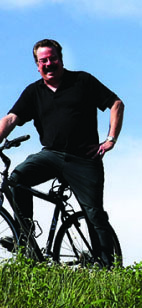
Pictured: Don Corrgian
By Don Corrigan
Trailnet, an advocacy group promoting biking, hiking and public transit, is always a major player in celebrating bicycling’s health and economic benefits on the special day in May.
“Sure, biking to work is more economical, but that has not always been my major motivator,” said Erik Herzog. “At one point I did estimate I save a few thousand dollars in gas and parking, but other perks weigh more heavily in my choice to bike.”
Herzog of Webster Groves bikes to his job in the biology department at Washington University. His trip to Washington University and his route have altered with changing traffic patterns.
“When the Metro built a station across Laclede Station Road, I suddenly had a nice stretch of road largely forgotten by car traffic,” Herzog noted. “As the Greenways developed, I’ve enjoyed adding a stretch through Deer Creek Park to my daily commute.”
He said his ride takes 25 minutes each way, although it seems longer as he gets older. He said the ride clears his head before and after work. He also said on his rides he has seen coyote, fox, woodchucks, deer, and eagles.
Herzog has high praise for Trailnet and Great Rivers Greenway. He also recommends that new commuter bikers would be wise to go to the Hub in Webster Groves for a little advice.
“Ron Clipp and his Hub staff can help you get started with bike tips, fitting your bike to your body so you ride in comfort, and they provide encouragement,” said Herzog. “They seem to know everyone in the store by first name.”
Ben Lake’s Take
Ben Lake, head mechanic at Billy Goat Bicycle Co. in Kirkwood, might disagree with Herzog on where to get bicycling advice. He is likely to recommend his shop, which he commutes to via bicycle from Arnold.
“I’ve been bike commuting on and off for 30 years,” said Lake. Five of those years, the bicycle was my only mode of transportation. Currently, I would say I am a fair weather commuter to Kirkwood.
“I use the MapMyRide website that allows me to create routes for running and cycling and it gives distances and elevations,” said Lake. “Getting into St. Louis County from Jefferson County safely can be tricky.”
Lake said there are really only three Merameci River crossings he can use: Meramec Greenway in Fenton, Jeffco Boulevard in Arnold, or Telegraph Road. He opts for the Fenton crossing, which is “a fantastic ride over the river” even if the route to Geyer Road is extra hilly.
According to Lake, riding those hills has health benefits. He said he has asthma, and the more regularly he can ride, the better his symptoms become. He said his commute also helps with weight management.
“The route I take is roughly one hour each way, and over the last three or so years, I have reduced my weight by about 35 pounds” Lake said. “The amount of fat I carry is reduced, so my energy levels and endurance are greatly increased.
“Mental benefits are harder to quantify. I definitely notice a reduction in stress and my moods are better whenever I ride,” he added. “The wonderful thing about cycling is the many ways to enjoy it – from riding greenways with family to ripping on trails in the forest.”
As far as advice for commuter bicyclists, Lake offers this: Plan your route. Blinky lights on a bike are your friend. Practice changing a flat. Get a small repair kit. kit. Get a good helmet. Find a helmet that meets all safety requirements, that looks good and fits well.
Peter Goode’s Take
“I’ve been commuting from Webster Groves to Washington University for 20 years,” said avid bicyclist Peter Goode. “I figured out my routes just by looking at a map and knowing which roads are too busy to ride on.
“By cycling to work, I get an hour or more of exercise each day,” said Goode. “My ride in the morning wakes me up and the ride home helps me burn off the day’s stress. But I have to say that cycling is my main hobby.”
Besides the health benefits, Goode sees commuting to work as an economic plus. He drives about 12 miles round trip to work, so biking allows him to avoid 240 miles of driving. That driving would consume 9 to10 gallons of gas.
“With gas now at $4 per gallon, that’s $35-$40 savings per month,” said Goode. “Then there’s a WashU parking pass, which costs $75 per month. By commuting, I’m saving over $100 per month compared to driving.”
Goode offers these tips for bicycle commuters: If you’re just starting out, scout out your route. Cycling gear is helpful, but by no means necessary. Light-weight, quick-drying clothing works best for short commutes. If it’s going to be hot, bring a small water bottle.
Trailnet’s Take
According to Trailnet’s Chantal Incandela, National Bike-to-Work Day is just one of several events planned for 2026. However, the commuter celebration on May 15 was one of the best days of the Trailnet biking year.
“Whether you cycle or use alternative transportation, it benefits everybody when you commute this way, whether it’s a morning workout, or a ride to school,” said Incadela. “It’s fun to energize your morning and connect with your community.”
Special station stops on May 15 provided refreshments and a welcome place for cyclists to stop, refuel, and to connect with others. For more information, contact Allie Reed at allie@trailnet.org, or call Trailnet at (314) 455-6329.
 Environmental Echo