
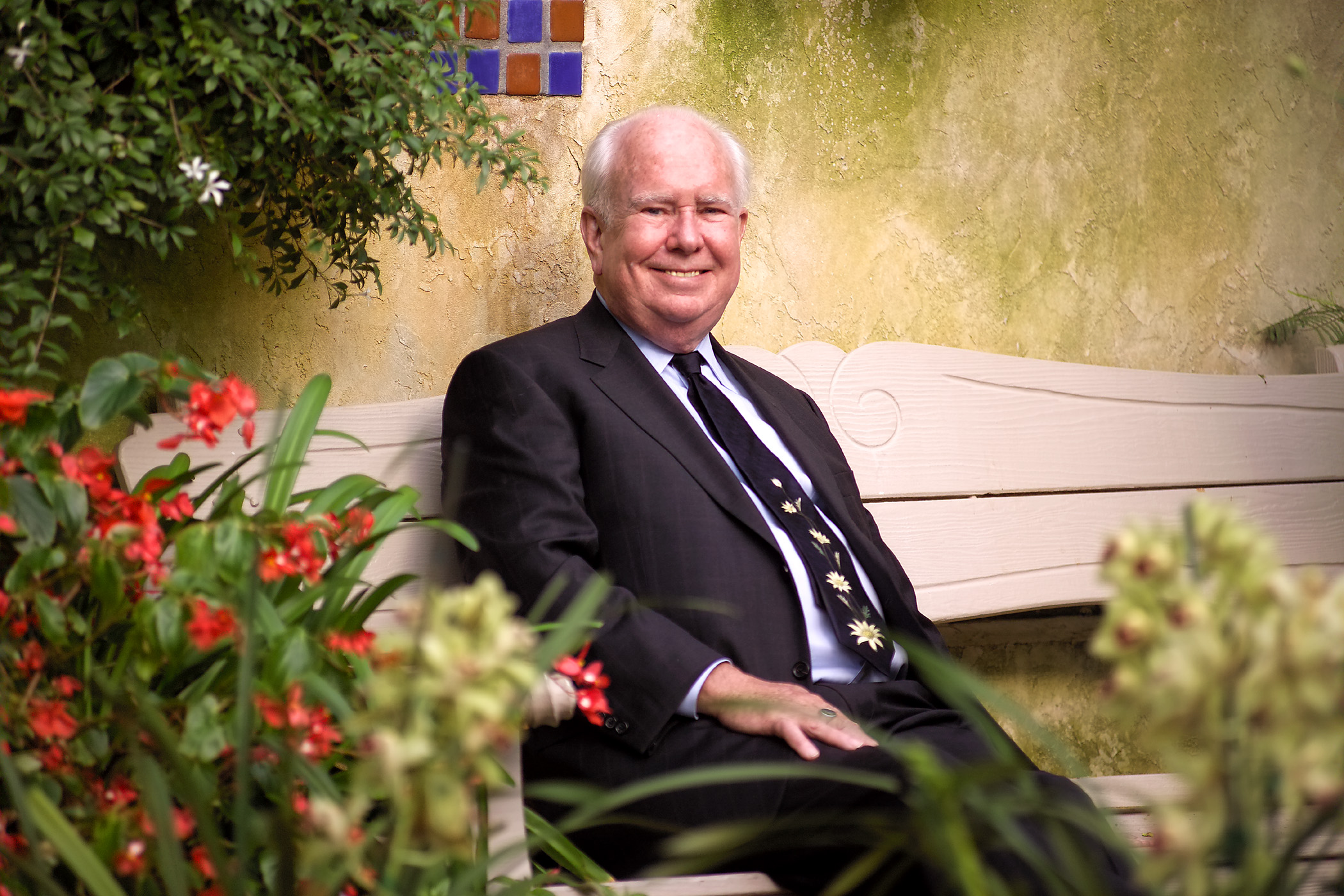
Dr. Peter Raven. Photo by Michael Jacob, Missouri Botanical Garden.
Dr. Peter Hamilton Raven, a botanist of global stature who transformed the Missouri Botanical Garden into one of the world’s leading centers for botany and became one of the most influential voices for biodiversity and conservation, passed away on April 25, 2026. He was 89 years old.
For nearly four decades, Dr. Raven served as President and Director of the Garden while also holding the George Engelmann Professorship of Botany at Washington University in St. Louis. When he assumed leadership of the Garden in 1971 at age 35, the institution was modest in scope. By the time he retired in 2010, he had transformed the organization into a global hub for research, education, horticultural display, and sustainability, with far-reaching scientific partnerships and conservation programs.
Dr. Raven’s vast and varied list of accomplishments at the Garden includes opening the Japanese Garden (Seiwa-en), the Margaret Grigg Nanjing Friendship Garden, the William T. Kemper Center for Home Gardening, and the Doris I. Schnuck Children’s Garden. He tripled the size of the Garden’s Herbarium, helping make it one of the largest botanical collections in the world, and greatly expanded its library, now among the world’s most comprehensive botanical libraries and since named in his honor. Dr. Raven’s many global scientific contributions in this role include founding the Garden’s William L. Brown Center and the Center for Conservation and Sustainable Development, as well as launching numerous research projects, conservation programs, and partnerships across North America and in China, Madagascar, Peru, Bolivia, and Tanzania. The 150-person staff at the start of his tenure, which included just a handful of scientists, had grown to nearly 500, including close to 50 PhD-level research scientists undertaking pioneering work on the St. Louis campus and around the world.
“Peter Raven didn’t simply lead the Garden; he redefined what it could be,” said June McAllister Fowler, chair of the Garden’s Board of Trustees. “His vision elevated it to a world-class institution while deepening its roots in St. Louis. He believed the Garden should serve its community as much as the scientific world, and that legacy is visible across our city today.”
During his two decades of retirement as President Emeritus and Professor Emeritus, Dr. Raven remained an energetic ambassador for the Garden’s mission, traveling widely to lecture and advocate for the protection of plant life and the ecosystems on which humanity depends. In addition to his named professorship at Washington University, he also served as an adjunct professor at Saint Louis University and the University of Missouri–St. Louis.
“Peter combined intellectual brilliance with a profound sense of purpose,” said Dr. Lúcia Lohmann, President and Director of the Missouri Botanical Garden. “He built not only a world-class scientific institution, but a global community committed to understanding and protecting the diversity of life on earth. He supported scientists from all over the world, including myself, and inspired generations to pursue knowledge in service of the planet.”
Outside the Garden walls, Dr. Raven worked to make St. Louis a plant science hub and build relationships with global partners. Under his leadership, the Missouri Botanical Garden became a founding member of the Center for Plant Conservation, a network of botanical gardens dedicated to conserving U.S. native plants. Dr. Raven was also a cofounder of the Danforth Center for Plant Science with Bill Danforth and Virginia Weldon, and he played a key role in the success of Gateway Greening, now known as Seed St. Louis, which helped to establish more than 200 community gardens in urban St. Louis. He was also instrumental in establishing a sister-city relationship with Nanjing, China, the first of its kind between the United States and China.
In 1988, Dr. Raven received the St. Louis Award in recognition of his work in environmental conservation and his contributions to the St. Louis community. In subsequent years, he was named St. Louis Man of the Year (1989), added to the St. Louis Walk of Fame (1995), and appointed Chair of the Parks (2002) and Chair of the Open Space Task Force of St. Louis (2004).
Dr. Raven’s influence extended well beyond St. Louis. He contributed 35 years of leadership as co-editor to the monumental Flora of China project, reflecting his lifelong commitment to international collaboration in botanical science. Over the course of his scientific career, he helped shape the modern understanding of plant evolution and coevolution, and trained generations of scientists who now lead institutions around the world. An excellent network builder, Dr. Raven promoted scientific collaboration, connecting people with similar interests to one another to great synergistic effect.
“Peter was among the rare scientists who understood the importance of plant diversity science, but who also marveled at the vast sweep of life’s history,” said Sir Peter Crane, president of the Oak Spring Garden Foundation and former Director of the Royal Botanic Gardens, Kew. “He brought those perspectives together to make an unanswerable case for the conservation of biodiversity.”
In 1985, Dr. Raven was awarded a MacArthur Fellowship—often called a “genius grant”—in recognition of his originality and leadership in science and conservation. In 2000, he received the National Medal of Science from President Bill Clinton, the nation’s highest honor for scientific achievement. Dr. Raven was also awarded the National Friendship Medal from the Premier of China, the highest award offered to foreigners. He served on the Council of the National Academy of Sciences from 1983 to 1986 and was Home Secretary of the Academy from 1987 to 1999. He was also a Fellow of the American Academy of Arts and Sciences and 25 other Academies of Science around the globe. His many international honors included the International Prize for Biology from Japan, 22 Honorary Doctor of Science Degrees, and innumerable Achievement and Distinguished Service Awards and Medals.
A public advocate as well as a scientist, Dr. Raven was named a “Hero for the Planet” by Time magazine in 1999. Throughout his career, he warned of the accelerating loss of biodiversity driven by population growth, consumption, and environmental degradation, urging international cooperation to address what he saw as one of the defining challenges of the modern era.
“Peter Raven understood earlier than most that biodiversity loss is not an abstract problem, but a direct threat to human well-being and all life on Earth,” said Cristián Samper, managing director and leader for nature solutions at the Bezos Earth Fund and former president of the Wildlife Conservation Society. “He was a strong advocate for science and conservation, and a mentor to generations of botanists and policymakers around the world.”
Dr. Raven served on numerous scientific boards and advisory bodies, including President Clinton’s Committee of Advisors on Science and Technology from 1994 to 2001 and as a trustee of the National Geographic Society. He was a life member of the Pontifical Academy of Science and raised awareness of the perils for biodiversity through his many lectures at the Vatican. A prolific author, he co-wrote Biology of Plants, a widely used textbook now in multiple editions, and Environment, another leading text in the field. In 2021, the Missouri Botanical Garden Press published his autobiography, Driven by Nature: A Personal Journey from Shanghai to Botany and Global Sustainability.
Peter Hamilton Raven was born in Shanghai in 1936 to Walter and Isabelle Breen Raven. He earned his doctorate from the University of California, Los Angeles, in 1960 after undergraduate studies at the University of California, Berkeley. Early in his career, he conducted fieldwork in the highlands of Chiapas, studying folk taxonomy—an experience that deepened his appreciation for the relationship between people and plants and helped shape his lifelong commitment to conservation. Before coming to the Garden, Dr. Raven served for nearly a decade as a professor at Stanford University along with his favorite cohort, Paul Ehrlich.
Dr. Raven is survived by his wife, Dr. Patricia Duncan Raven; four children, Alice Raven (Sam Stuhlman), Liz Raven McQuinn (Daryl McQuinn), Francis Raven (Carolyn Kousky), and Kate Raven (Katrina Schaffer); and the grandchildren, Noah, Nate, Louisa, and Rosvita. A celebration of his life will take place at the Missouri Botanical Garden. Donations in memory of Dr. Raven may be made to the Garden’s Dr. Peter H. Raven Memorial Fund securely online or by calling 314-577-0291. Condolence messages or memories of Dr. Raven may be shared online.

