Blog Archives

Image

Learn To ID trees At The MDC Forester-Guided Hike May 13

MDC is hosting a Tree ID and Guided Hike Tuesday, May 13 from 10 a.m. – noon at Caldwell Memorial Wildlife Area in Franklin County. The hike will be guided by MDC Forester, Cody Baily.

A forest full of trees can seem almost impossible to sort out.  Yet, by learning to look for and identify some key characteristics, the forest and its trees can become a familiar place.

The Missouri Department of Conservation (MDC) is hosting a Tree ID and Guided Hike Tuesday, May 13 from 10 a.m. – noon at Caldwell Memorial Wildlife Area in Franklin County.  The hike will be guided by MDC Forester Cody Baily.  This is a free event and open to anyone 15 years of age and up.

Participants can improve tree identification skills while enjoying a short hike at Caldwell Memorial Wildlife Area.  Baily will explore the unique identifying characteristics of more than 20 of Missouri’s most common tree species.

“This program is perfect for families, hikers, and nature lovers who want to connect with the forest in a whole new way,” said MDC Conservation Educator Kayla Rosen.

Continue reading

Image

Spring Floods Take Toll: Meramec Basin, Riverway Towns, Park Sites Hit Again  

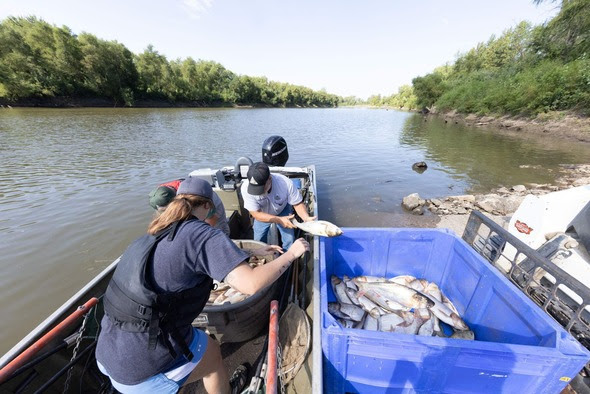
All photos: Minnie HaHa Park.

by Don Corrigan

For the second time in less than six months, eastern and southern Missouri have been hit with record floodwaters. Stretches of roadway were closed at Meramec Bottom, Hawkins, Butler Hill, Smizer Mill and Pritchard Farm roads

The early April storms were a repeat of a November scenario when flooding severely damaged state and local parks and closed highways. Sandbags once again found use in some river towns along the lower Meramec and its tributaries.

A fatality occurred this time around when a 16-year-old junior firefighter was on his way to a water rescue and lost control of his vehicle. Chevy Gall was killed on Highway 50 near MO-185 on April 4 in the midst of heavy rains.

Gall was remembered April 12 in a ceremony in Franklin County’s Life Stream Church after being killed in the crash. Firefighters in the Beaufort-Leslie Fire Protection District had high praise for Gall and his dedication to rescue and responder work.

Heavy rains and flash floods hurt river site parks and also scoured riverbeds. The torrential rains and high water damaged stream beds and caused unprecedented erosion at some locations.

Only ducks, frogs, and their tadpole spawn were happy with standing water that covered bike and hiking trails for days. Greenway trails in Kirkwood, Fenton and Valley Park were especially hit hard.

In the St. Louis region, drivers in the Valley Park-Fenton area were once again frustrated when roads closed part of Highway 141 near I-44 due to the flooding Meramec River. Horses had to be moved to higher ground at nearby riding stables.

Marshall Road in Valley Park went underwater as did riding trails along the Meramec in Eureka. Minnie Ha Ha Park in Sunset Hills suffered severe damage to its shoreline with trails and facilities washed out.

Recovery work at Minnie Ha Ha was yet to be completed from November washouts on park trails. This month’s storm waters took out tables, fencing, picnic areas and washed out a major piece of trail along the Meramec River.

For more information on state parks and historic sites, visit mostateparks.com. Missouri State Parks is a division of the Missouri Department of Natural Resources.

Image

“In Search of Manhood” St. Louis EE Environmental Writer Wins Best Pop Culture Book Award In New Orleans

St. Louis environmental writer Don Corrigan always learns from the seminar offerings of the American Culture Association / Popular Culture Association’s annual conferences. The ACA-PCA’s Ecology and Culture Interest Group always has topical offerings on media and the environment.

The conference interest group examines portrayal’s of a planet facing environmental challenges as depicted in  literature, film, streaming and even poetry, dance and song. This year, Corrigan was surprised to learn that his own literary output was singled out for examination and plaudits.

Author Corrigan’s study, In Search of Manhood: American Men’s Movements Past and Present, has been selected as top pop culture book among those published in 2024. Award recognition was slated for April 18 at the New Orleans convention of the Popular Culture Association.

Choice magazine describes Don Corrigan’s book as “a succinct, accessible chronicle of American men’s constant construction and reconstruction of masculinity and manhood, and a welcome addition to the ever-growing field of men’s and masculinity studies.”

The identity crisis of men and boys in America has attracted media attention nationwide, as American males suffer economic, social and psychological setbacks. Corrigan’s analysis joins those of writers such as Scott Galloway, Richard Reeves, Leonard Sax and Warren Farrell.

Corrigan devotes considerable attention to examining the role that male movie and television icons have played in male self-conceptions. The author details how these iconic figures have been incorporated into a range of men’s movements.

He chronicles the Promise Keepers, Million Man March and fathers’ rights groups of last century. He then examines the rise of more militant contemporary men’s groups including Proud Boys, Oath Keepers, Alt-Knights, and the growing militia movement.

The author also reviews media reaction to U.S. Sen. Josh Hawley’s book on manhood that takes a biblical perspective. Corrigan explores the rise of toxic masculinity in America and suggests new masculine icons be summoned and widely adopted.

Corrigan notes that toxic masculinity is manifest on the environmental front by attitudes that the earth and its creatures are there for exploitation. A new environmental ethic for masculinity would put an emphasis on men as stewards of the planet and its varied wildlife.

“Don Corrigan’s latest book is a welcome and thought-provoking contribution to McFarland’s gender studies list,” said Karl-Heinz Roseman, vice president of sales & marketing. “We’re delighted that his work is being honored by PCA.”

“This book is also a good example of the journalism and academia combo that makes Don Corrigan special,” said Roseman. “For example, he draws upon his background as a newspaper reporter in interviewing members of different men’s groups.”

Continue reading

Image

St. Louis Earth Day!

Image

Safety, Aesthetic Issues: Billboard Lobby Calls Highway Visual Clutter Study A Waste

Billboards on interstates 44, 55, 70 and 65 are ubiquitous with the roadway on I-65
between Springfield and Branson being one of the most cluttered in the nation.

by Don Corrigan

Missouri’s rank as 6th among states with the most billboards is once again drawing scrutiny. Concern comes as state officials eye the continuing $2.8 billion project to widen Interstate 70 between Wentzville and Kansas City.

Scenic Missouri President John Hock is urging legislators to commit to a serious study on safety issues, as well as the aesthetic impact of so many billboards along the 250-mile highway from St. Louis to Kansas City.

Hock notes that I-70 is called the “Main Street of Missouri” as part of the vital 2,200-mile interstate. I-70 has a significant footprint in nine states. Missouri has 3.64 billboards per mile along its I-70 corridor.

This is 2.5 times the average of its adjacent neighbors. Missouri has a billboard problem, according to Hock. He said Missouri’s “Main Street” travelers are not only deprived of natural beauty, but distracted driving caused by billboards puts them in danger.

John and Marilyn Hock are in the fight against highway billboards for the long haul.

Several legislators, both Democrat and Republican, agree with Hock that now is an opportune time to take a look at billboard clutter in the state. Proposals include a moratorium on the signage and hikes in billboard placement fees.

Billboard companies and the Missouri Outdoor Advertising Association are telling legislators that a commission to study the issue is a waste of taxpayer money. They also question any studies suggesting billboards could present traffic safety hazards.

Many Missouri legislators have spent thousands of election dollars on their own billboard advertising to improve their facial recognition among voters. Some state politicians are sympathetic to the billboard industry as a force promoting the local economy.

Hock said his organization, Scenic Missouri, has seen this rodeo before. His group tangled with the billboard industry over a Nov. 7, 2000 ballot issue. The ballot Proposition A was identified for voters as, “Save Our Scenery 2000.”

Save Our Scenery

Proposition A would have ended construction of most new billboard advertising along highways; granted authority to local governments to regulate existing billboards within their communities; halted the practice of allowing billboard companies to cut down trees on public land next to highways.

Prop. A’s “Save Our Scenery 2000” was a coalition of over 70 different business, environmental and professional organizations from across Missouri. It was placed on the ballot by 130,000 citizens who signed petitions across the state.

Opponents of Prop. A were led by the Citizens Against Tax Waste Committee. The group said Prop. A would raise taxes and effectively kill small businesses relying on outdoor advertising to attract customers.

Citizens Against Tax Waste Committee also claimed that requirements for compensation to landowners and sign owners after billboard removal would cost the state $500 to $600 million.

Supporters of Prop. A fired back that the Tax Waste Committee was simply a tool for the Missouri Outdoor Advertising Association. They also said the billboard industry was attempting to mislead voters with “ridiculous” figures of up to $600 million in reimbursements required.

In the end, state voters chose to side with the billboard industry in the 2000 election. The margin was as close as could be: 51% to 49%. At the time, Scenic Missouri spokesperson Karl Kruse lamented the state had about three times as many billboards per mile as its eight neighboring states.

Kruse said Missouri was 40 years behind the times in its laws regulating billboards. Four states, Maine, Alaska, Hawaii and Vermont, have complete bans on billboards along primary highways. About 20 states have laws prohibiting new billboard construction along interstates.

Today, Scenic Missouri’s John Hock can say the Show-Me State is now 65 years behind the times in its laws regulating billboards. Hock will also insist that the organization, Scenic Missouri, has not given up the fight against billboard clutter he says distorts the natural beauty of Missouri.

Image

More St. Louis Area Sightings! Coyotes Proliferate After Much Cicada Munching in 2024

By Don Corrigan

Photo: MDC

Coyote sighting photos have been finding their way onto Facebook sites in the St. Louis area. If you want to know why the wily coyotes are now appearing in abundance, blame it on … cicadas. Cicadas?

“This is an exceptional year for seeing coyotes on the landscape,” said Erin Shank. “This is due to the cicada emergence last spring, which produced plentiful food resources. This has led to high survival rates for coyotes and many other species.

Photo: MDC

In other words, many critters enjoyed some ready-made dinners – feasting on literally billions of cicadas last year. Among the many diners were coyotes and their pups who benefited from a banner year of bountiful bugs in 2024.

“The most important item to stress now is to not feed the coyotes, whether on purpose or inadvertently,” said Shank, a once-familiar face at Powder Valley Nature Center in Kirkwood.

These days Shenk spends a lot of her time at Busch Wildlife Center. She works there as the St. Louis Region Community and Private Land Conservation Unit Supervisor for the Missouri Department of Conservation.

Shenk has a soft spot for coyotes, but she concedes their presence in St. Louis suburbs can become problematic, especially if they become aggressive. They should not be fed.

“The cicadas are gone, but coyotes are here and they’re very opportunistic eaters. They’ll feast on anything from pet food to trash,” said Shank. “Fed coyotes have a much higher tendency to become a nuisance.”

Continue reading

Image

Forest ReLeaf of Missouri: April Open Nursery Potting Day, April 12, 2025

April Open Nursery Potting Day, Saturday, April 12 · 9 – 11am, located at CommuniTree Gardens Nursery, 2194 Creve Coeur Mill Road South Maryland Heights, MO 63146. Register HERE.

Each year Forest ReLeaf pots over 20,000 bare root seedlings in preparation for distribution to tree planting projects across the state of Missouri in the spring and fall. This is made possible through volunteer efforts!

Helping hands of all ages are welcomed to the nursery to help make sure these young trees get planted properly. Potting days begin with a tour of the nursery and a quick overview of the process, and ample opportunities for breaks. We’ll provide gloves, training, and snacks.

Please dress for dirt and weather and bring a reusable water bottle to stay hydrated!

Image

2025 Urban Gardening Symposium

Join Brightside St. Louis, Saturday, May 31st, 2025 for the St. Louis Urban Gardening Symposium located at Brightside St. Louis’ Demonstration Garden at 4646 Shenandoah Avenue.

The symposium will feature Dr. Ed Spevak as the keynote speaker. Dr. Spevak is the Curator of Invertebrates at the Saint Louis Zoo and Director of Saint Louis Zoo’s WildCare Institute Center for Native Pollinator Conservation (CNPC). He will share his expertise in native plants and pollinators.

The event will also showcase local experts with experience and knowledge of installing and caring for native plants and creating garden designs beneficial to pollinators and beautiful for your neighborhood. You’ll enjoy the variety of organizations represented- from MSD Project Clear to St. Louis Master Gardeners!

Following the initial showcase, concurrent workshops led by experts in their respective fields will help gardeners learn how to plan, plant and care for a neighborhood or home garden. There will be opportunities to “Ask the Experts” between sessions and to purchase native plants after the workshops!

For more information, registration and cost details, workshop line-up and event flyer click link below.

Brightside Symposium 2025

Image

Confluence Trash Bash, April 12, 2025

Register now to volunteer for the 2025 Confluence Trash Bash on April 12, 2025.

Be a part of one of the largest volunteer clean-up events in the region & help beautify the Lower Missouri River watershed.

Learn more at: https://volunteer.openspacestl.org/agency/detail/?agency_id=132647

Image

Starhill Tree Scholar: Guy Sternberg Notes ‘Global Destabilization’ In Arbor Talk

by Don Corrigan

In a March 1 talk that focused on oak trees in Missouri and Illinois, arborist Guy Sternberg introduced an audience at the Kirkwood Performing Arts Center to the term “global destabilization.”

The term “global destabilization” is closely related to the crisis of global warming and destructive climate change. While human awareness of the destructive impacts of global warming is growing, the will to address warming and climate change is woefully inadequate.

Hence, we get “global destabilization,” which means over-heated land masses and urban cores, destruction of plant and animal life, the creation of super-cell storms, mass migrations – and the strife that results from mass relocations of people.

Trees figure into all of this. Trees suffer immensely from the destruction of plant and animal life, from the loss of habitat, from the loss of the many pollinators that make their existence possible.

Wildfires are nothing new, but increasing climate destabilization has made their ferocity and frequency unprecedented. Whole forests of trees have been lost to these fires leaving terrible scars upon the land.

Trees also suffer from global warming because it brings the migration of insect pests into areas where they have never thrived before. Some pests wreak havoc on particular species of trees, which can have catastrophic consequences.

Although trees are victims, they also can be the heroes in the growing crisis of global warming and climate change. This is because trees can mitigate the harmful effects of climate change.

Restoring lost trees is important to slowing the climate change crisis. CO2 emissions are a major culprit in climate change. Trees capture CO2 from the atmosphere and store the carbon in their leaves, stems and roots – eventually increasing the carbon stored in soil.

Six million trillion trees once grew on Earth. Humans have cut down half of them. Restoring trees and forests can achieve much in the growing climate crisis. New tree plantings and forests can help us avoid the loss of plant and animal species that call forests home.

Continue reading