Blog Archives

Image

Native Plant Sale at the World Bird Sanctuary, May 11, 2024

Shoppers enjoy a past Missouri Prairie Foundation native plant sale at the World Bird Sanctuary. Photo by Felicia Brundick

Native plants beautify landscapes and help support songbirds and other treasured wildlife.

You can shop for native plants at this Missouri Prairie Foundation sale hosted by the World Bird Sanctuary on Saturday, May 11, 2024, located at 125 Bald Eagle Ridge Road, Valley Park, MO.

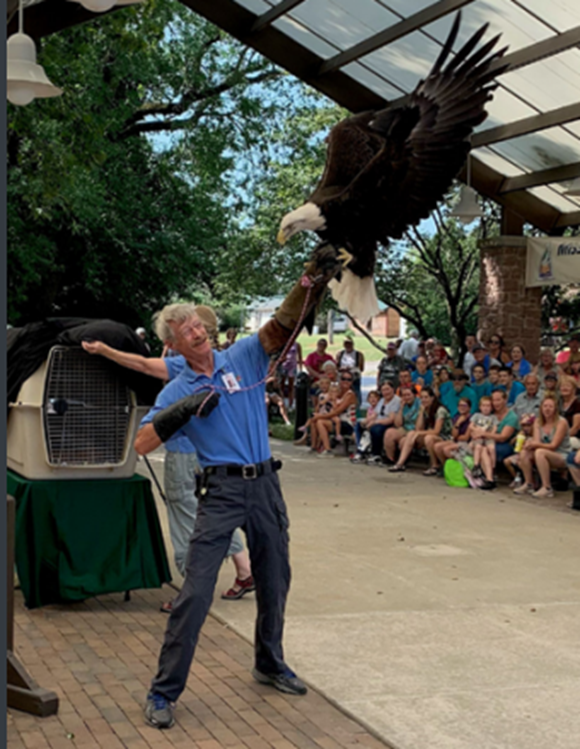
The World Bird Sanctuary will host the sale rain or shine from 10:00 a.m. to 2:00 p.m. The World Bird Sanctuary has an entry fee of $12 per vehicle that all plant sale customers will have to pay to enter. Enjoy the magnificent live birds while at the World Bird Sanctuary.

River City Natives, Ozark Soul, Papillon Perennials, and Gaylena’s Garden will supply a variety of native plants for your landscaping needs.

“We are pleased to partner with the World Bird Sanctuary, who will host this native plant sale,” said Carol Davit, Executive Director of the Missouri Prairie Foundation. “Native plants—as the basis of food chains here and around the world—are critical to sustaining bird populations as well as monarch butterflies and other wildlife we all enjoy.”

Continue reading

Image

Webster Discussion On May 7: Can Popular Culture Bolster U.S. Environmental Awareness?

The Webster Groves “Eco-Ed” Series continues its 2024 program with a discussion of Missouri environmental issues at 7 p.m. Tuesday, May 7, at the Webster Groves Public Library.

Environmental Missouri author Don Corrigan will present issues and discuss how movies like Erin Brockovich, Day After Tomorrow and The China Syndrome have raised public awareness on environmental issues.

The contention that popular culture can play a role in saving the planet from environmental mayhem and degradation was taken up at the annual conference of the national Popular Culture Association/American Culture Association in Chicago in late March.

Movies, novels, youth books promoting sustainable living, environmental streaming services, cable series programming – are all contributing to increased public awareness of environmental issues, according to a PCA session on “Ecology and Culture: Coping with a Changing Planet.”

Continue reading

Image

Saint Louis Zoo’s Mike Dawson: Local Frogs’ Best Friend

Photo by Ursula Ruhl

By Jess Holmes

It’s thanks to the Saint Louis Zoo’s Michael Dawson that spring peepers, chorus frogs, and cricket frogs are still on the map ­— literally. Dawson’s creation and maintenance of the FrogWatch chapter known as the Spring Peeper Program in St. Louis has put these small, but noisy creatures back on conservation radar.

Statewide, these critters are not near extinction, but Dawson explores the effects urbanization has had on their significant population loss in the St. Louis area, while also encouraging the community to get involved in reversing their decline.

“I started looking at data collected by citizen scientists, species by species. One of the patterns I recognized is that certain species were almost completely absent inside of I-270. Whereas you go three minutes outside of I-270, they show back up on the observation maps,” Dawson said. “Some frog species are unaffected by urbanization, but the spring peepers, chorus frogs, and cricket frogs all seemed to be.

“I wanted to see if the citizen-collected data was true, and the Zoo encouraged me to put a project together. So, I did. After getting it approved and funded, I started setting up acoustic surveying devices around the St. Louis area,” Dawson explained. “Over the last three years, I found that the citizen scientists were right.”

The Saint Louis Zoo FrogWatch program stems from an even larger effort, FrogWatch USA. The Akron Zoo manages the national program. The mission is to build a community to help the frog and toad populations across the United States. Thanks to smartphones, this has become even easier.

“If you’re out in the field and have a phone, you can record a frog’s call,” Dawson said. “Recording calls is even better than using photos because I can download it, put it through my software, and can determine what species it’s from. Plus, it’s timestamped and GPS coded. It’s no different than the recording devices I leave out on trees.”

Continue reading

Image

Feel Like A Kid Again At MDC’s Camp Hellbender

MDC’s Camp Hellbender returns in 2024 during June and July to make grownups in the St. Louis region feel like kids again.

Everybody grows up eventually.  But being adult doesn’t mean a person can’t still be a kid . . . at least sometimes.

The Missouri Department of Conservation (MDC) is inviting adults in the St. Louis region to become kids again and experience a bit of what it felt like to be out of school for the summer, one more time.

MDC is hosting Camp Hellbender 2024, a series of nine events in June and July for those age 18 and over that recreate the fun of a day at summer camp.  Camp Hellbender returns after proving to be an extremely popular series of events in 2023.  Each camp session is free and will be held at a different MDC site in the St. Louis region.  Adult summer campers can register for one session per location, at as many sites as they wish.  Each session will have a different agenda of activities that will highlight the resources its location has to offer.

“This summer camp is designed to let adults feel like a kid again and have fun in the outdoors while exploring some of the best conservation areas in the region and the unique resources each one has,” said MDC Naturalist, Sabrina Hansen.

Continue reading

Image

Battle Against Invasive Asian Carp Continues

Photo by MDC Staff, courtesy Missouri Department of Conservation.

By: Zoe DeYoung

A billion dollar project to prevent invasive Asian carp from entering the Great Lakes is set to begin construction this year, but don’t feel too bad for the nuisance fish.

The species has been wreaking havoc throughout the Mississippi River Basin, out-competing native fish for living space and resources since the 1980s.

Pictured: Jill Moon

Longtime Alton Telegraph reporter Jill Moon first heard of the invasive carp issue at a 2009 city council meeting in Grafton, a river town where the Illinois River acts as a perfect feeder for breeding carp.

Three entrepreneurs presented a plan at the meeting to capitalize on the carp. “They thought they had a good money making venture,” Moon said.

The plan involved an Asian carp processing plant. It got the green light. Moon was on the story from there: if you have lemons, make lemonade; if you have carp, put them on the menu.

“When I went to these city council meetings, they would have the boring stuff like, ‘The Street Department fixed Oak Avenue.’ A factory to make Asian carp byproducts stood out to me. And I already knew that the Asian carp was a problem,” Moon said.

A problem not only for native aquatic life, but for boaters. Asian carp tend to feed at the water’s surface and are very easily disturbed. When agitated by a boat propeller or even a sculler’s oar, they can jump up to 10 feet in the air. Think popcorn, but instead it is hundreds of soaring fish.

“Certain times of year when they are spawning, the Asian carp will jump out of the Illinois River. They’ve jumped in boats before, and they’ve accidentally given bloody noses,” Moon explained. “They’re a nuisance species,” Moon added. “So that just struck a nerve in me to find out more.”

The Grafton-based American Heartland Fish Products plant was the brainchild of those entrepreneurs at the meeting Their plan came to fruition, soon processing as much as 60,000 pounds of carp a day, as well as fish oil, fish meal and a funky smell.

The odor began to bother residents, so much so that the plant was given 30 days to address the stink. Ultimately, the plant went kaput.

Continue reading

Image

Meramec College Event: Area Tree Celebrations Blossom In Month of April Showers

STLCCM Arbor Day, Carrie Coyne with Horticulture students. Photos by Robert Weaver.

by Don Corrigan

April showers may bring May flowers, but April 2024 has brought an abundance of events honoring trees in the St. Louis area. Missouri is celebrating both a state and a national Arbor Day on the April calendar.

On the state-designated Arbor Day of April 5, a crowd at the Meramec campus of St. Louis Community College in Kirkwood enjoyed the addition of a new oak species to the campus oak collection.

The Missouri native swamp chestnut oak was the gift of Bill Ruppert, who is with the school’s Horticulture Program Advisory Committee. Horticultural student Abigail Andrews expressed appreciation for the tree addition.

“This ceremony today means so much to us, because trees are so important,” said Andrews, an Oakville resident. “To plant a tree is to do something for posterity.

“Trees are all about future generations,” added Andrews. “We don’t plant them just for us, but more for the coming generations who will enjoy them.”

Continue reading

Image

Environmentalist Says: “We All Live In A Watershed”

Environmentalist David Wilson, an expert on watersheds and wetlands, surveys Shady Creekin suburban St. Louis. Photo by  Ursula Ruhl.

by Jack Farish

The creeks and streams of St. Louis play crucial ecological roles and can provide social and economic benefits to the communities on their banks. Unfortunately, due to intervention, watersheds can be damaged and their natural beauty destroyed. Local watershed expert David Wilson can teach us a lot about watersheds, how they should function, and how we can change our ways to encourage their survival.

Wilson began his academic career as a student of history. As a graduate student, Wilson studied Chinese history at Washington University in St. Louis and had an opportunity to spend two years abroad in Hong Kong.

“It’s a very crowded city,” said Wilson. “When I was there in the 1970s, there were 4 million people living in Hong Kong”

Due to a combination of drought and political tensions in China, Hong Kong was neither able to collect nor trade for the water needed by its growing population.

“They limited the water to four hours a day,” Wilson recounted. “Then they limited it to four hours every two days – that’s all the tap would run. Then it was four hours every four days. If you live in an environment like that, you become very aware of your environment and where your water comes from.”

That awareness grew into a concern for environmental issues. When Wilson returned to St. Louis, he began volunteering, and eventually working for, the Missouri Coalition for the Environment, taking on a variety of different issues. For the last fifteen years, Wilson has worked as a water quality and watersheds specialist with the East-West Gateway Council of Governments – the metropolitan planning organization of greater St. Louis.

In addition to working to address environmental issues directly through these organizations, Wilson has strived to get the word out on issues he is passionate about. He has taught sustainability at Webster University and organized tours of local watersheds.

The first lesson of watersheds is that everyone lives in one, according to Wilson. “A watershed is not the river,” Wilson said. “It’s not the river and the river banks or the floodplains around it. The watershed is everything that drains into the river. Everybody’s in a watershed.”

This means that the responsibility to manage watersheds in an effective and sustainable way falls not only on the communities right along river banks but on all of us. Unfortunately, human-managed watersheds are often far from naturalistic.

Continue reading

Image

The Wild and Scenic Film Festival, April 10

The Wild & Scenic Film Festival shares an urgent call to action, encouraging all of us to learn more about what we can do to save our threatened planet. Showcasing films from directors across the country, the Festival inspires environmental activism and a love for nature through film.

Join Great Rivers Environmental Law Center as we premiere a selection of environmental short films designed to inspire and educate. The event is free and open to the public with tickets first available to existing donors. The event will be held at Chase Park Plaza Cinemas, 212 Kingshighway Boulevard, St. Louis, MO 63108.

Attendees will have the opportunity to meet representatives from Great Rivers to learn more about how we ensure compliance with the environmental laws that protect us.

We support and value the work that the Great Rivers Environmental Law Center does to protect Missouri’s natural resources. We’ve partnered with them to present a series of short films at the Chase Park Plaza Cinema in St. Louis.

Click HERE for all the information you’ll need. The code to register is, of course, Magnificent.

Image

Brews & Blooms Event with Grow Native! and Civil Life Brewing Company

The Grow Native! program of the Missouri Prairie Foundation will host its first Brews and Blooms native plant education event in partnership with Civil Life Brewing Co. at their South City brewery on Saturday, April 6 from 3:00 to 6:00 p.m.

Grow Native! will be offering a free native plant giveaway (one per household, while supplies last), a container gardening demonstration, and gardening advice from St. Louis native plant and landscaping experts. Grow Native! merchandise will also be for sale, including native plant garden signs manufactured in Washington, Missouri.

Continue reading

Image

Learn About Naturescaping Your Yard for Blooms, Bugs, and Birds with MDC Webcast April 10 at Noon

Join MDC to learn about Naturescaping Your Yard for Blooms, Bugs, and Birds through the MDC Wild Webcast on April 10 at noon. Register in advance at mdc.webex.com/weblink/register/r9350abfe19cf8e5c13de93d5820f7b8f.

Spring is the time when many gardeners are digging in the dirt to prepare their landscapes for the coming growing season. Whether you have a big yard or just a bit of a porch or patio, you can attract butterflies and other good bugs along with birds through naturescaping with native blooms.

Planting native plants can help the garden grow by attracting native bees, birds, and butterflies as pollinators. And many fruit and vegetable plants produce better from pollination by some of Missouri’s hundreds of species of native bees and butterflies.

The Missouri Department of Conservation (MDC) invites anyone interested in gardening, landscaping, native plants, and native pollinators to join its free, online Wild Webcast on “Naturescaping Your Yard for Blooms, Bugs, and Birds” on Wednesday, April 10, from noon to 1 p.m.

Continue reading