
Screenshot of My Park Story website.
The National Park Service celebrates its centennial this year! Here is fun and interactive way to be part of the story by sharing your personal adventures and memories from our National Parks.
Screenshot of My Park Story website.
The National Park Service celebrates its centennial this year! Here is fun and interactive way to be part of the story by sharing your personal adventures and memories from our National Parks.

Bob Criss inside a flood gate at Valley Park. Outside the gate, MSD’s sewage treatment plant was disabled by flood water. photos by Ursula Ruhl, Webster-Kirkwood Times.
Six months after a Meramec River flood left millions of dollars in damage to cities along its banks, the finger-pointing continues – with much of it directed at Valley Park’s levee.
Critics contend the levee is built beyond its authorized height. The extra height resulted in flood waters of unprecedented volume and speed, causing destruction in Fenton, Sunset Hills, Kirkwood, Arnold and more.

A female Feral Hog is caught on a snare in a wood near Taum Sauk Mountain in Ironton County, MO. Photo by MDC Staff, courtesy Missouri Department of Conservation.
The Missouri Conservation Commission approved changes to prohibit the hunting of feral hogs on lands owned, leased or managed by the Missouri Department of Conservation (MDC) beginning September 30, 2016.
The new regulations do not apply to privately owned property in Missouri.
The new regulations are in response to a public comment period, research from other states, and issues with efforts by MDC staff to trap and eliminate groups of the feral hogs, according to information contained in an MDC press release.
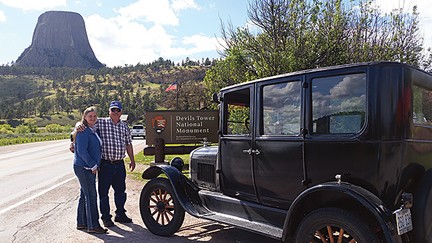
Steve and Diana Thum of Webster Groves alongside their Touring Model T. Photos provided by Steve Thum.
Environmental Echo is celebrating the 100th Anniversary of the National Park Service and our national parks by periodically posting stories about how much people enjoy these environmental assets with their natural beauty and abundant wildlife.
This story features the head of the St. Louis Model T Club and hits adventures driving his Model T through some of our great national parks.

Pamela Braasch, SLSC education director and the GROW exhibit operations manager. All photos by Holly Shanks.
By Holly Shanks
Pass by the front lobby, the ticket lines and concession stands, and the watchful predatory eye of the T-Rex, and you’ll find a different kind of exhibit at the Saint Louis Science Center. It’s an exhibit, complete with chickens, vegetable gardens and tractors, and it tells the modern-day story of how our food makes it from a farmer’s hands all the way to our dinner table.

Photo credit: NPS
The National Park Service celebrates its centennial this year! Here is another look at some interesting facts inside our National Parks.

GROW, the newest exhibit at the Saint Louis Science Center. The exhibit opened June 18, 2016. Photos by Holly Shanks.
Here is a look at the sights you’ll find at GROW, the newest exhibit at theSaint Louis Science Center. The exhibit opened June 18, 2016.
Check back soon for Environmental Echo’s latest article that will have insights about the exhibit, what it took to bring the exhibit to life, and the collaboration between scientist and local farmers that brought accuracy and truth to the story of local agriculture.
See more photos from the GROW exhibit by visiting Environmental Echo’s new Facebook page HERE. Be sure to “like” our new Facebook page!
 A new state park is about to open. Echo Bluffs State Park, located in Eminence, Missouri, opens July 30. The Park will host a campground and lodging choices, which are now accepting reservations. Find more information from Gov. Nixon’s press release outlining the park’s features below.
 The EPA announced that Meramec Caverns is approved to open tours in the upper level of the caverns as of June 10, 2016.
Find the EPA Region 7 announcement that includes a list of controls that have been implemented in the caverns HERE.
The show cave closed on March 10, 2016, because of unsafe levels of TCE fumes. TCE is an unsafe solvent used in manufacturing of metals, like vehicle parts. The contamination most likely originates from Sullivan, Mo, four miles away from a landfill and the former TRW/Ramsey facility, according to the EPA.
Learn more about the contamination from an earlier Environmental Echo podcast report that can be found below.

Something about Don fits right in with the 100th Anniversary Celebration of the NPS.
 Environmental Echo