Category Archives: Outdoor/Nature

Image

Promoting State Nature: Missouri Outdoor Communicators Revving Up For Year 2026

by Don Corrigan

Since 1994, members of Missouri Outdoor Communicators have been telling great nature stories, snapping great photos, as well as just plain promoting the great outdoors. They’ve been making their mark for more than 30 years, and they’re revving up for a great 2026.

“MOC is a group of professional journalists, authors, bloggers, photographers, videographers, biologists, naturalists, companies and communities intent on celebrating all the outdoor adventures that can be enjoyed in Missouri,” said Kyle Stewart, long-time MOC Board Member.
According to Stewart, the mission of MOC is to advance knowledge of natural resources and related recreational pursuits, to improve MOC members’ communications skills, to promote the outdoors, to encourage appropriate use and conservation of natural resources.

Of course, another mission is to attract and to mentor the next generation of outdoor communicators. The need for a new generation to treasure the outdoors and to take up the efforts of MOC is critical.

“MOC is about championing the great outdoors and all its beauty, inspiration, and life lessons,” Stewart said. “It’s about building meaningful professional relationships and lasting personal friendships while fostering healthy communications.

“It’s also about spending time in both familiar and unfamiliar environments and learning new tips and techniques along the way,” he added. “MOC is about protecting and promoting the things that mean the most to us – the natural world and its inhabitants.”

For more information about MOC or joining the group, please call Kyle Stewart at 573-619-3296 or email him: kylewaynestewart@gmail.com. He and other MOC members will gladly assist you.

Image

MEEA Eyes 2026 Projects: Environmental Educators Celebrate Three Decades Of Projects


by Don Corrigan

Environmental educators in Missouri have been organized for 30 years to promote nature and outdoor education for children. They also have worked to be protectors and caretakers of the environment.

They’ve started many environmental initiatives in their three decades. They’ve seen good times and bad times. These are challenging times, and they concede 2026 may be just a year for holding their ground.

“As caretakers of Missouri’s environment, we have many challenges ahead of us – funding is limited, environmental protection policies and support for education are on shaky ground, and many Missourians are just struggling to make ends meet,” said Jamin Bray.

Bray of Salem, Mo., is co-director of the Missouri Environmental Education Association (MEEA), along with co-director Lesli Moylan of Kirkwood, Mo. in suburban St. Louis

“So, we intend to be even more strategic, focused and efficient moving forward into 2026,” said Bray. “MEEA will soon have a new 3-year Strategic Plan that will continue to  provide the very best environmental education services possible.”

Continue reading

Image

Cheetah Cubs Make Public Debut at Saint Louis Zoo

Photo courtesy Saint Louis Zoo

Four-month-old quintuplet cheetah cubs—Asha, Bozzie, Chirpa, Milani and Wickett—are now making public appearances at the Saint Louis Zoo. The cubs and their mother gained access to the cheetah habitat at River’s Edge starting, Sept. 17, 2025. The cheetah cubs will be visible for extremely limited hours over the next several weeks as they adjust to their new space. Cora and her quints will frequently have access to their public habitat first thing in the morning (typically between 9 and 10 a.m.). The Zoo is open from 9 a.m. to 5 p.m. daily, but there are no guaranteed times when the cubs will be visible.

The quintuplet cheetah cubs were born May 5, 2025, to first-time parents Cora, age 4, and Vader, age 8, and were soon dubbed “Cora’s Quints.” In their first months of life, the cheetah cubs have bonded closely with their mother and each other behind the scenes in a private habitat at the Zoo. The Animal Care Team has gradually introduced them to new enrichment and experiences to aid their development and prepare them for public debut.

Continue reading

Image

MDC will remove invasive carp from Platte River

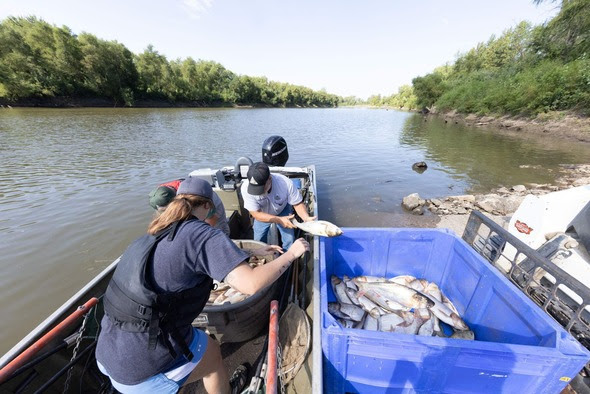
Invasive carp removal efforts, as photographed above, aim to combat the overpopulation of fish that outcompete native species for resources in Missouri waters. MDC will close Schimmel City Access on Sept. 8-11 and 22-25 to continue this work on the Platte River. Photo: MDC

The Missouri Department of Conservation (MDC) is conducting an invasive carp removal on the Platte River. This effort will seek to inform management of invasive carp populations in the state’s big rivers and their smaller connected rivers and creeks. On Sept. 8-11 and Sept. 22-25, MDC will close the Schimmel City Access for the fish removal project. The access is located in Platte County, just north of Farley, Mo. The project is being conducted in partnership with the U.S. Fish and Wildlife Service.

Crews will be removing the carp from the river, and a commercial fishing operation will then process the fish into various products such as a protein additive for animal feeds and for prepared fish bait for anglers.

Removal efforts like this project have potential to increase the available food and habitat for native fish in the Platte River such as buffalo, multiple catfish species, and the many smaller fish species that are part of the ecosystem. The invasive carp tend to spawn during periods of high water, and both young and mature carp congregate in the slower feeder streams and in the nutrient-rich water of deep pools. Continued work in those areas has the potential to remove large numbers of invasive carp for the betterment of the native species competing for resources in those areas.

Invasive carp reproduce prolifically and grow quickly to sizes too big for native predator fish to consume. They filter food and nutrients from the water that are needed by the many fish species native to the rivers, including those popular with anglers. One invader, silver carp, grow to large sizes and leap from the water when startled, and they can seriously injure boaters. The removal will target silver, bighead, grass, and black carp. Any other fish species captured will be measured and released as part of research and monitoring of the river’s fishery.

MDC has fish population sampling data from prior years and populations will be sampled after the carp removal. Biologists will monitor how native fish populations respond and how quickly invasive carp re-populate the stream section.

Continue reading

Image

41st Birthday Bash Planned For Anti-litter superhero Peanut the Turtle (8/31 Powder Valley)

Powder Valley Nature Center is celebrating Peanut the Turtle’s 41st birthday with a free Birthday Bash Saturday, August 23, from 10 a.m. – 2 p.m. The famous, figure-eight turtle has been an anti-litter superhero for nearly 40 years. Photo by John Miller.

There was more than one famous turtle to hit the scene in 1984.  That was the year comic book artists Kevin Eastman and Peter Laird first published their iconic creations, the Teenage Mutant Ninja Turtles.  The reptilian superheroes heroes skyrocketed to fame that year soon after their comic book debut.

Another famous turtle crusader entered the world in 1984—Peanut the Turtle.  Her mutation didn’t come about from a mutagenic ooze; she was transformed into a litter fighting superhero by a cast-off plastic six-pack ring.  And she’s been a real deal trash basher for 40 years.

Peanut is turning 41 years old, and the Missouri Department of Conservation (MDC) is throwing her a Birthday Bash. The party is happening at Powder Valley Conservation Nature Center Saturday, Aug. 23, 10 a.m. – 2 p.m. It’s a free event and open to all ages.

Continue reading

Image

Explore One of Missouri’s Remaining Lowland Swamp and Bottomland Forest

Some of the Allred Lake Natural Area’s bald cypress trees (shown here) are estimated to be over 500 years old. Photo: MDC.

The Missouri Department of Conservation (MDC) invites Missourians and visitors to explore Allred Lake Natural Area (NA) — home to one of the best remaining examples of lowland swamp and bottomland forest habitat in the state.

Located in the Bootheel region of Missouri, the area spans a diverse and ecologically rich landscape, including a 76-acre portion designated as a Missouri Natural Area. This designation recognizes the area’s exceptional educational and scientific value, and MDC actively manages the site to preserve its unique plant and animal communities.

“Allred Lake is a rare and beautiful reminder of the swampy wilderness that once covered much of southeastern Missouri,” said MDC Conservation Agent Clarissa Stroder. “It’s an outstanding place for nature study, birding, and quiet appreciation of some of the state’s oldest natural features.”

Continue reading

Image

MDC Reminds the Public to Keep Wildlife Wild This Summer

Photo courtesy the Missouri Department of Conservation.

As Missouri families head outdoors to enjoy the beauty of summer, the Missouri Department of Conservation (MDC) is reminding everyone to appreciate wildlife from a distance and keep wild animals wild.

With warmer weather, you may encounter young wildlife such as racoons, baby birds, rabbits, and other animals that may appear to be orphaned or abandoned.

“Human interference, even with good intentions, can often do more harm than good,” said Russell Duckworth, MDC protection regional supervisor. “It’s natural to want to help when you see a baby animal alone. But what many people don’t realize is that in most cases, the young are not abandoned, and their mothers are usually nearby, watching and waiting for humans to leave so they can safely return.”

MDC reminds the public that picking up, feeding, or attempting to care for wild animals not only disrupts their natural behaviors but may also violate state wildlife laws.

“Missouri law prohibits the possession of many species of wild animals without a valid permit,” said Duckworth. “Removing a wild animal from its environment can lead to serious consequences for both the animal and the person. It’s also important to remember that wild animals can carry diseases and parasites that pose risks to people and pets.”

MDC recommends observing wildlife from afar, since wild animals can become dangerous as they mature. Although it is tempting to take them into homes, the best help people can offer wild animals is to leave them alone. It’s also best to secure trash and avoid feeding wildlife.

“When people feed wild animals, either directly or by leaving out pet food or unsecured garbage, they’re encouraging unnatural behaviors that can lead to animals becoming aggressive or dependent,” said Bridget Jackson, MDC regional recreational use specialist. “It’s essential that wild animals remain wary of humans for their own safety.”

To help Missourians better understand how to responsibly interact with nature, MDC offers educational materials, public workshops, and online resources at mdc.mo.gov.

If you encounter wildlife that may be injured or truly orphaned, contact your local MDC office before taking any action.

“The best way to help wildlife is to let wild animals stay wild,” added Jackson. “Observing nature is a wonderful part of summertime in Missouri. By keeping our distance and respecting wildlife, we can all play a part in conserving the state’s natural heritage.”

For more information about Missouri wildlife or to report concerns about wild animals, visit MDC online at mdc.mo.gov or contact your local MDC office.

Image

Lone Elk Park Welcomes Two Baby Bison Calves

Saint Louis County is excited to announce the birth of two bison calves at Lone Elk Park. The two calves were born overnight on May 6, 2025.

The arrival of the calves marks the beginning of a new chapter for the park’s bison herd and a special opportunity for visitors to witness native wildlife in action.

The reddish-orange calves can be seen trailing closely behind their mothers in the bison pasture. While the new arrivals are a heartwarming sight, park officials urge visitors to remain in their vehicles and observe all wildlife from a safe distance.

“These calves are a sign of a healthy herd and a successful habitat,” said Pat Curry, Park Supervisor at Lone Elk Park. “They’ll spend the next few months bonding with their mothers and gradually gaining independence. It’s a special time for the herd, and we’re thrilled to share it with the public.”

Lone Elk Park is a unique, free drive-through wildlife experience operated by St. Louis County Parks and Recreation. It is home to bison, elk, deer, and other native species. The park is open daily from 8 a.m. to sunset.

Visitors are welcome to enjoy the park’s scenic views but are reminded to follow all posted guidelines and avoid approaching or feeding wildlife.

Image

Missouri House Passes Invasive Plant Bill

On May 15, one day before the close of the 2025 Missouri legislative session, the Missouri House of Representatives passed Senate Bill 105 to halt the sale of select invasive plants by a vote of 124 to 19. A similar bill, House Bill 60, was introduced and passed by the House Natural Resources Committee during this session as well, but was not brought up for a floor vote.

“The Missouri Invasive Plant Council is extremely pleased with this wonderful news, and thanks Missouri legislators for their support of this bill that will help protect Missouri’s working lands and native habitats,” said Carol Davit, Missouri Invasive Plant Council (MoIP) Chair.

Several years ago, MoIP, administered by the Missouri Prairie Foundation, proposed the idea of legislation to cease the sale of select invasive plants to reduce their negative impacts on Missouri’s landscape. MoIP invited feedback from nearly 100 stakeholder groups, and tabulated feedback that was received to assess opinions in support or against inclusion of specific invasive plants on eventual state legislation.

Continue reading

Image

Hoessle’s Backyard Albinos: White Squirrels Touted As Tourist Attraction For Olney, Ill.; Local Resident Has No Need To Travel So Far

All photos provided by Charlie Hoessle.


by Don Corrigan

Travelers over the Mississippi River from Missouri to Illinois are greeted with a billboard urging them to drive 140 miles to see the white squirrels. Charlie Hoessle can visit with the albino critters right in his south St. Louis County backyard.

Hoessle is best known to St. Louisans for his past work as director of the St. Louis Zoo. In that position, he became familiar with deadly snakes of Asia, lumbering giraffes from Africa, and poisonous frogs of South America – as well as other exotic animals.

Now retired, Hoessle is content these days with simply tracking the feisty squirrels in his Sunset Hills neighborhood. However, these are not just your average, ordinary, run-of-the-mill squirrels. These are the relatively rare white squirrels of North America.

Hoessle has no need to travel miles to see his favorite white squirrels. He can just amble out the back door of his home.

“We have had white squirrels in our back yard for about five or 6 years now,  but not always the same ones,” said Hoessle. “The first one I named ‘Spirit.’ He was a daily visitor to my patio bird feeder.”

Hoessle has a fond place in his heart for ‘Spirit.’ However, he welcomes the new white squirrels to his location, and he often has his camera or cell phone ready to snap pictures of the bushy tails.

“I loved Spirit because he was not afraid of me,” said Hoessle. “He loved to bask on our crab apple tree and just relax. Sometimes I spread cracked corn on my patio for him.”

Continue reading