Category Archives: Environment

Meramec Bridge Plan: GRG Proposal To Link Unger And Greentree Park With Trail Bridge Brings Backlash

Bottomland trees (e.g. Sycamore, Elm) in Greentree Park, near proposed bridge. GRG describes trail (far-right) as; “Travels through the riparian forest along the Meramec River. This wooded area helps to control sediment in water, reduce damaging effects of flood and prevents riverbank erosion and provides food, shelter and water for diverse wildlife.” Why build here?

By Don Corrigan

A proposal to link Kirkwood’s Greentree Park and St. Louis County’s Unger Park is in its exploratory phase – with a formal public campaign set for this fall. However, the idea already is facing opposition.

Great Rivers Greenway (GRG) is conducting a feasibility study for a pedestrian and bicycle bridge that would connect the two parks. It also would tie together a trail network that runs along either side of the Meramec River.

“Rivers are a barrier, obviously, so this is an opportunity for people to connect across a major waterway,” said Great Rivers Greenway’s Emma Klues.

“In our studies and our surveys, people tell us they want us to work on these kinds of opportunities,” said Klues, vice president of communications and outreach for GRG. “They want these connections.”

Great Rivers Greenway representatives have been in communication with affected communities in the trail areas within their borders. According to Kirkwood Parks and Recreation Director Kyle Henke, the city has been contacted as Greentree Park is a Kirkwood Park.

The possibility of such a Meramec River Bridge was first evaluated during a flood study of Unger Park, which itself is now being redeveloped by GRG in partnership with St. Louis County.

Opponents Decry Plan

Among those opposing the GRG bridge plan are environmentalists like Linda Fenton of Kirkwood and Scott George of Jefferson County. George and Fenton note that the increasingly violent floods in the area are problematic.

Higher flood waters in the Meramec, and torrents that rip away the shore land, make a new bridge dicey – and costly, according to these area residents. There is no shortage of evidence of river bank erosion.

“The Meramec River requires ever wider channels and riparian zones to handle the ever-increasing frequency and magnitude of floods,” said George. “These are being caused by urban land use and climate changes.

Greentree Park pavilion destroyed by spring 2025 floods.

“Any structure built to withstand these mega-floods will need to be massive and expensive, with piers to bedrock, large riprap, diversion structures and more,” said George. “ADA compliance will require low-slope ramps on both sides of river, and they also will require protection.”

Fenton of Kirkwood also mentioned the flooding issue. Damage to structures at Greentree, Emmenegger, and Minnie Ha Ha parks along the Meramec River this past fall and spring has alarmed park officials at those sites.

Continue reading

Image

Missouri House Passes Invasive Plant Bill

On May 15, one day before the close of the 2025 Missouri legislative session, the Missouri House of Representatives passed Senate Bill 105 to halt the sale of select invasive plants by a vote of 124 to 19. A similar bill, House Bill 60, was introduced and passed by the House Natural Resources Committee during this session as well, but was not brought up for a floor vote.

“The Missouri Invasive Plant Council is extremely pleased with this wonderful news, and thanks Missouri legislators for their support of this bill that will help protect Missouri’s working lands and native habitats,” said Carol Davit, Missouri Invasive Plant Council (MoIP) Chair.

Several years ago, MoIP, administered by the Missouri Prairie Foundation, proposed the idea of legislation to cease the sale of select invasive plants to reduce their negative impacts on Missouri’s landscape. MoIP invited feedback from nearly 100 stakeholder groups, and tabulated feedback that was received to assess opinions in support or against inclusion of specific invasive plants on eventual state legislation.

Continue reading

Image

Spring Floods Take Toll: Meramec Basin, Riverway Towns, Park Sites Hit Again  

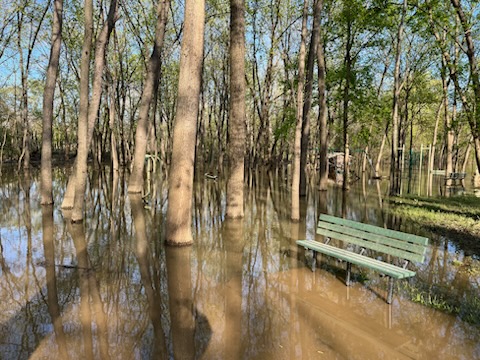
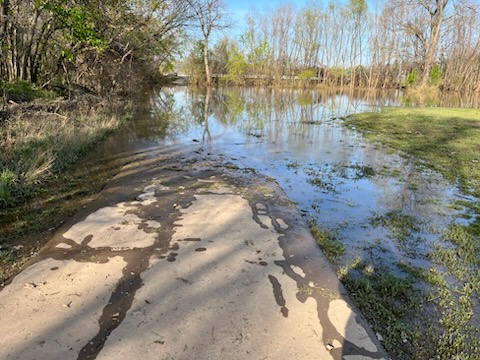
All photos: Minnie HaHa Park.

by Don Corrigan

For the second time in less than six months, eastern and southern Missouri have been hit with record floodwaters. Stretches of roadway were closed at Meramec Bottom, Hawkins, Butler Hill, Smizer Mill and Pritchard Farm roads

The early April storms were a repeat of a November scenario when flooding severely damaged state and local parks and closed highways. Sandbags once again found use in some river towns along the lower Meramec and its tributaries.

A fatality occurred this time around when a 16-year-old junior firefighter was on his way to a water rescue and lost control of his vehicle. Chevy Gall was killed on Highway 50 near MO-185 on April 4 in the midst of heavy rains.

Gall was remembered April 12 in a ceremony in Franklin County’s Life Stream Church after being killed in the crash. Firefighters in the Beaufort-Leslie Fire Protection District had high praise for Gall and his dedication to rescue and responder work.

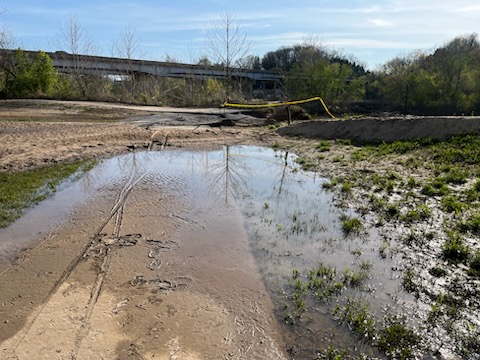
Heavy rains and flash floods hurt river site parks and also scoured riverbeds. The torrential rains and high water damaged stream beds and caused unprecedented erosion at some locations.

Only ducks, frogs, and their tadpole spawn were happy with standing water that covered bike and hiking trails for days. Greenway trails in Kirkwood, Fenton and Valley Park were especially hit hard.

In the St. Louis region, drivers in the Valley Park-Fenton area were once again frustrated when roads closed part of Highway 141 near I-44 due to the flooding Meramec River. Horses had to be moved to higher ground at nearby riding stables.

Marshall Road in Valley Park went underwater as did riding trails along the Meramec in Eureka. Minnie Ha Ha Park in Sunset Hills suffered severe damage to its shoreline with trails and facilities washed out.

Recovery work at Minnie Ha Ha was yet to be completed from November washouts on park trails. This month’s storm waters took out tables, fencing, picnic areas and washed out a major piece of trail along the Meramec River.

For more information on state parks and historic sites, visit mostateparks.com. Missouri State Parks is a division of the Missouri Department of Natural Resources.

Image

Safety, Aesthetic Issues: Billboard Lobby Calls Highway Visual Clutter Study A Waste

Billboards on interstates 44, 55, 70 and 65 are ubiquitous with the roadway on I-65
between Springfield and Branson being one of the most cluttered in the nation.

by Don Corrigan

Missouri’s rank as 6th among states with the most billboards is once again drawing scrutiny. Concern comes as state officials eye the continuing $2.8 billion project to widen Interstate 70 between Wentzville and Kansas City.

Scenic Missouri President John Hock is urging legislators to commit to a serious study on safety issues, as well as the aesthetic impact of so many billboards along the 250-mile highway from St. Louis to Kansas City.

Hock notes that I-70 is called the “Main Street of Missouri” as part of the vital 2,200-mile interstate. I-70 has a significant footprint in nine states. Missouri has 3.64 billboards per mile along its I-70 corridor.

This is 2.5 times the average of its adjacent neighbors. Missouri has a billboard problem, according to Hock. He said Missouri’s “Main Street” travelers are not only deprived of natural beauty, but distracted driving caused by billboards puts them in danger.

John and Marilyn Hock are in the fight against highway billboards for the long haul.

Several legislators, both Democrat and Republican, agree with Hock that now is an opportune time to take a look at billboard clutter in the state. Proposals include a moratorium on the signage and hikes in billboard placement fees.

Billboard companies and the Missouri Outdoor Advertising Association are telling legislators that a commission to study the issue is a waste of taxpayer money. They also question any studies suggesting billboards could present traffic safety hazards.

Many Missouri legislators have spent thousands of election dollars on their own billboard advertising to improve their facial recognition among voters. Some state politicians are sympathetic to the billboard industry as a force promoting the local economy.

Hock said his organization, Scenic Missouri, has seen this rodeo before. His group tangled with the billboard industry over a Nov. 7, 2000 ballot issue. The ballot Proposition A was identified for voters as, “Save Our Scenery 2000.”

Save Our Scenery
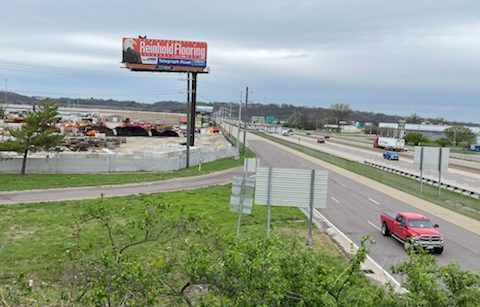
Proposition A would have ended construction of most new billboard advertising along highways; granted authority to local governments to regulate existing billboards within their communities; halted the practice of allowing billboard companies to cut down trees on public land next to highways.

Prop. A’s “Save Our Scenery 2000” was a coalition of over 70 different business, environmental and professional organizations from across Missouri. It was placed on the ballot by 130,000 citizens who signed petitions across the state.

Opponents of Prop. A were led by the Citizens Against Tax Waste Committee. The group said Prop. A would raise taxes and effectively kill small businesses relying on outdoor advertising to attract customers.

Citizens Against Tax Waste Committee also claimed that requirements for compensation to landowners and sign owners after billboard removal would cost the state $500 to $600 million.

Supporters of Prop. A fired back that the Tax Waste Committee was simply a tool for the Missouri Outdoor Advertising Association. They also said the billboard industry was attempting to mislead voters with “ridiculous” figures of up to $600 million in reimbursements required.

In the end, state voters chose to side with the billboard industry in the 2000 election. The margin was as close as could be: 51% to 49%. At the time, Scenic Missouri spokesperson Karl Kruse lamented the state had about three times as many billboards per mile as its eight neighboring states.

Kruse said Missouri was 40 years behind the times in its laws regulating billboards. Four states, Maine, Alaska, Hawaii and Vermont, have complete bans on billboards along primary highways. About 20 states have laws prohibiting new billboard construction along interstates.

Today, Scenic Missouri’s John Hock can say the Show-Me State is now 65 years behind the times in its laws regulating billboards. Hock will also insist that the organization, Scenic Missouri, has not given up the fight against billboard clutter he says distorts the natural beauty of Missouri.

Utility Bills To Increase: State Lawmakers Poised To Overturn People’s Will – Again

by Don Corrigan

Missouri legislators are once again poised to overturn the will of the people after voters made their wishes known at the ballot box. Media attention is focused on two ballot measures from Nov. 4, 2024, but another measure grabbing attention goes back to 1976.

The two most recent measures involve a minimum wage increase and reproductive rights. Conservative lawmakers want to amend the wage measure (Prop A) to exclude substantial segments of workers from an increase to $13.75 per hour from the current $12.30 hourly.

Gov. Mike Kehoe and Lt. Gov. David Wasinger are urging legislators to void provisions of Amendment 3 legalizing abortions. They say voters were misled in 2024 by special interests and Missouri must be restored “as one of the top states protecting innocent life.”

Although news headlines have focused on actions in Jefferson City to void voter approval of Amendment 3 and the minimum wage ballot measure, there is also a move to nullify a 1976 citizen vote to protect ratepayers in the state from CWIP.

Utilities, including Ameren Missouri, are lobbying lawmakers to overturn a four-decades old prohibition on “Construction Work In Progress” (CWIP). CWIP allows utilities to bill consumers to finance new plants and other construction before they’re built.

Missouri voters in 1976 said a resounding “No” to prior financing of utility plants by a 2-1 margin. That will-of-the-people vote has been under constant attack ever since.

Continue reading

Image

Deep Roots, Strong Community: Kirkwood Tells The World What A Post Oak Is On March 1

PHOTO CREDIT: Starhill Forest Arboretum.

by Don Corrigan

The term “Post Oak” means different things to different people:

• To Virginians, Post Oak is an unincorporated community in Spotsylvania.

• To folks in western Missouri, Post Oak is a community in Johnson County.

• To Texans in the city of Houston, Post Oak is a mixed-use skyscraper.

• To folks in East Texas, Post Oak is a shopping mall in College Station.

For citizens in Missouri’s Greentree City of Kirkwood, a post oak is a tree, but no ordinary tree. On March 1, the post oak will be officially and most definitively declared “Kirkwood Tree of the Year 2025.”

The post oak tree program is from 10 a.m. to noon at the Kirkwood Performing Arts Center at 210 E. Monroe Ave. Visitors can consult with tree specialists and forestry experts at information tables.

“My goal for the March 1 event is to build enthusiasm among Kirkwood residents to plant more trees,” said Kirkwood Mayor Liz Gibbons. “As everyone can see, we have been losing some tree canopy in the city.

“Holding an event to highlight the ‘Kirkwood Tree of the Year,’ and to inform citizens on the advantages of a fuller canopy, should get us to the goal of replacing lost tree canopy.”

Continue reading

Image

Atomic City Update: STL Region Can’t Wake Up From Its Radioactive Nightmare

Groups like Just Moms have advocated for radiation warning signs along contaminated creeks and streams – signs similar to these warning residents to stay out of the West Lake Landfill area.

By Don Corrigan

St. Louis has been dubbed “Atomic City” by environmental organizations across the country. And, in 2024, the St. Louis region once again got the short end of a poisonous radioactive stick due to its U.S. atomic legacy.

The nation’s atomic bomb builders have used portions of St. Louis City and County, as well as St. Charles County, as guinea pigs and as sacrificial lambs, for nuclear weapons programs dating back to World War II.

As Environmental Echo has previously reported, there has been plenty of political posturing, plenty of statements from government agencies, and plenty of nothing getting done. It’s been going on for decades with the radioactive contamination left here from America’s atomic bomb program.

In 2024, there has been plenty of talk about more testing for radioactive contamination at new land sites, more talk about testing groundwater for contamination, more talk about testing backyards and physical structures.

In 2024, there also has been plenty of talk about posting more “Danger Signs” at creeks and streams. Kids have been playing and hiking along contaminated waterways – without even the “Band Aid” of warning signs – for several generations.

Continue reading

Polar Bear Nightmare? More Record-Breaking Warmth In St. Louis In Year 2024

by Don Corrigan

When St. Louis saw its first fall freeze Nov. 26, residents thought the winter season had finally arrived. However, temperatures below 32 degrees have been scarce since Thanksgiving, and 2024 may be the hottest year ever.

Nationally, 2024 will be the hottest year in America since record-keeping began. The Year 2023 was recorded as hottest previously. Climate change is at work, according to scientists, and 2025 also is shaping up to be hot, hot, hot.

Jared Rennie, a research meteorologist at the National Oceanic and Atmospheric Administration, told NPR after Christmas this year that records for heat have been falling left and right.

“The last 10 years, most if not all of them are in the Top 10 as hottest,” Rennie noted. “So, we’re all pretty much clustered – all the recent years are pretty much clustered as the warmest on record.”

Continue reading

Image

Chirping At Mighty Cricket! Sustainable Startup Scores $650,000 In Grant Support

by Don Corrigan

Munching on crickets may not be what you have in mind with a season of Christmas cookies, salty snacks, and New Year’s Eve toasts.  However, delectable crickets are very much on the mind of Sarah Schlafly.

Schlafly is the founder of Mighty Cricket, which this season is celebrating the gift of a grant to further efforts to convert food waste into nutritious cricket feed. The $650,000 nod of support comes from a Small Business Innovation Research grant through the Department of Agriculture.

This is not the first grant that the young cricket lady has scored. Three years ago, her sustainable protein startup, Mighty Cricket, received a $50,000 equity-free grant from Arch Grants. The company competed with hundreds of applicants and was one of 35 chosen.

“We are thrilled to receive this level of acceptance here in the Midwest,” said CEO Schlafly at the of the Arch grant . “Historically, the heartland has lagged behind the east and west coasts in terms of food trends.

“Here is our chance to lead the nation and the world with food options that are better for ourselves and the planet,” said Schlafly, a resident f the St. louis suburb of Des Peres.

Mighty Cricket’s mission is to build a sustainable protein supply. According to the Food and Agricultural Organization of the United Nations, the world is projected to run out of natural resources to feed everyone on the planet by 2050.

Continue reading

Image

November Flash Floods – Storms Dump Rains: Closing Parks, Altering Ecosystems

by Don Corrigan

After an extended period of drought, historic downpours on Nov. 3 severely damaged state and local parks, closed highways and put cars underwater, and actually scoured away ecosystems crucial to fish species.

Horses enjoyed playing in high water near I-44 and Highway 141, but drivers in the area were not amused by traffic problems. Photo by Ursula Ruhl.

In the St. Louis area, drivers in the Valley Park-Fenton area were frustrated when roads closed at I-44 and Highway 141 due to the flooding Meramec River. Horses had to be moved to higher ground at riding stables near the southwest quadrant of the two highways.

Marshall Road in Valley Park went underwater as did trails along the Meramec in Eureka, Valley Park and Fenton. Minnie HaHa Park in Sunset Hills suffered severe damage to its shoreline with trails and facilities washed out.

The National Weather Service reported rain amounts in the 6 to 8-inch range in the southeast St. Louis County area on Nov. 3. However, rain amounts in the Current River watershed area exceeded one foot.

Bike and hiking trail was washed into the Meramec River at Minnie HaHa Park in Sunset Hills.

Missouri’s Department of Natural Resources reported the closure for days after the deluge of such parks as Onondoga Cave State Park near Leasburg, Meramec State Park near Sullivan and Route 66 State Park near Eureka.

Unprecedented river levels shut the Current River down to recreational activities for several days and severe damage occurred on river sites near Akers and Pulltite and Round Springs. Also shuttered were Montauk State Park near Salem and Current River State Park north of Eminence.


Damage was incurred at the trout hatchery at Montauk State Park. Fish and wildlife authorities also expressed concern over habitat destruction for Ozark hellbenders in the streams of the Ozark Scenic National Riverways.

Continue reading