
 by Don Corrigan
In a March 1 talk that focused on oak trees in Missouri and Illinois, arborist Guy Sternberg introduced an audience at the Kirkwood Performing Arts Center to the term “global destabilization.”
The term “global destabilization” is closely related to the crisis of global warming and destructive climate change. While human awareness of the destructive impacts of global warming is growing, the will to address warming and climate change is woefully inadequate.
Hence, we get “global destabilization,” which means over-heated land masses and urban cores, destruction of plant and animal life, the creation of super-cell storms, mass migrations – and the strife that results from mass relocations of people.
Trees figure into all of this. Trees suffer immensely from the destruction of plant and animal life, from the loss of habitat, from the loss of the many pollinators that make their existence possible.
Wildfires are nothing new, but increasing climate destabilization has made their ferocity and frequency unprecedented. Whole forests of trees have been lost to these fires leaving terrible scars upon the land.
Trees also suffer from global warming because it brings the migration of insect pests into areas where they have never thrived before. Some pests wreak havoc on particular species of trees, which can have catastrophic consequences.
Although trees are victims, they also can be the heroes in the growing crisis of global warming and climate change. This is because trees can mitigate the harmful effects of climate change.

Restoring lost trees is important to slowing the climate change crisis. CO2 emissions are a major culprit in climate change. Trees capture CO2 from the atmosphere and store the carbon in their leaves, stems and roots – eventually increasing the carbon stored in soil.
Six million trillion trees once grew on Earth. Humans have cut down half of them. Restoring trees and forests can achieve much in the growing climate crisis. New tree plantings and forests can help us avoid the loss of plant and animal species that call forests home.
Need For Diversification.

In his Kirkwood presentation, Sternberg cited a special champion of tree diversity, scientist Frank Santamour, known for encouraging forest growth in unpopulated areas as well as when promoting so-called urban forests.
“Santamour warned us more than 20 years ago about climate change and that global warming was coming,” said Sternberg. “He made the point that tree diversity has to become a major concern.”
Tree diversity needs to be a major concern as climate change brings pests that often target a particular tree species. If a city or county has a history of concentrating on planting one particular species, an attack on that tree by new pests can be devastating.
The elm-ash catastrophe provides a much-needed lesson to be learned in this regard. Widespread monotypic planting of the American elm in the early 20th century amplified the species’ vulnerability to the spread of Dutch Elm Disease.
The spread of Dutch Elm Disease created huge voids and magnified the sad emptiness caused in communities by widespread tree mortality. The void was not addressed in the best way.
Subsequent extensive planting of ash trees, in order to replace the lost elms, increased the ash trees’ vulnerability to the spread of the Emerald Ash Borer.
The effects of infestation by the Emerald Ash Borer involved widespread tree mortality – once again. The losses, which continue today, prove the wisdom of using a diverse tree planting palette. This offers the best solution and alternative for ending repeated catastrophic tree die-offs.
Santamour, who worked as a research geneticist at the U.S. National Arboretum, suggested a planting guideline of no more than 30% in the same plant family, no more than 20% in the same genus, and no more than 10% of the same species.
Santamour is now recognized for preaching an American ideal: our strength is in our diversity. Santamour transferred this ideal to best practices in how America plants its trees.
Top Tree Scholar
Guy Sternberg’s tree knowledge is nationally recognized. He is co-founder of Starhill Forest Arboretum of Illinois College near Springfield, Illinois. He also is founding president of the International Oak Society.
At his March 1 presentation, Sternberg applauded Kirkwood’s many tree planting activities and its initiation of a new “Tree of the Year Program.” The tree selected for 2025 is the post oak.
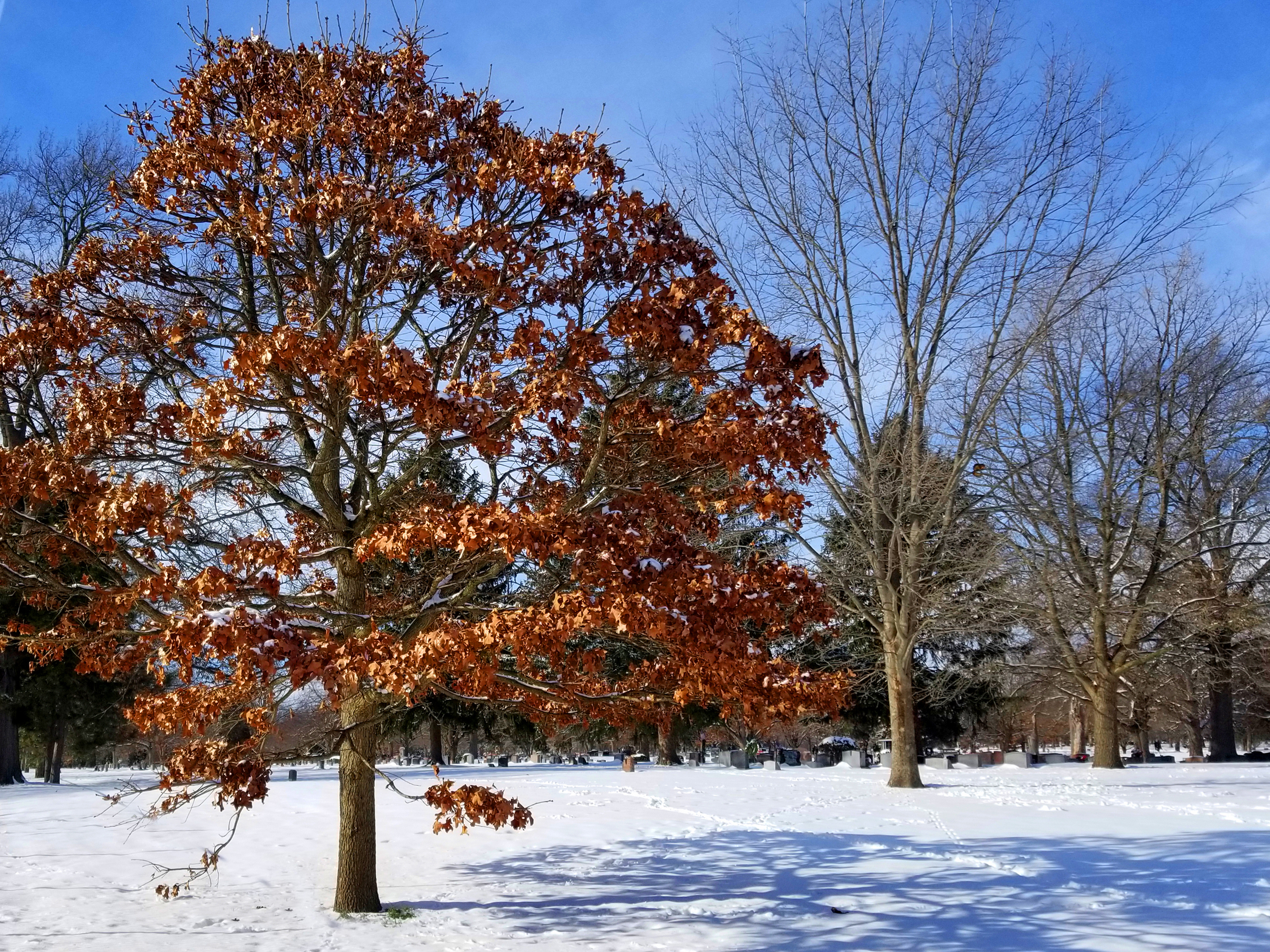
Sternberg emphasized how the post oak is “a long-lived, medium-sized, strong-wooded, beautifully fall-colored, good for wildlife, and an impervious to droughts kind of tree.”
At home in Kirkwood, the post oak tree is found spontaneously in numerous parts of the community. It is a heritage tree, thriving in large numbers in Kirkwood, and long before the city of Kirkwood was founded.
At the conclusion of his talk, Sternberg pointed out some other species that could be considered as “top trees” for future years. Those trees included the black gum, the coffee tree, gingko tree and the baldcypress.
Sternberg emphasized that supporting tree diversity and climate adaptation should be key considerations ins assessing what trees should be celebrated – and planted – in the future.
Springfield’s Sternberg is an ISA-Certified Arborist. Sternberg serves as an adjunct research associate in botany at the Illinois State Museum, and as an adjunct with the biology faculty of Illinois College.
Additionally, he is manager of the annual Oak Ridge tree tours in Illinois with 42 assistant volunteers He is author of many tree-related articles for specialized publications and several tree books, including “Native Trees of North America.”
Sternberg’s Starhill Forest Arboretum, founded in 1976, is a research and education facility placed in trust to Illinois College. Among its several thousand trees, the arboretum holds the largest oak (Quercus) research collection in North America.
 Environmental Echo