

A pedestrian was struck and killed on the evening of Dec. 14 on South Geyer Road near the signage entrance to Powder Valley Nature Center at Cragwold Road.
by Don Corrigan
A hike in human roadkill casualties in the St. Louis area at the end of 2024 is raising concerns. Pedestrians hit near the iconic Ted Drewes custard stand have led the St. Louis TV news for several years now.
Vehicles mowing over pedestrians elsewhere in the St. Louis region have received less media coverage. A hike in pedestrian deaths in the Webster-Kirkwood area at the end of 2024 is grabbing attention with the new year of 2025.
• A pedestrian, age 73, was struck and killed on Manchester Road in Des Peres on the evening of Dec. 7.
• A pedestrian, age 56, was struck and killed on South Geyer Road in Sunset Hills on the evening of Dec. 14.
• A pedestrian, age 79, was struck and killed near Manchester Road in Glendale on the evening of Dec. 27.
The recent spate of pedestrian deaths has sparked a debate on traffic safety issues in the letters pages of the Webster-Kirkwood Times. Although at times contentious, the discussions are focused on a common goal of reducing fatalities and injuries.
“From my study of these deaths, there are a number of common threads,” said Michael Carmody of Safer Streets for Kirkwood and St. Louis County. “These accidents happened at night and the lighting was poor. There were no visible crosswalks. Apparently, there were no witnesses.”
With no witnesses other than the drivers involved, Kirkwood’s Carmody said traffic reports are biased in favor of vehicle operators. Also, the reports do not detail all conditions at the time, information that could be useful later in preventing future accidents
“My belief is that with this reporting system, the fox is in the henhouse,” said Carmody. “It is designed to protect the entities involved from liability and to put the onus on the pedestrian – the pedestrian should have just exercised more caution.”
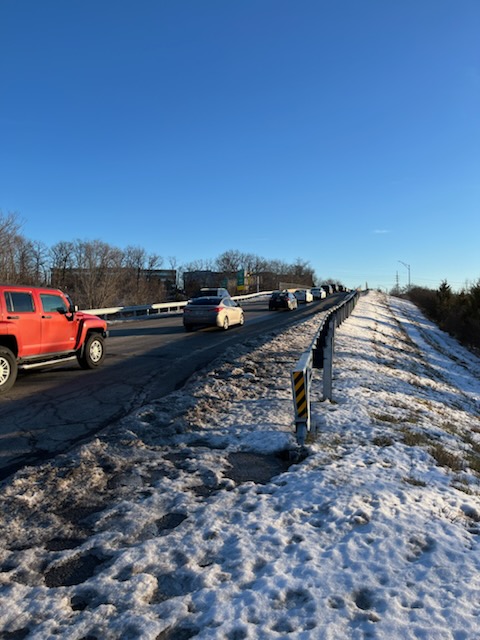
South Geyer residents complain that a sidewalk exists on the new bridge over I-44, but there are no sidewalks to assist with pedestrian safety on either side of the bridge.
Carmody said this reporting system also gives cities and counties involved a reason not to pay attention to infrastructure remedies that can be costly. Safety measures may involve more lighting, more visible crosswalks, roadway designs that promote traffic “calming” rather than speeding.
Sometimes criticized as a gadfly, Carmody has made it his business to study traffic problems with the safer streets program. The organization’s page on Facebook has attracted the attention of police, TV news media, city officials and families who’ve lost loved ones.
“I’ve been doing this for seven years,” said Carmody. “I don’t enjoy talking to next-of-kin in these accidents. But the families often don’t feel they’re getting the whole story. They want answers on safety, the drivers, the road conditions, how others can be spared what they’re going through.”
Safety Awareness Issue
Carmody’s complaints in the Webster-Kirkwood Times about lack of roadway infrastructure improvements drew a response from Alan Hopefl of Kirkwood. Hopefl has been involved with road safety issues with several city boards in Kirkwood.
“Since roadways are inanimate objects that don’t think or move, it’s hard to believe they are the root cause of crashes,” declared Hopefl. “Common sense would say the root cause of traffic crashes are people – motorists, cyclists and pedestrians.”
Hopefl suggested roadway casualties could be addressed by two of the five E’s recommended in Kirkwood’s Pedestrian and Bicycle Plan of 2015: Education and Enforcement.
Education could involve bringing back a semester of driver’s education in schools. A mandated course would cover driver regulations, defensive driving, pedestrian protections, bicycle safety and more.
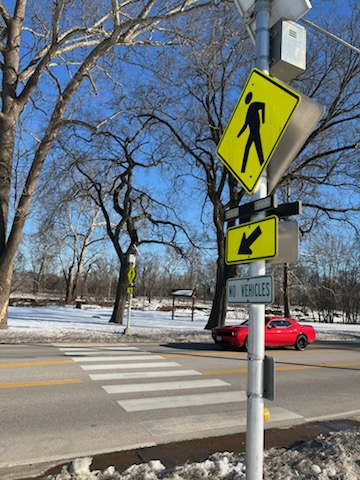
Some roads are marked with crossroad walks with flashing lights to help pedestrians cross busy roads. However, this crosswalk on the east side of Fenton Park is routinely ignored by drivers.
Hopefl also insisted that police traffic enforcement must be upped. He said anyone who drives five minutes in Kirkwood or other communities will be witness to three or four moving violations in short order.
He advocates “periodic hyper enforcement of laws” especially at highly-trafficked streets and locations where pedestrian accidents have occurred or where drivers are ignoring crosswalks.
“I’m a ‘law-and-order guy’ when it comes to traffic law enforcement,” said Hopefl. “I think it’s time to bring the cameras back for ticketing speeders and people blowing through red lights. I know there will be complaints about surveillance, but street safety is a priority.”
Hopefl said Kirkwood’s Vision Zero Committee should reconvene to put renewed emphasis on the two E’s of Enforcement and Education. He said these two safety measures may not be as showy as reflective street crossings, bike decals on the road, and bump outs, but over time the two E’s would be more effective.
Infrastructure Is Important
Carmody disputes Hopefl’s contention that many infrastructure improvements for roadway safety are just for show. Carmody argues that more lighting, reflective paint at crosswalks, and lane reductions that result in “traffic calming,” will most certainly save lives.
However, he does not disagree with Hopefl’s ideas on more education and enforcement. Any school driver’s education program should emphasize that roadways are not just for drivers and they should not be designed with just drivers in mind, he said.
“We have a major problem in that too many aggressive drivers think they own the roads,” said Carmody. “The roadways are also for pedestrians, bicyclists and people in wheelchairs.
“Unfortunately, school districts will argue that driver’s education is too costly and there’s no room for it in the curriculum given other education demands,” lamented Carmody. “What’s more important in the curriculum than saving lives?”
Carmody joins Hopefl in wanting to bring back the traffic cameras at intersections to record the dangerous, unsafe actions of lawbreakers behind the wheel. He wants roadway cameras.
“Bring them back! I know nobody likes the cameras, but they work. And they work better than when they were first installed on our roads some years ago,” Carmody said.
“Drivers blow red lights and crosswalks. Cameras would catch them and free up police to do the other work that they are required to do,” Carmody said.
An Environmental Aside
Decades ago, environmentalist Rachel Carson and other wildlife lovers were alarmed by the numbers of animal carnage on the road. Carson wrote the best-selling book, “Silent Spring,” about pesticides killing birds and other creatures.
She also noted that a growing automobile culture in America was causing roadway deaths. And, if humans were insensitive to these deaths of creatures on roadways, it would only be a matter of time before they became numb to human deaths on roadways.
A modern-day Rachel Carson, devoted to addressing the pain inflicted on the nation’s roadways, including vulnerable pedestrians, is sorely needed in these times.
In Carson’s time in 1960, there were 61 million cars operating in America. Today, there are 284 million vehicles that hit the roadways in the United States – and they also hit humans and wildlife.
Drawing on the original words of Carson regarding the cruelty of roadway carnage: “Unless we have courage to recognize cruelty for what it is – whether its victim is human or animal – we cannot expect things to be much better in this world.”
(For more about Rachel Carson and her concerns about the auto culture of her era, see Don Corrigan’s book, “American Roadkill: The Animal Victims Of Our Busy Highways.”)
 Environmental Echo