
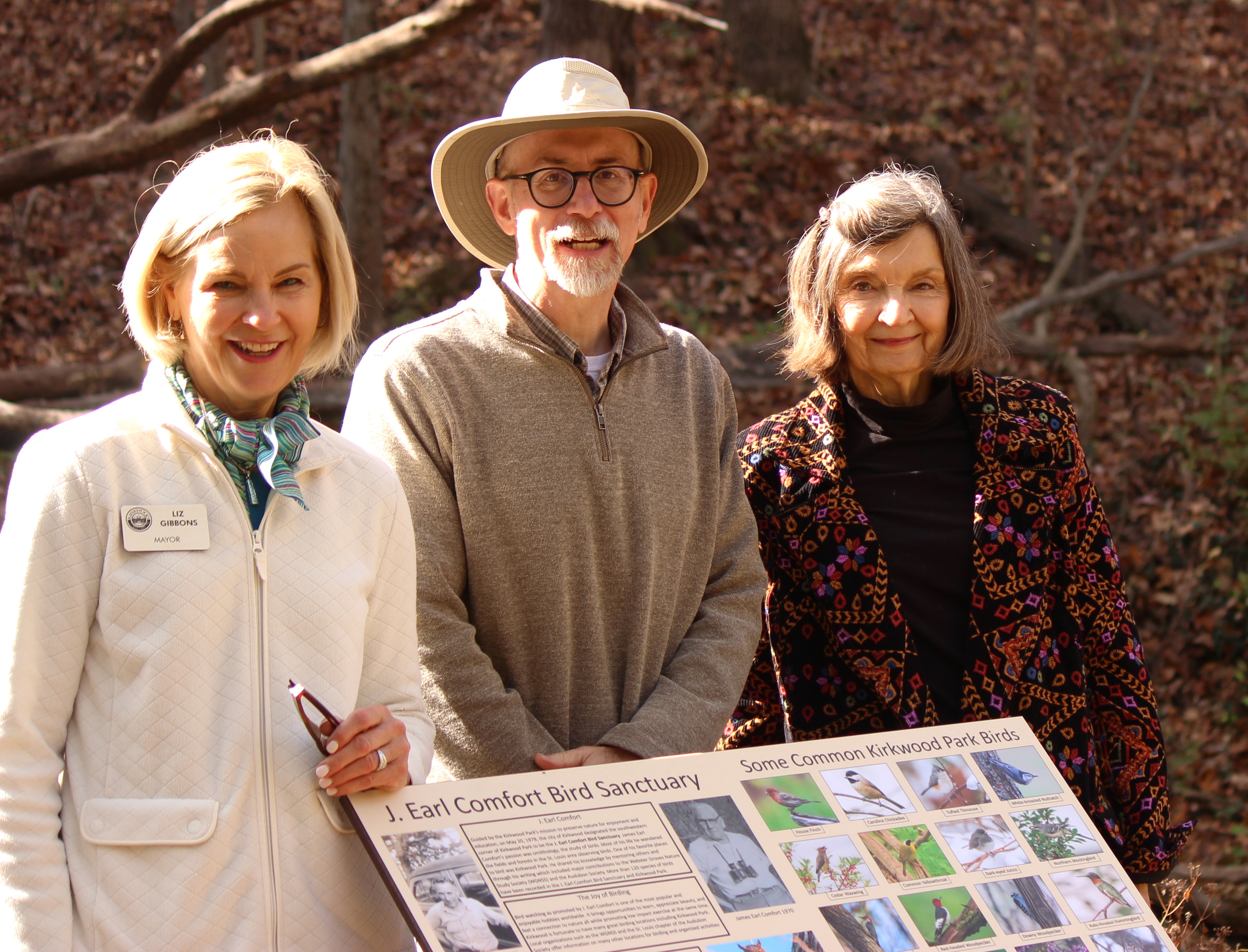
(left to right) Kirkwood Mayor, Liz Gibbons, WGNSS President Bill Duncan and Kirkwood Parks Board Chairperson, Ellen Edman stand beside the new J. Earl Comfort display. Photo by Richard Thoma.
by Don Corrigan
Saturday, Nov. 2, was a fine, sunny day to dedicate the new J. Earl Comfort Bird Sanctuary display in Kirkwood. A well-known St. Louis area birder, Comfort was a conservationist, educator and writer of bad bird puns.
No one ducked the issue of Comfort’s wayward wit, such as his contention that gulls may not be such gullible birds. The dignitaries at the dedication on the banks of Sugar Creek in Kirkwood Park, chose instead to focus on other aspects of his life.
Bill Duncan, volunteer extraordinaire of the Webster Groves Nature Study Society, outlined the work of Comfort as a WGNSS writer who contributed 461 articles to its Nature Notes publication.
Ellen Edman, Kirkwood Parks Board Chair, was among those wowed by Comfort’s birding in Kirkwood Park during the period he lived in Kirkwood from the 1950s until his death in 1977. He was born and raised in central Illinois, then moved to Webster Groves, then Kirkwood.
Kirkwood Mayor Liz Gibbons talked about the importance of community participation to protect wild areas within the Kirkwood Park system. She also mentioned that bird populations have been declining and the need to insure bird-friendly habitats.
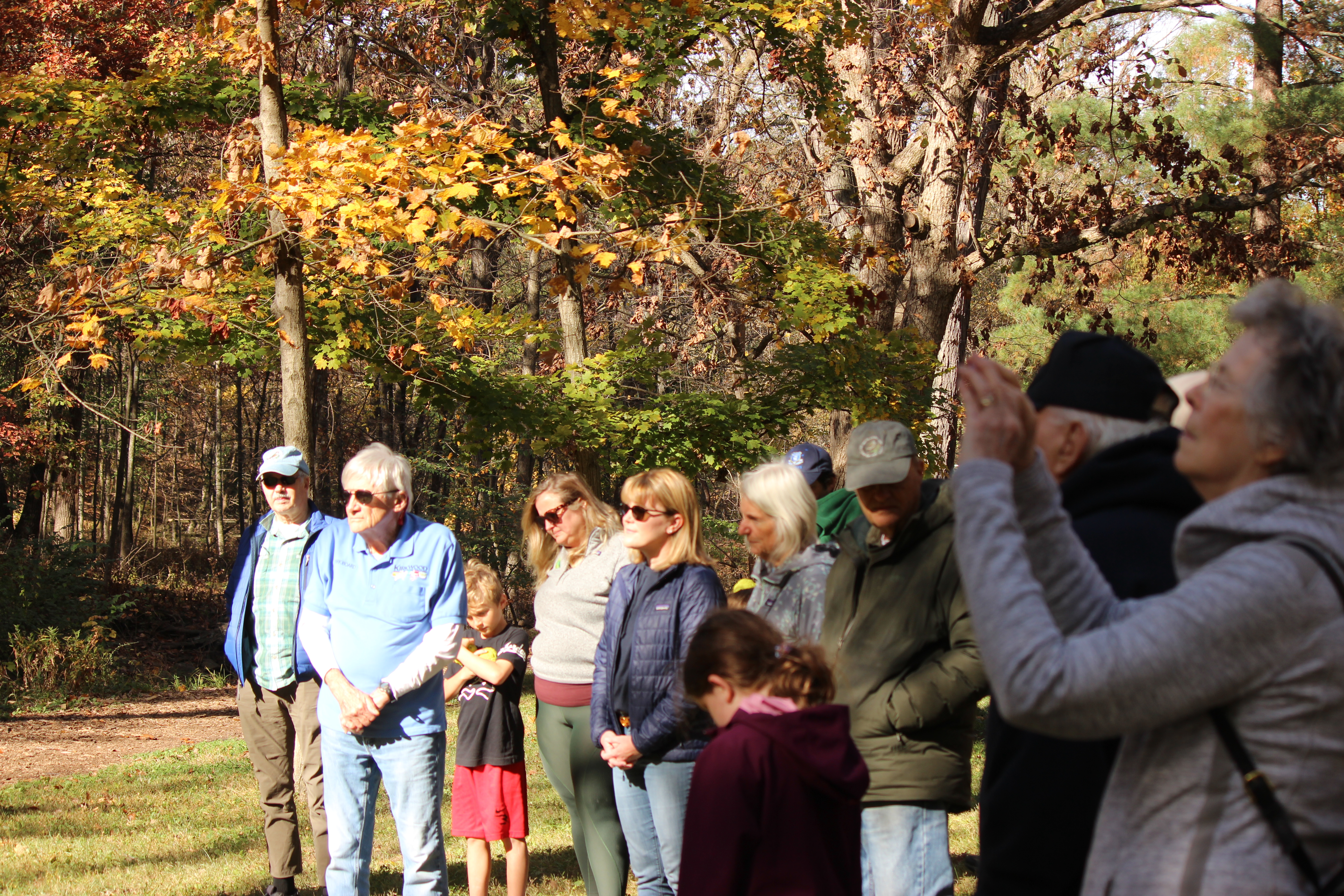
Naturalists of all kinds attend the dedication of the new J. Earl Comfort Bird Sanctuary display dedication Photo by Richard Thoma.
At the park event, Richard Thoma, longtime WGNSS board member and author of its 100th anniversary history, said he was most impressed that a young birder – not yet in her teens – was already able to use the Comfort exhibit for avian identification purposes.
“Of particular note for me, a young girl was the first to use the J. Earl Comfort Display to identify two birds in the bird sanctuary,” said Thoma. “The two birds that Francesca Bennett-Hartmann identified were the Carolina Chickadee and the Downy Woodpecker.
“And WGNSS birding expert David Becher, also at our dedication, verified that Francesca was correct,” added Thoma. “I’m so pleased that Francesca’s mother said that we could include Francesca’s name for a future article for WGNSS Nature Notes and in our local newspaper.”
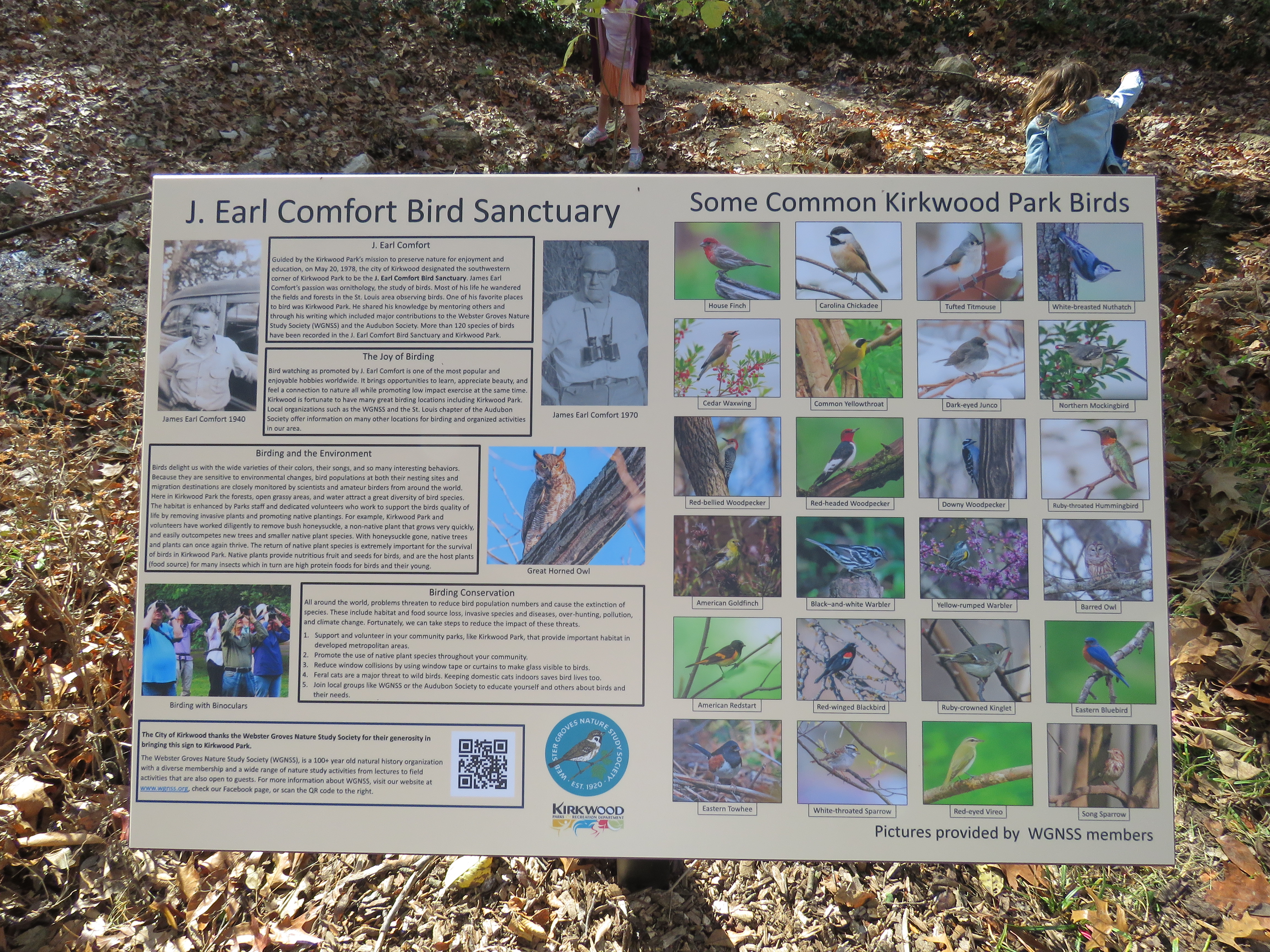
The new J. Earl Comfort bird display located along Sugar Creek in Kirkwood Park. Photo by Lisa Nansteel.
The Next 100 Years
Thoma said he regretted that Earl Comfort was not properly recognized in the book, “100 Years of the Webster Groves Nature Study Society.” He said that lapse will certainly not happen again when the 200-year book gets written.
“Of all our natural history groups, ornithology is the only one that was organized at the WGNSS’ inception in 1920 and has been in continuous operation ever since,” said Thoma. “Over that time, WGNSS has seen numerous people who can truly be recognized as great birders.
“One birder, however, soars high above all others in WGNSS lore – James Earl Comfort,” said Thoma. “From the mid-1940s to 1977, Earl participated and led countless birding field trips and special events such as the Christmas Bird and May Big Day counts.”
Thoma said that of all birds, ducks seemed to be Comfort’s favorite. Using binoculars, he was able to identify ducks at great distances. One of his favorite places for ducks was in the marshes near the Alton Dam, now known as the Riverlands Migratory Bird Sanctuary.
In an incident during World War II, Comfort was caught by a St. Charles County deputy near the dam with his powerful binoculars and accused of being a saboteur. It was a traumatic experience. Thoma said many people back in the 1940s were unaware of birding.
The incident did not stop Comfort’s field trips to the Alton dam. It also did not deter him from teaching junior members of WGNSS, like his nephew James F. Comfort, or J. Marshall Magner, or Jim Jackson, and taking them on birding trips.

A gathering of naturalists in Kirkwood Park, attending the dedication of the new J. Earl Comfort Bird Sanctuary display dedication. Photo by Lisa Nansteel.
Jim Jackson wrote in Nature Notes in 1977 that even though he was “not a teacher by profession, Earl Comfort was nevertheless one of the best when it came to initiating young birders. He had a wealth of knowledge, enduring enthusiasm, and always showed patience and good humor.”
Comfort also found time to write nature articles for Bluebird Magazine, The Bourbon Beacon, The Eccentric of Kirkwood, Missouri, The Cuba Free Press, The St. Clair Chronicle and the Purple Martin Capital News.
“Everyone that got to know Earl Comfort became very familiar with his jokes and puns,” said Thoma. “To him they were a fun bit of nonsense or maybe just some fowl play on words.”
Sidebar:
Earl Comfort’s Fowl Word Play
Here are just a few examples of Kirkwood birder Earl Comfort’s (1898-1977) very fowl word play:
– If one good tern deserves another, why does it take a tern for the worse?
– Which gulls are the most gullible?
– Does illegal mean a big sick bird?
– Is a wood duck a decoy?
– If a bird went for a lark in a field, would it be a meadowlark?
– Did the golfer shoot a birdie because he didn’t like what the little birdie told him?
– Why can’t hummingbirds learn the words?
– Is a bird’s eye view strictly for the birds?
– How long does a chat chat?
– Does a lame or sitting duck become a dead duck when it fails to duck?
“Let’s all moan because Earl Comfort had a million more,” said Richard Thoma of Webster Groves Nature Study Society. “Today, these jokes would be known as Bad Dad Jokes. These jokes were only really loved by the 3-5 year-old crowd – and groaned upon by most everyone else.”
 Environmental Echo