
Photo: Missouri Department of Conservation.
by Don Corrigan
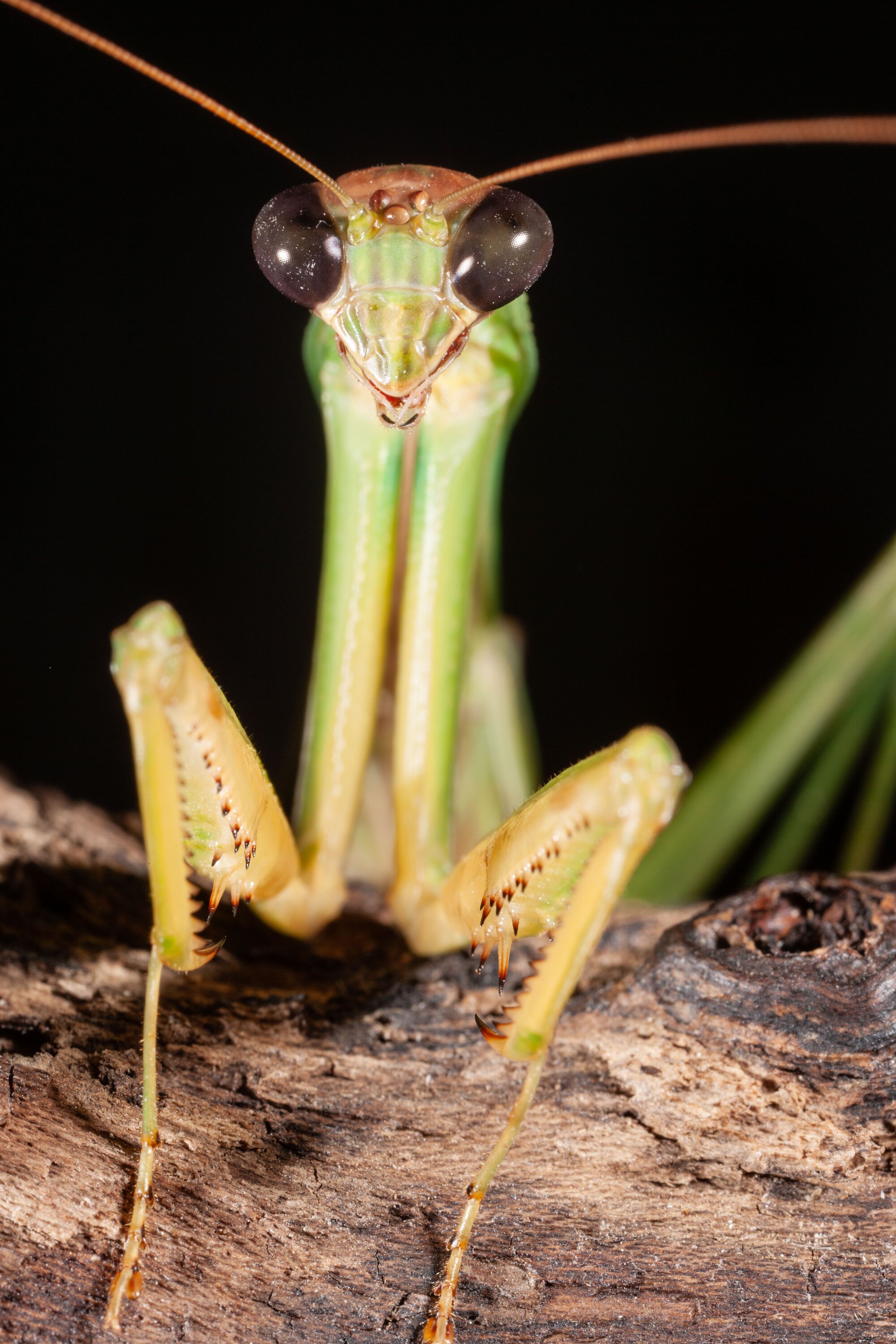
The Chinese mantid, classified as a non-native exotic species, is raising the ire of those who value pollinators such as butterflies. The large mantids grasp victims with raptorial front legs and then devour the captured prey.
The alarming critters are being found in Webster-Kirkwood backyards, as well as in stretches of prairie across Missouri. These beady-eyed predators ravage butterflies and are pretty, darned scary-looking.
“They’re twice as large as the common praying mantis that we are most familiar with,” said Mark Peters. “I have killed hundreds of them. I don’t have nightmares about them, but I can see why they made horror movies about mantises in the 1950s.”
Among the mantis horror movies is the 1957 film, “The Deadly Mantis.” The story begins when a melting iceberg releases a giant prehistoric mantis. A paleontologist advises the military to kill it after it attacks scientific outposts on its way to New York.
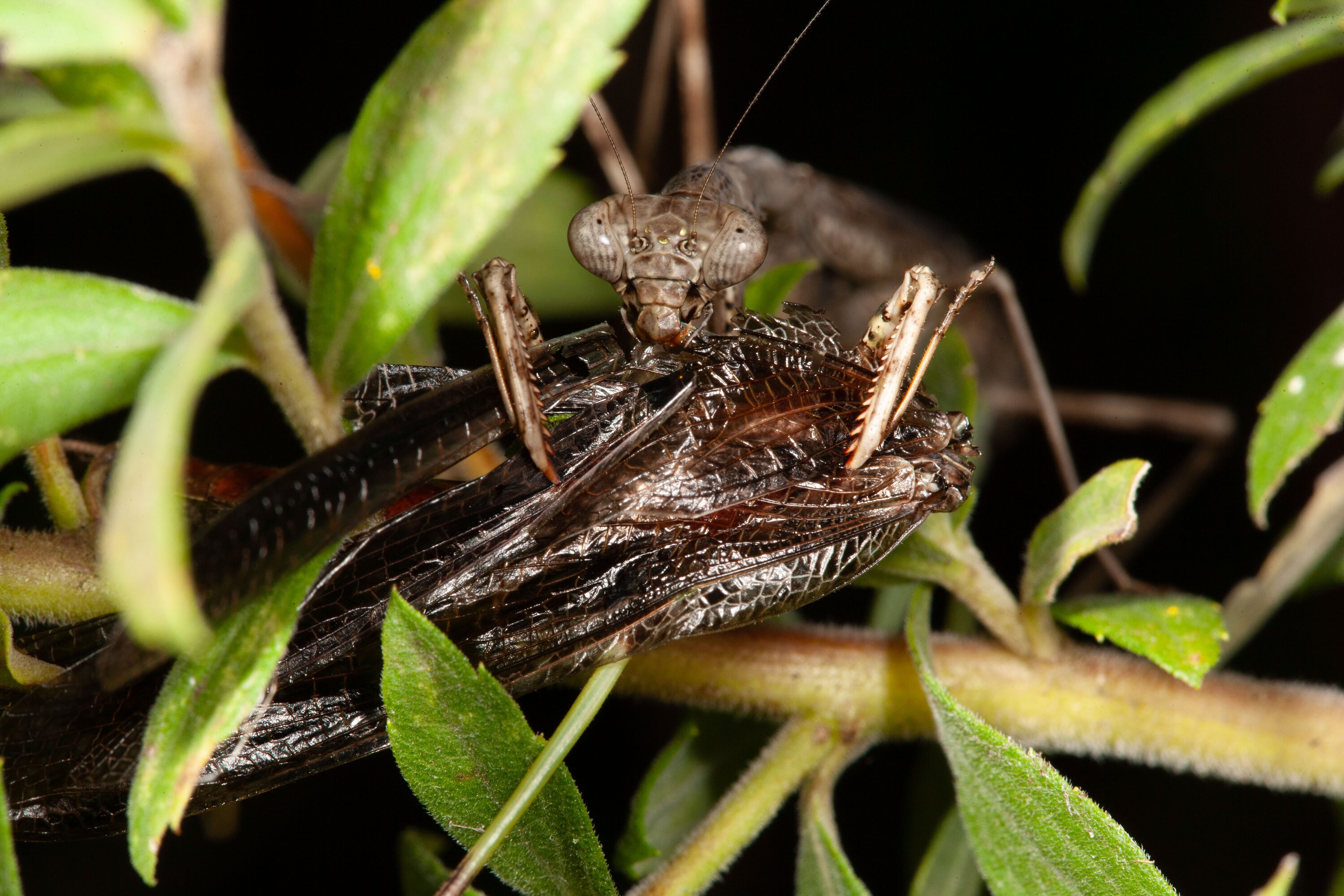
Photo: Missouri Department of Conservation.
Peters has no qualms about killing the Chinese mantises in a stretch of prairie land where he lives that he purchased three decades ago in rural Jefferson County. He said there are no restrictions or species protections for the mantises.
A 1971 graduate of Vianney High School in Kirkwood, Peters said he was given a pair of binoculars at age 10 for birding. He said his attention shifted in time to watching insects and prairie inhabitants.
Peters majored in nutrition science after high school and he received his degree in that subject area from the University of Missouri–Columbia. He has been employed in the nutrition field, but has never put down those binoculars or lost an interest in nature.
“In the prairie land that I am working to restore, there are lots of flowers,” explained Peters. “I actually started seeing the Chinese mantis on some of the goldenrod 25 years ago, but in 2019 the population seemed to explode.
“It seemed like they were on every flower,” said Peters. “They sit quietly on blooming flowers and when a bumble bee, dragonfly or monarch butterfly comes along, they just pounce and eat them alive.”
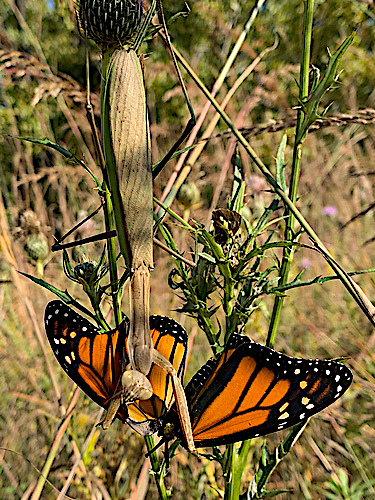
Photo: Mark Peters
In turn, Peters has pounced on the Chinese mantises. He said he killed 1,527 of the mantises in 2019. Peters also has spread the word at Webster Groves Nature Study Society (WGNSS) meetings about the mantises’ threat to pollinators.
Another Invasive Issue?
Members of the Webster Groves Nature Study Society point out that many people are focused on invasive honeysuckle these days, but America is not just dealing with invasive plants. There are invasive birds, fish, insects and, of course, the Chinese mantises.
Rich Thoma, a Kirkwood resident and the historian for WGNSS, said he has captured the mantises and been surprised by their size. He has pinned specimens to styrofoam displays to take to schools to show students an example of an invasive.
“They are 6 inches long, that’s double or triple what we normally see,” said Thoma. “Students are amazed to see their barbed front legs, their huge eyes and swivel heads, their green camouflage that aids them in ambushing prey.
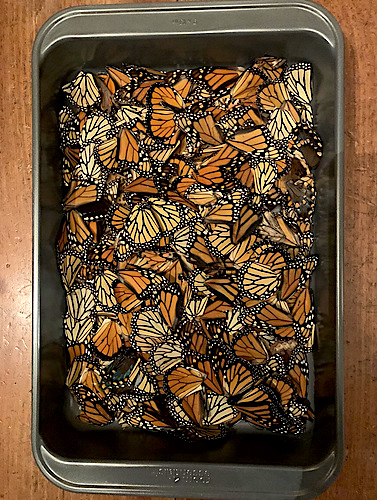
Photo: Mark Peters
“I am hard-pressed to totally condemn them, because they do eat a lot of pests,” said Thoma. “But if you see a whole tray of monarch wings left from their eating the butterflies, that is pretty alarming for many people.”
Thoma said the Chinese mantises do present a good way to educate about invasives. And invasives have become a fact of life because creatures are straying from their normal homes because of climate change.
Invasives also are hitching a ride on international transport like container ships or passenger jets. In some cases, they are brought into this country intentionally for a variety of reasons, including illegal sale.
“I understand why people are beginning to think that it is a losing battle to fight invasives,” said Thoma. “But, we need to realize that if we help our native flora and fauna, we give them a chance to compete with invasives.”
Chinese Mantis War
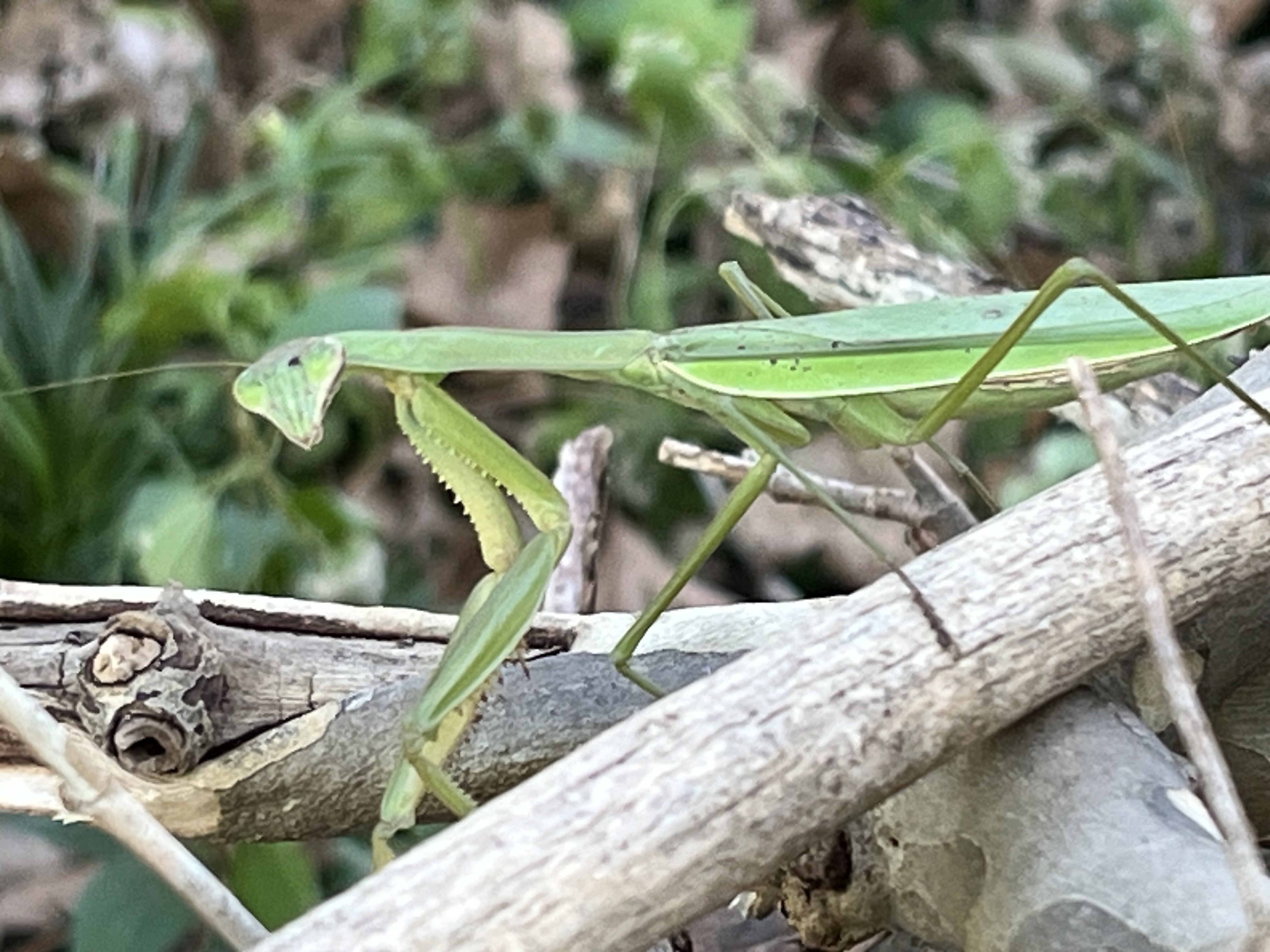
Photo: Mark Peters
Peters said it’s not a fair fight when pollinators are in competition with the voracious Chinese mantises. He said he has even tried to rescue some butterflies from the “ambush predators” on his land.
“Monarchs are having such a hard time surviving as it is, and now they have to deal with these guys,” said Peters. “These mantises are so aggressive, I have even seen them feeding on the breasts of captured humming birds.”
Peters said that other than some large birds, he believes that the invasive mantises have few natural enemies. However, he does count himself as their natural enemy. He is an unapologetic Chinese mantis killer.
“I used to try killing them with a scissors,” said Peters. “The females are slow and easier to take care of, but the males do fly, although it’s a weak flight.
“If you bare-hand them, they can prick you and draw a blood droplet, so I finally bought the Hardy Gloves from Harbor Freight,” explained Peters. “I just grab them and crush them in the gloves.”
Another way to eliminate the bug-eyed ambush predators is to find their egg cases this time of year. Crushing an egg case can potentially destroy up to 100 potential mantises, according to Peters.
It’s a war out there in nature, but with the first hard frost, most of the mantises, and the pollinators, will disappear. The ceasefire will be short-lived, however, with the return of summer in 2025.
 Environmental Echo