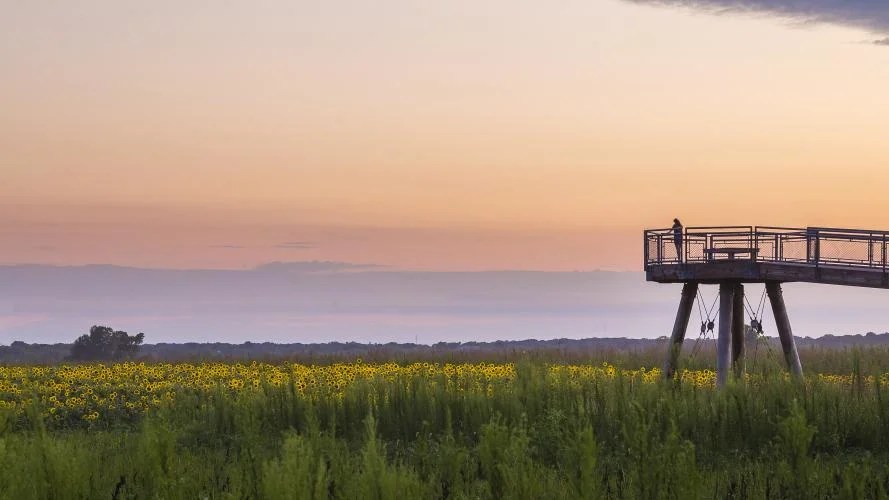
Photo by Dan Zarlenga, MDC.
The Missouri Department of Conservation (MDC) is beginning construction of a new road on Columbia Bottom Conservation Area in Spanish Lake. When completed, the road will create a more direct connection from the area entrance to the boat ramp on the Missouri River. MDC estimates the construction project will be complete by spring 2025, depending on weather. The contractor will begin staging equipment on the area by the end of July.
The construction project will significantly improve public access to the boat ramp when completed. The current route to the ramp is six miles; more than half of the travel is on gravel roads. The new route will only be two-and-a-half miles long, with just one mile of gravel road.
“The new road will provide quicker access to the river for the public as well as emergency services. The current road will still be accessible for those wishing to access other parts of the area,” said Clinton Owenby, MDC Regional Resource District Manager.
The project will also include an improved circle drive at the boat ramp, which will make it easier to maneuver trailers for launching and loading boats. Visitors should note that the boat ramp and privies there will continue to be accessible to the public during the construction project.
“After the river destroyed the previous circle drive, it made it difficult to maneuver a trailer around the parking lot. The new circle drive will make it a lot more convenient,” Owenby said.
Columbia Bottom Conservation Area is located at 801 Strodtman Road in Spanish Lake. It can be reached by taking the Riverview Drive exit three miles north from I-270. For more information on the area and the latest updates, go to http://short.mdc.mo.gov/4bR.
MDC purchased this 4,318-acre tract in 1997 to create an urban conservation area. Columbia Bottom is located at the confluence of the Missouri and Mississippi rivers, has more than 6.5 miles of river frontage, about 800 acres of bottomland forest, and a 110-acre island. It includes boat access onto the Missouri River, and canoe/kayak access to the Mississippi River.
 Environmental Echo
Hey Don,Thanks for your Environmental Echo blog. It’s always a pleasure! Would you be interested in a story about invasive non-native Chinese Mantises?  My BF, Mark Peters, restored a prairie on his Imperial, Mo, property 30 years ago, intending a bird and butterfly mecca. He loves that prairie beyond measure! But in addition to a never-ending battle against invasive non-native vegetation (esp. Sericea lespedeza) he’s had to deal with an infestation of Chinese Mantises. These mantises are “ambush predators” that perch on wildflower stalks, camoflaged in green, wait for an unsuspecting butterfly or hummingbird and pounce. Mark has collected whole trays of the Monarch wings he has found under mantis perches. He also finds hummingbirds with their chests eaten out. (photos below) Chinese Mantises even kill and eat our native mantises.Â
 MDC information on Chinese Mantises:
https://mdc.mo.gov/discover-nature/field-guide/chinese-mantis Another concerned property owner, in Park Hills, Mo! https://www.facebook.com/Stopthechinesemantis/
Every summer around this time, Mark begins his mantis safaris, spotting them with his binos and exterminating them one by one. In one season he’ll get rid of over a thousand of these deadly pests. Unfortunately Chinese Mantises are still sold as “natural” garden bug control, and many people are charmed by them! Mark would like to get the word out that Chinese Mantises are invasive and deadly to our beneficial pollinators and hummingbirds. Â
If you think you might be interested in a story, please let me know and I’ll put you in touch with Mark! best to you!
Gwyn
LikeLike