

Corrigan and Boston Globe reporter Brian MacQuarrie climbing to the ruins of Whitby Abbey on the North Sea Coast.
by EE Staffers
EE’s Corrigan served time in a pillory aboard the HMS Endeavor after he confused Captain Cook with Captain Hook of the legendary Peter Pan myth. Endeavor’s crew was miffed, noting Cook is real, Hook is a fake.
Corrigan was in the midst of a whirlwind global reporting tour in June in the United Kingdom with Mizzou J-School Alumni Brian MacQuarrie and Keith Schmidt. The three were on Mizzou’s London Reporting Program last century.
The HMS Endeavor is anchored near the English harbor at Whitby, a favorite haunt of the legendary Captain Cook. The ship’s crew pointed out that Hook was a mythical pirate with a hooked arm. Not so with Cook.
“Cook was a real seaman, a brilliant navigator. He was a favorite of Americans during his time sailing around the world,” said an indignant Endeavor crew member. “Americans need to know that their own Ben Franklin admired Cook.”
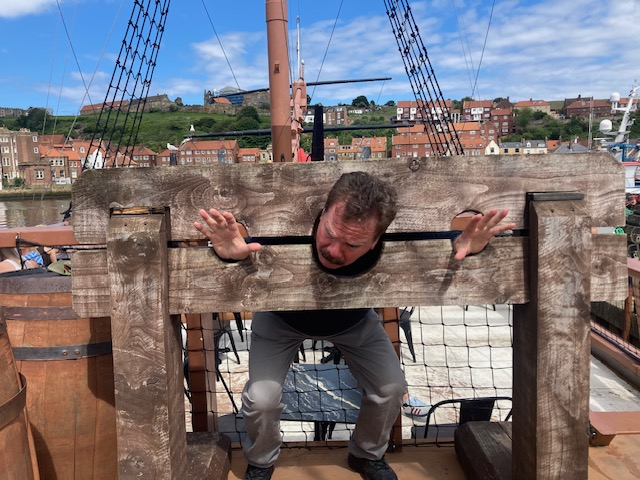
EE’s Don Corrigan being punished for his many transgressions aboard Captain Cook’s HMS Endeavour in Whitby.
Corrigan was unable to research the authenticity of those remarks while placed in the pillory. The wooden device secures the head and hands of scoundrels and has been used for public humiliation for centuries.
“After finally being released from the pillory, I was able to confirm the information about Ben,” said Corrigan. “Ben Franklin did advise American sailors not to hassle Cook, even when battling the Brits in the 1770s.
“Franklin wrote a directive to colonial ship captains instructing them ‘to treat Cook and his crew as common friends to mankind,’ if ever encountered at sea. Do not attack him,” Corrigan noted.
Some reasons why Ben Franklin regarded Cook as a “friend of mankind” – who deserved special treatment:
•Cook produced ocean maps so accurate that they were still in use in the 20th century. Cook’s methods for charting the seas proved crucial for many an ocean voyager.
•Cook took scientists along on his sailing trips. His journeys were ostensibly scientific expeditions. Scientists were charged with such navigations aids as tracking the transit of Venus across the face of the sun.
•Cook managed to keep his big expeditions free of scurvy – an ailment caused by a lack of vitamin C. Cook reportedly kept his expeditions scurvy-free with sauerkraut. Cook had his crews eat nutrient-rich, pickled cabbage as a scurvy preventative
Visiting the Cutty Sark

Keith Schmidt, retired public relations professional and now a freelance writer, aboard the Cutty Sark tour with Don Corrigan at Greenwich near London on the Thames.
Intrepid traveler Corrigan had better luck aboard the sailing ship Cutty Sark in Greenwich outside London. The giant ship was one of the great tea clippers of the world and even traveled to America with tea in its time.
One of the fastest sailing ships, it only was retired after the invention of steamships, which took over old sailing routes. Cutty Sark was named after the short shirt of the fictional witch character in the Robert Burns’ poem Tam o’ Shanter published in 1791.
Even before learning about the Burns’ connection to the Cutty Sark, Corrigan had resolved to visit the stomping grounds of the Scottish Poet Laureate in his native southwest Scotland.
Before embarking for Burns’ home in Scotland, however, Corrigan visited Robin Hood’s Bay and the old Bendectine Abbey on cliffs above Whitby. He found the Abbey in ruins, thanks to the inconsiderate Vikings who had no use for the early Christians.
Next, Corrigan visited the land of Beatrix Potter in Lake Country. Potter was an English naturalist who wrote about Peter Cottontail and the story of Squirrel Nutkin. These tales inspired Corrigan’s own nature book, Nuts About Squirrels.
After some harrowing drives in an Enterprise Lease car on the narrow roads of the Lake Country, Corrigan aimed the GPS for Dumfries, Scotland.
From Potter’s Lake Windemere and landscapes that inspired poets Coleridge and Wordsworth, Corrigan headed north for Jolly Old Scotland, where jolly Scotch whisky and haggis awaited.
In Robert Burns’ town of Dumfries, Corrigan stayed on the lovely campus of the Chrichton College. The old church, dorms, dining quarters and university halls at Dumfries are like something out of Harry Potter.
Dumfries is proud of its homes, museum, and mausoleum honoring its poet. The curator for the museum can recite the poems of Burns with their amazing range of subjects: witches, brave warriors, pretty lasses, wind-swept moors. And then there’s the mouse:
Wee, sleekit, cowrin’, tim’ rous beastie O, what a panic’s in thy breastie!
Burns’ poem, “To A Mouse,” is essentially an apology for his plowing over a poor field mouse, frightening it to death. The poem is destined to become an epigram in the second printing of Corrigan’s, American Roadkill: The Animal Victims of Our Busy Highways.
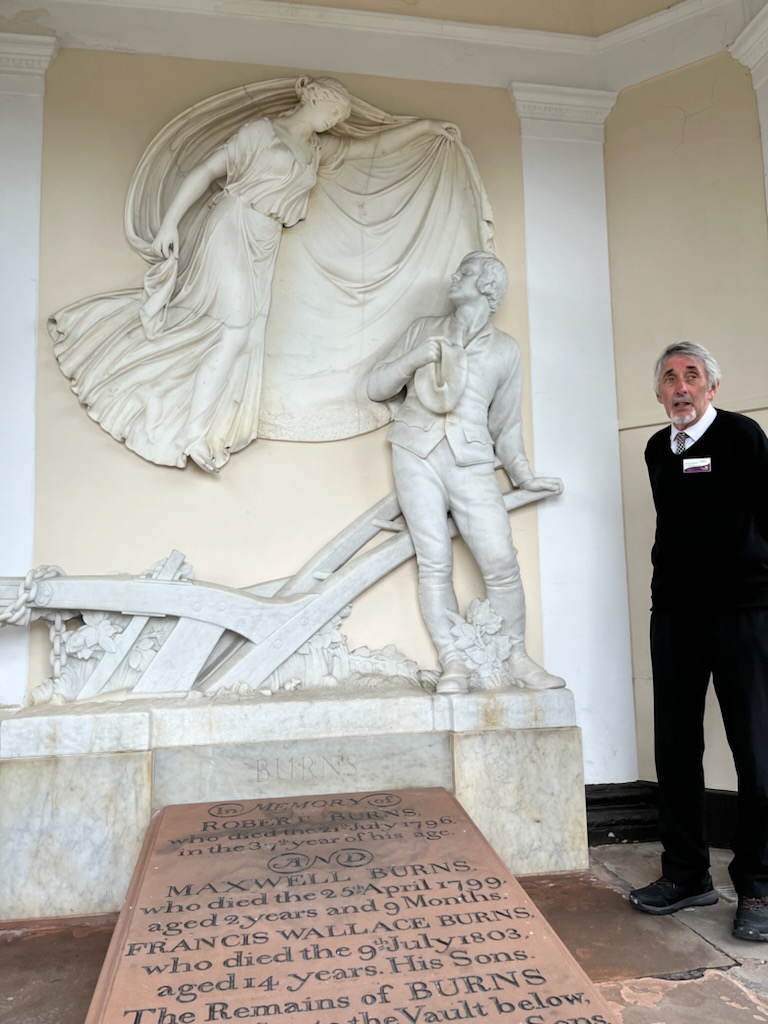
The curator of the Burns’ home in Scotland shows off a sculpture of the poet and the sacred muse that helps him create his masterpieces.
Upon taking his leave, the museum curator told Corrigan that Burns Nights are celebrated around the world. In fact, the traveler learned that the poetry of and spirit of Burns are celebrated in a big way in his own hometown of St. Louis, Mo.
The Scotts of St. Louis honor Burns in their pubs and restaurants by wearing kilts, dancing and singing to his words, downing haggis and chasing it with shots of Scotch. Plenty of photos on the Web from pubs like Tom Schlafly’s Tap Room attest to Burns Night revelry in St. Louis.
Lockerbie: Somber Ending
Corrigan, an emeritus journalism professor at Webster University in St. Louis, concluded his Scottish travels at a cemetery in the town of Lockerbie, just east of Burns’ joyful town of Dumfries.
Lockerbie is a sad place where terrorism blew Pan Am Flight 103 out of the sky on the Dec. 21, 1988. Body parts rained down on the town from 243 passengers and 16 crew in what became known as the “Lockerbie Bombing.”
Large sections of the aircraft crashed in the streets of Lockerbie, killing 11 residents. With a total of 270 fatalities, the terrorist bomb on the flight from Frankfurt to Detroit – with stopovers in London and NYC – became the deadliest terrorist attack in United Kingdom history.
Several students from the European campuses of Webster University died from the insanity that destroyed Pan Am Flight 103. It was not fair. They were innocents. It’s not fair.
Corrigan came to pay his respects, but he was surprised to find other mourners in the garden memorial. They were from Scotland, England, Australia and America.
“We had to come, while vacationing in Lake Country,” said Brian Smith of Melbourne. “I worked on 747s for Quantas at the time. A 747 doesn’t just fall out of the sky. When we heard the news, we knew something terrible had happened.”
Paul Heaton of Lancashire remarked: “We were passing through on a golf vacation, and we saw the sign for Lockerbie, and we knew we had to stop. This is sacred ground.”

Zoe and James Jarvis and David Eliot of Hertfordshire took time out from their travels in Scotland to visit the Lockerbie Memorial.
Three friends from Hertfordshire came to see the memorial together – Zoe and James Jarvis and David Eliot. “I was a lorry driver at the time and I was here,” said Eliot. “The crash scene was all roped off and we had to detour around Lockerbie. It was incredible – incredibly sad.”

Carol and Richard Nye of Aberdeen pause to view the names of the victims on the Lockerbie Memorial to the victims of terrorism in the skies over Scotland.
Carol and Richard Nye from St. Andrews, Scotland, stopped at the garden memorial on their travels. “The television news from that horrible evening is still etched in our minds. So sad that so many young students were coming home for Christmas and died senselessly,” Carol lamented.
Joy And Sadness
On benches at the Lockerbie cemetery, sorrowful headstone inscriptions can be read: “Something has happened – to keep us apart – but always and forever you are in my heart.”
There are lessons to be learned on long trips away from home: First, do not pass up the joy of a chance to visit and travel with old friends from far-away places and far-away times. The opportunity may not come again. Go. Go.
Second, always find time to remember the dead – and the loss of so many innocent young, once destined to lead full and joyful lives – all cut short by our world’s unfathomable madness and cruelty. Oh, no. No.
Also, find sympathy for those left behind with gaping wounds that can never fully heal: For ALEXIA: INNOCENT VICTIM OF TERRORISM: “They never die, who have the future in their heart.”
At the turn of every year, give thanks to Scottish poet Robert Burns. We all sing his song for those we have loved, and for those we have lost – for the living and the dead:
For old acquaintance be forgot
And never brought to mind
Should old acquaintance be forgot
In the days of auld lang syne?
For auld lang syne, my dear
For auld lang syne
We’ll drink a cup of kindness yet
For the sake of auld lang syne.
 Environmental Echo