
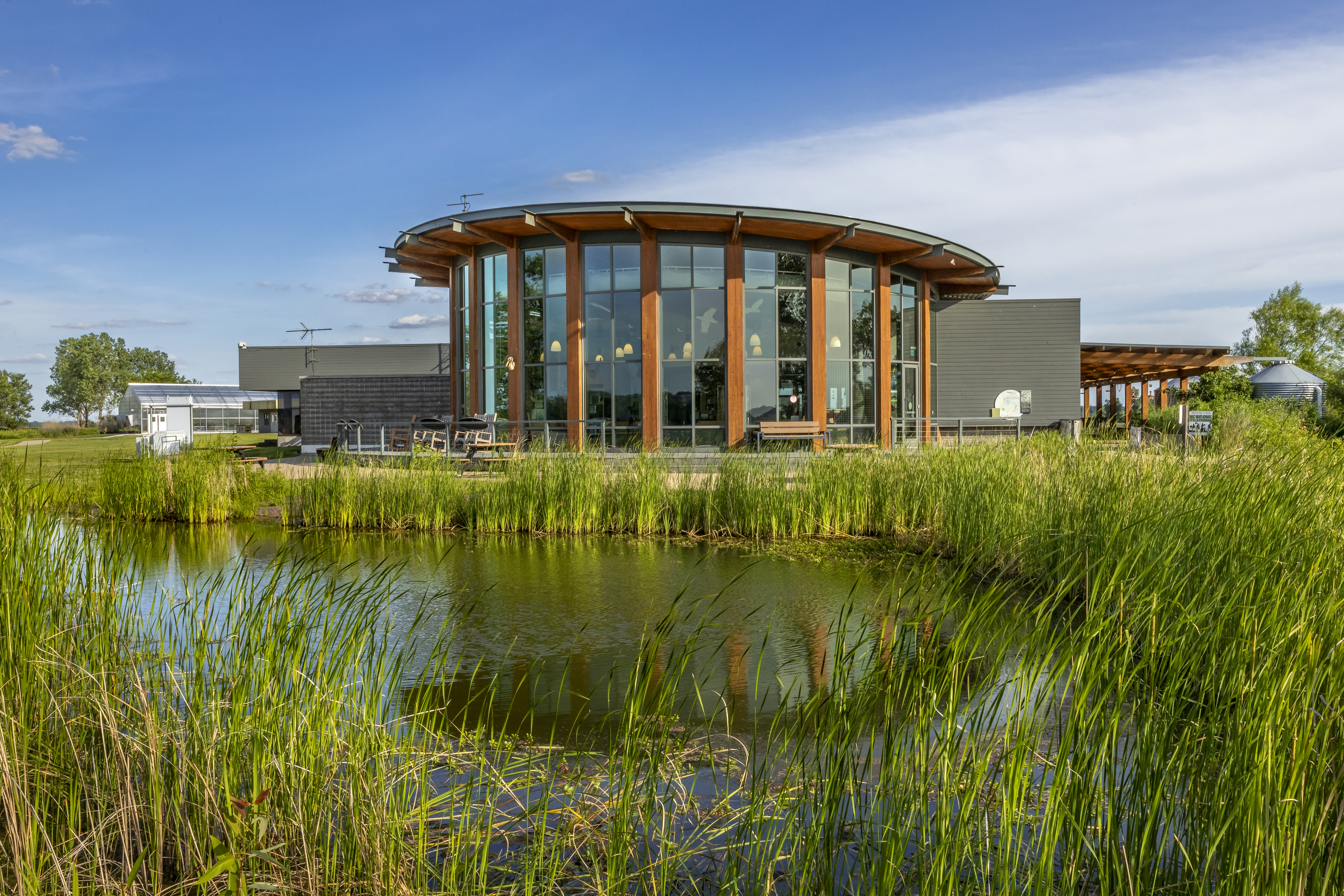
Photo by Rob Schultz. Provided by Ken Buchholz.
By Jess Holmes
Nestled away in an eastern tendril of St. Charles County is avian education center that isn’t just for the birds. The Audubon Center at the Riverlands’ floor-to-ceiling windows display the tall, grassy banks of the Mississippi—a large variety of birds fluttering and gliding throughout the expansive green space.
Visitors can meander the 8.5 miles of hiking trails and learn about the importance of a premier migratory bird sanctuary. Throughout the seasons, more than 300 bird species can be found where this crucial piece of land meets river. The center even provides guests with seasonal checklists, so they know which flying friends to look for.
Natural beauty aside, The Audubon Center, directed by Ken Buchholz for the last eight years, is doing wonders for surrounding communities, Florissant and Ferguson, in particular.
The Center’s mission is “to connect people to the beauty and significance of the Mississippi River and the Great Rivers confluence, to inspire conservation of the river’s rich diversity in birds, wildlife, and other natural resources, and to support healthy, vibrant communities.” They’re doing just that.

Pictured: Ken Buchholz. Photo credit Tom Feiner. All photos provided by Ken Buchholz.
“This Riverlands Center was built and finished in 2011. We do conservation, education, public engagement programs year round and not just at the center,” Buchholz said. “We have a whole education program called NEST, Nature Education for Stewards of Tomorrow, and it’s largely focused on folks that mainstream conservation groups have left behind.
“It’s STEM-driven, inclusive, and immersive. With us, kids are going to get dirty and learn hands on. We mainly work with Madison County, North County, and North City schools. We also have a big partnership with Ferguson-Florissant schools,” Buchholz said.
Birdwatching may seem like an activity for people over 60, but with the mental health benefits, it’s something we should all consider. A 2022 study in Scientific Reports, “Smartphone-based ecological momentary assessment reveals mental health benefits of birdlife,” found that exposure to the sight and sounds of birds can positively impact an individual’s mental health.
“We report significant mental health benefits of birdlife, evident not only in healthy people but also in those with a diagnosis of depression,” the study reported. “Visits to habitats with high degree of birdlife could become part of social prescribing schemes, playing a role in preventing mental health difficulties and complementing more traditional interventions. Paramount to all of this, will be the adoption of environmental and wildlife protection policies for the preservation and enhancement of a mosaic of habitats in rural and urban settings.”
The Audubon Center at the Riverlands has been leading the way with this type of mental health assistance with their NEST program. It’s not just during the school year either.
“We have our camp, Little Creek, for 3 rd -5 th graders during the summer,” Buchholz said. “Because of our position in this area, we bring in Army Corps Rangers, Fish and Wildlife, National Park Service,
Missouri Department of Conservation into the camp over the three weeks, really leveraging expertise and resources.
“It allows us all to pull together and provide a high-quality camp for these kids. We offer it for free thanks to the partnerships, school district, and outside funding from the St. Louis community.”
Thanks to the partnerships The Audubon Center maintains, Little Creek Summer Camp offers more than just three weeks of birdwatching.
“What’s cool is how hands on it really is,” Buchholz said. “For example, with the Missouri Department of Conservation, the kids get to do turtle tracking, or archery with Ranger Bob from Fish and Wildlife. With us, they do birding and bird identification. Then, their favorite is always the creek exploration where they get to learn about all the aquatic features.”
While the center has a great emphasis on the upcoming generations, it also offers programs to attract adults and families. One of the newest additions is the kayak launch out onto Ellis Bay. It’s ADA-accessible with guided tours discussing the large variety of wildlife along the Mississippi River.
For those who prefer to stay on dry land, the center also hosts community science events, photography classes, and collaborative writing workshops.
“In winter, we have a big series, Birds of Winter, that lasts six weekends because we get trumpeter swans, ducks, geese, and even eagles. They’re big, charismatic birds. People can see them, identify them. It’s a way of helping them understand this is a massive ecosystem,” Buchholz said.
“The trumpeter swans come in around November and are a huge conservation success story,” Buchholz said. “They slipped under the radar back in the 40’s and 50’s. Luckily, some conservationists noticed something funny and sure enough, the last population of swans was plummeting in the Northwest US.
“Once we figured that out, conservationists and scientists were able to come together to protect the swans, and now we have a recovered population. These swans come down to these river areas during the winter then head back home. They’re a blast to see. We’re seeing more and more.”
With birding able to boost mind and spirit, the Audubon Center at the Riverlands is more than a hub for conservation and community. It represents hope for an ecologically-focused future for all—people and animals alike.
“We look at birds as a tool to connect people with this land,” Buchholz beamed. “This is really the only place in St. Louis you can look out and see the big rivers. It’s an important flyway, migratory corridor. We’re right at the heart of it. Everything is moving up and down these rivers.”
 Environmental Echo