
Photo by Ursula Ruhl
By Jess Holmes
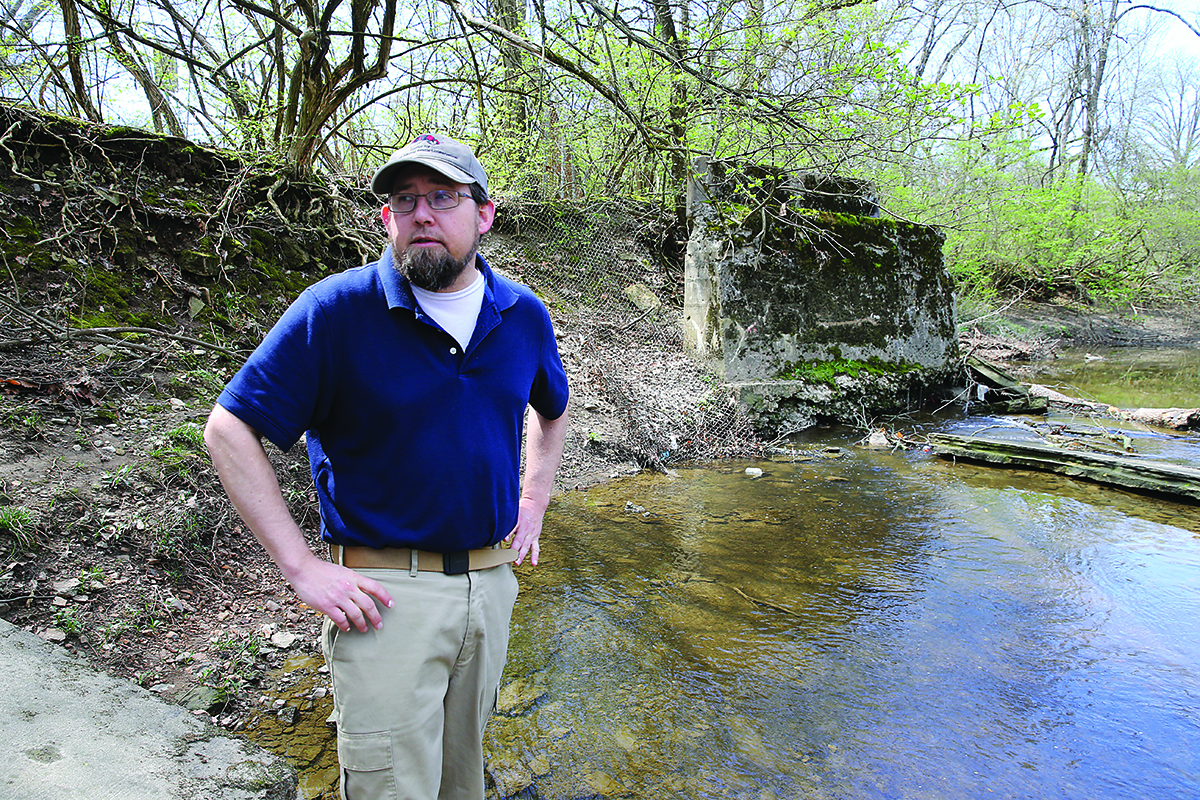
It’s thanks to the Saint Louis Zoo’s Michael Dawson that spring peepers, chorus frogs, and cricket frogs are still on the map — literally. Dawson’s creation and maintenance of the FrogWatch chapter known as the Spring Peeper Program in St. Louis has put these small, but noisy creatures back on conservation radar.
Statewide, these critters are not near extinction, but Dawson explores the effects urbanization has had on their significant population loss in the St. Louis area, while also encouraging the community to get involved in reversing their decline.
“I started looking at data collected by citizen scientists, species by species. One of the patterns I recognized is that certain species were almost completely absent inside of I-270. Whereas you go three minutes outside of I-270, they show back up on the observation maps,” Dawson said. “Some frog species are unaffected by urbanization, but the spring peepers, chorus frogs, and cricket frogs all seemed to be.
“I wanted to see if the citizen-collected data was true, and the Zoo encouraged me to put a project together. So, I did. After getting it approved and funded, I started setting up acoustic surveying devices around the St. Louis area,” Dawson explained. “Over the last three years, I found that the citizen scientists were right.”
The Saint Louis Zoo FrogWatch program stems from an even larger effort, FrogWatch USA. The Akron Zoo manages the national program. The mission is to build a community to help the frog and toad populations across the United States. Thanks to smartphones, this has become even easier.
“If you’re out in the field and have a phone, you can record a frog’s call,” Dawson said. “Recording calls is even better than using photos because I can download it, put it through my software, and can determine what species it’s from. Plus, it’s timestamped and GPS coded. It’s no different than the recording devices I leave out on trees.”
With over seven million people signed up, iNaturalist provides every citizen the opportunity to contribute to science. It’s a one-stop shop where an individual can track and record their observations, have direct access to expert knowledge, learn more about nature, and contribute to science.
Dawson’s taking the commitment to community science to a new level.
“Because of all the conservation projects I’ve done in the city, I know a lot people. I noticed a niche in which all these community science projects, green projects, and university project were up and running, but nobody was talking to each other. So, I pulled the trigger,” Dawson said. “December of last year, I invited a bunch of people to the Zoo to create a citizen scientist working group for our area.
“I look at it as a web of all these cool people and projects,” Dawson continued. “With all these neat things going on, how can we help each other promote these projects and create an even stronger network of people who do community science?”
Why Frogs?
Dawson’s journey to FrogWatch began more than 20 years ago when his mother signed him up for courses at one of the very few colleges at the time with an accredited teaching zoo involved, Santé Fe College Teaching Zoo. This associate’s degree program not only guided him toward his love of herpetology but to the love of his life, as well.
After graduation, the zoology-loving couple lived in Toledo for a bit, before Dawson’s, now wife, was offered a position at the St. Louis Zoo. Shortly after, Dawson also found himself hired by The St. Louis Zoo into the education department in a naturalist position.
“I got a chance to take people outside, hiking around, looking for frogs, toads, and all kinds of stuff. I got really into teaching the herpetology classes there,” Dawson reminisced. “At that point of my life, I thought I wanted to be a high school biology teacher, so I went to get a master’s of secondary education from UMSL.”
Although Dawson never completed his teaching certificate, he was able to sculpt his career in a way that maintained his passion for sharing knowledge. This is where the community science came in. He started leading herpetology teams and participating in a lot of “bio-blitzes,” cataloging events where people come together to survey all life in a given area, within a limited time period.
“Working with the public and collecting information with everyone really got me more interested in amphibians. I’d always had a love for snakes, but I was getting older and slower. I was getting tired of getting bit by snakes,” Dawson laughed.
As his love for frogs blossomed, he heard about FrogWatch USA and looked for the nearest chapter. His search told him to contact his nearest zoo. Being in the heart of the nearest zoo, he went to his supervisor, who encouraged Dawson to create a St. Luis chapter. That was 15 years ago.
“I’ll be honest, when we first started the chapter, I took one of their online tests and only scored a 60% on auditory identification,” Dawson admitted.
It took a year and a half of listening to frog calls as often as possible to become as good as he is now at species identification. He even went on to create a FrogWatch STL SoundCloud – the Frogwatchstl resource website frogwatchstl.com – so individuals can do their own identification practice. This may seem like an overcommitment to frog enthusiasm, but it even extends beyond that.
“Hopefully most of the people in these citizen scientist groups have common goals that we want to push forward. A lot of it is increasing biodiversity and conserving what we have here,” Dawson said. “We have a beautiful, green city that’s continuously getting greener.
“I’m interested in working with the people who are expanding these green spaces and helping them design more frog friendly habitats. They might not be directly working with animals, but their work directly affects all types of animals – insects, frogs, birds,” Dawson said.
FrogWatch is about the bigger picture. It’s a way to bring humans back to nature and reignite the community’s curiosity about green spaces.
“It’s always a pleasure to see young children get excited about frogs. One of the things I like to do is go for a night walk, so I can actually catch a few things, carefully, to show the kids,” Dawson said.
“Nothing makes it more personable than seeing the animal making the noise they’re listening for.
“To me, it’s just as important to go out with a group of people and get them excited about nature, as it is to collect the data itself. I love giving walks and answering questions,” Dawson said. “Even more, I love giving people the time to ask a question.”
 Environmental Echo