
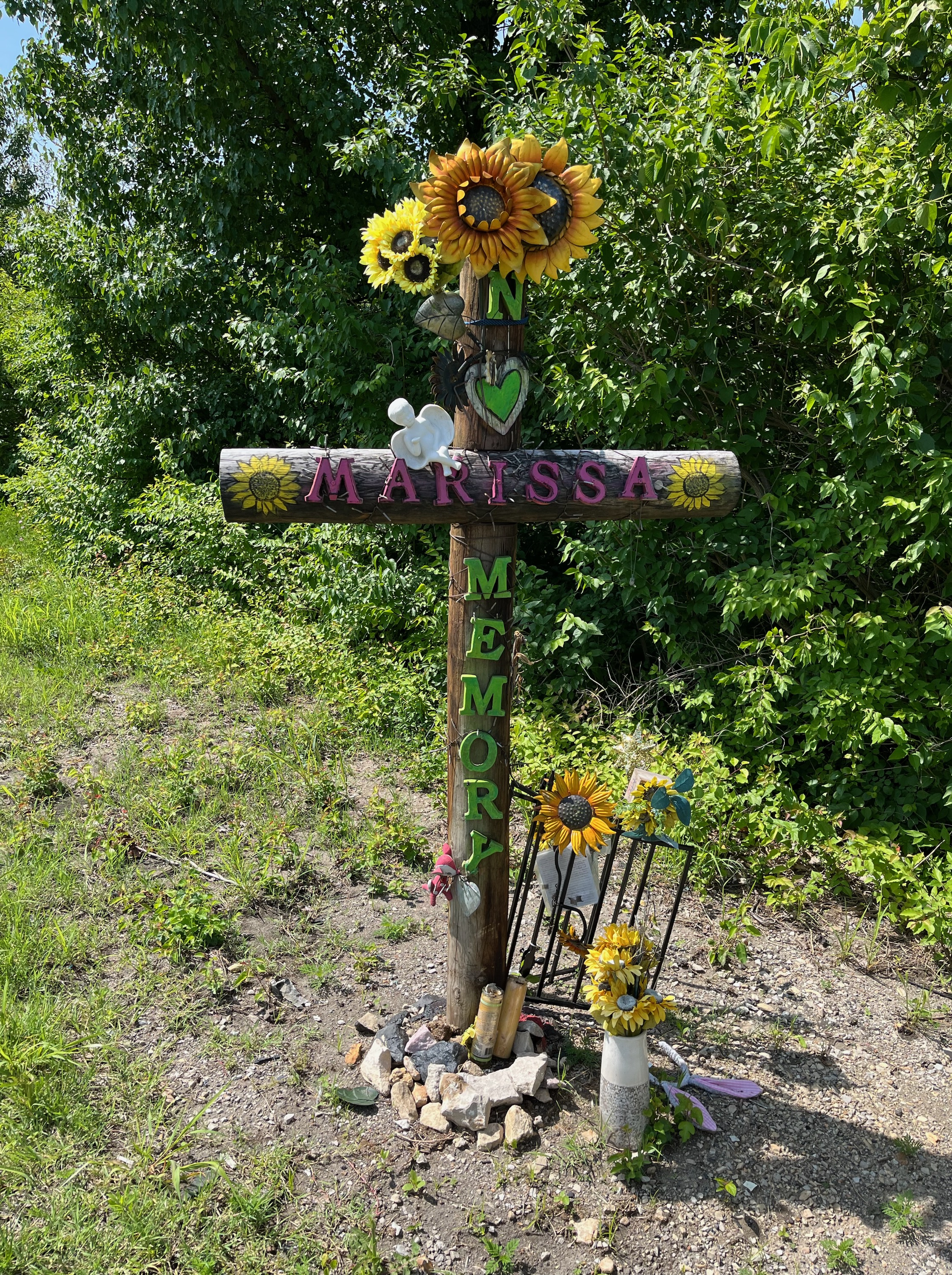
The road memorial for Marissa can be found on I-270 South between
the I-44 interchange and Gravois.
By Don Corrigan
Roadside memorials are becoming part of the highway landscape along with Culver‘s, Waffle House, and Circle K fuel stops. The grim reminders are not so hard to find in St. Louis – just hit the on-ramp of your nearest interstate – and drive.
James Hill of northern Indiana has made it his business to archive as many of these roadway memorials as he can with his Roadside Tribute. His web master handiwork can be found at roadsidetribute.com.
“Roadside Tribute is a place where families and friends can memorialize their loved ones lost in traffic accidents,” said Hill. “It does this by providing a place to share a picture and story of their roadside tribute site they built along the roadway.”
Hill is a mechanical engineer who began working in automotive design in 1985 at the Ford Motor Company. After witnessing many test crashes, he began to develop a passion for reducing automobile accidents.
According to Hill, there are a number of benefits in registering, free-of-charge, a roadside tribute to a crash site on Roadside Tribute:
• Roadside Tribute provides a means to preserve roadside tributes. Physical tribute sites require maintenance, otherwise they degrade over time. Also, some states have laws restricting their creation and will remove them.
• Roadside Tribute provides an easy means to share the roadside tributes online.
• Roadside Tribute offers a way to visit a roadside tribute site virtually online, anytime, without having to physically visit the site. Tribute sites are often located in dangerous areas along highways and busy intersections, making it hard to safely visit them.
“I have become a roadway safety fanatic after receiving and indexing hundreds of these memorials,” said Hill. “I hope that these visible reminders of how unsafe roadways can be will wake people up to driving safer and advocating for safer roadways.
“Once people wake up to the increasing fatalities and injuries, I hope they will wake up every morning and say, ‘This could be my last day on earth,’” remarked Hill. “They need to resolve not to use the cell phone while driving, drive the speed limit, look both ways at intersections, give pedestrians the right-of-way.”
Read more below…
St. Louis Roadway Memorials
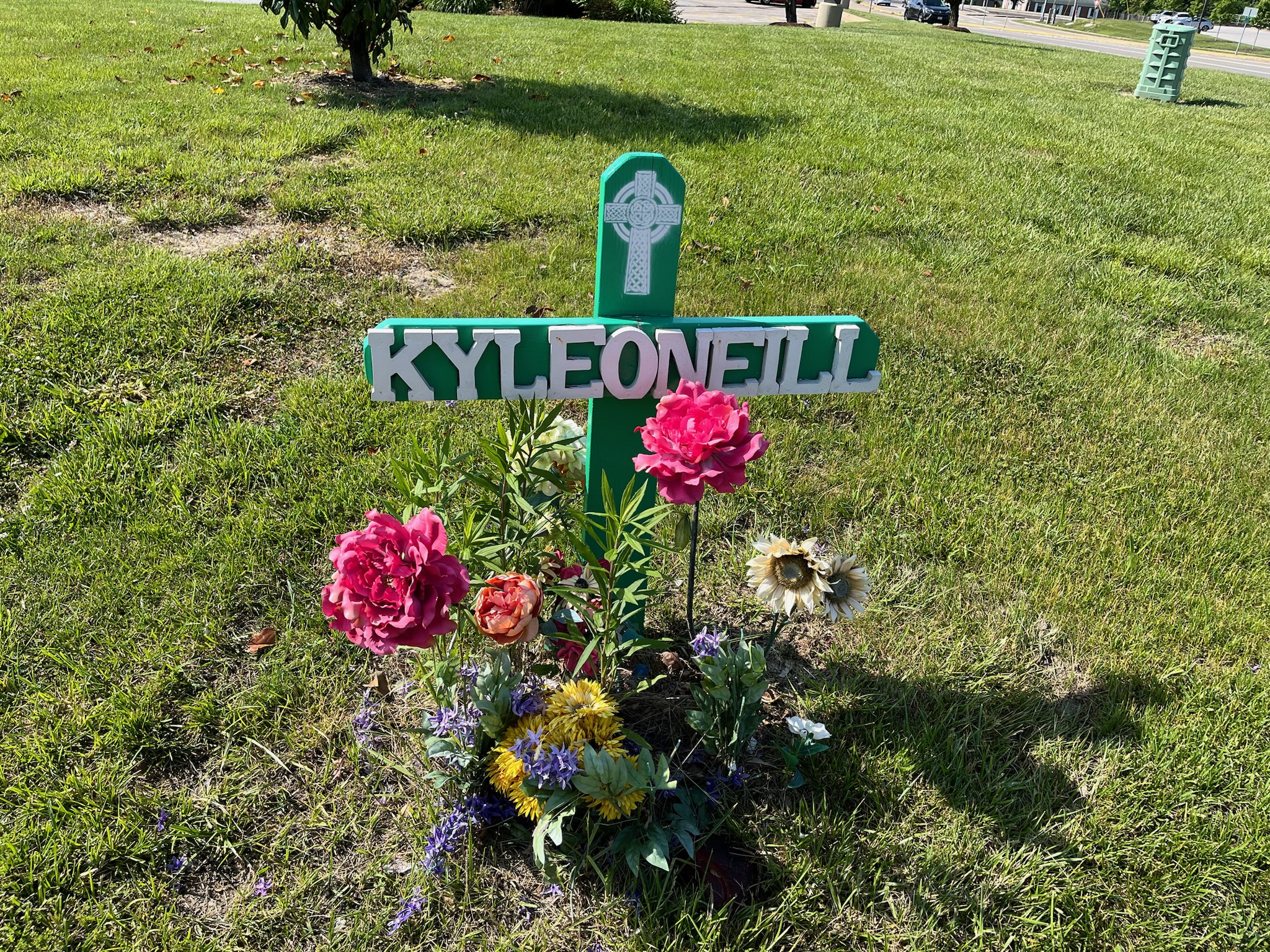
The road memorial for Kyle can be found at Hwy 141 and Bowles Avenue.
A drive to inspect just a few of the roadway memorials in the St. Louis area reveals that few drivers are reducing speeds, or exercising more caution, near these sad reminders.
• A memorial decked with flowers near Hwy 141 and Bowles Avenue seems to have not had much impact. Drivers are still speeding through the nearby Fenton exchange – and pressing their luck – as highway lights change from yellow to red.
• A memorial with a tire on a wooden cross at West Watson and Highway 30 is at an extremely dangerous exchange in Sunset Hills. Fatalities have been recorded all up and down the highway as doomed cars have pulled into oncoming traffic.
• An elaborate memorial, with obituary information in attached plastic sleeves, can be found on I-270 in south St. Louis County north of Tesson Ferry. Deadly multi-car pile-ups in the vicinity have continued since the tribute was erected in 2021.
Roadside Tribute’s Hill said he thinks there would be many more memorials out there, if these small monuments did not encounter resistance.
Commercial and residential property owners do not want to provide space for such tributes for the survivors. The tributes are disturbing to homeowners and may hurt the business climate for retail developments and strip malls.
Highway departments and cities don’t want to provide space for such tributes either, because they might suggest officials are not doing their best to insure traffic safety.
“A lot of it comes down to this: Do we want to spend the money to save lives?” said Hill. “We know roundabouts calm traffic and are superior to a bunch of stop signs that people will run. Problem is, putting in roundabouts costs money.
“Some urban highways are just like interstates and they should not have red lights and those early yellow warning lights, because people are driving at high speeds, and the warning lights don’t always work,” said Hill. “The highway departments just don’t want to spend the money for on-and-off ramps.”
The obvious example of this is in the outer-ring suburban areas of St. Louis is Hwy 141. Many drivers have commented that Highway 141 is “just a high-speed Interstate 270 with inconvenient red lights.”
Fatalities Climbing
A recent report issued by St. Louis Trailnet shows an increasing number of traffic fatalities in both St. Louis city and county. Last year, 173 people were killed and 14,930 people were injured in traffic crashes in the region.
The “traffic violence” that is afflicting the region is not just about car crashes. Just in the county, the number of pedestrian fatalities over a three-year span from 2020-2022 was up 228% from a decade ago.
A new report from the Governors Highway Safety Administration reveals that in Missouri, there were 111 pedestrian fatalities in 2019, which rose to 129 last year.
Across the country, more than 7,500 people died last year because they were hit by vehicles on roadways. That’s up from 6,300 just three years earlier. American drivers seem to have little respect for pedestrian right-of-ways, many of them marked on the roadways and illuminated with yellow flashing lights.
Hill said highway departments and cities are even more reluctant to allow roadside tributes for pedestrians, never mind for car crashes. Pedestrian tributes might suggest officials are not doing their best to insure traffic safety for walkers.
People often assume it’s all getting better out there on the roadways – measures are being taken and progress is being made – things are safer. But, “things” are not safer.
 Environmental Echo