
 by Don Corrigan
A new film, “Silent Fallout: Baby Teeth Speak,” covers the Cold War era study of atomic bomb radiation in 320,000 baby teeth by St. Louis scientists. It’s a St. Louis International Film Festival offering at 1 p.m., Nov. 18, at the Hi Pointe Theatre, 1005 McCausland Ave.
Liz McCane of Kirkwood remembers her parents’ concern over atomic testing and the release of radiation. When she was young, Congress was in heated debate over whether U.S. atomic testing should be stopped.
“My parents sent in my baby teeth, as well as those of my 3 siblings,” recalled McCane. “My parents were both scientists, and they had some inkling of what the results would be.
“It was probably a difficult time to be a parent,” said McCane. Some friends built an underground fallout shelter in their back yard, and at school we regularly experienced drills to instruct us in case of nuclear war.”
McCane likened the school nuclear war drills to the active-shooter drills that are going on at schools today.
“I have experienced an active shooter drill with a preschool class,” said McCane. “It’s sad that teachers need to explain the reasons for such drills to children. I can imagine what my parents’ generation felt when nuclear bombs were the classroom threat for children.
The baby teeth nuclear test study was coordinated by volunteers such as the late Yvonnne Logan of Webster Groves. Initially a St. Louis project, Logan served as director of collections.
Logan’s job with the survey was to persuade parents to send in baby teeth to be analyzed at Washington University for Strontium 90, a radiation by-product of atomic testing by the U.S. and the Soviet Union.
The survey took in more than 300,000 teeth. Analysis showed increasing levels of Strontium-90, a cause of bone tumors and cancer. The findings convinced President John F. Kennedy to urge Congress to pass the Partial Test Ban Treaty limiting nuclear tests.
Logan led and participated in marches in St. Louis and Washington, D.C., to ban the bomb. She demonstrated against the draft and the war in Vietnam. She attended vigils outside the offices of General Dynamics to protest its Trident submarines and their nuclear missiles.
JFK’s Somber Speech
On July 26, 1963, Kennedy gave a speech for passage of the test ban treaty that included an appeal to care about children “with leukemia in their blood, with cancer in their bones, with poison in their lungs.”
The baby teeth survey revealed the damage being done to children who were drinking contaminated milk and water. It prompted Kennedy to sign the test ban treaty after his success in getting Congress to pass it.
Joseph Mangano, a consultant for the film, “Silent Fallout: Baby Teeth Speak,” is executive director of Radiation and Public Health Project (RPHP) in New York. He described the St. Louis-based tooth study as one of the greatest achievements of the 20th Century in environmental science.
 The U.S. conducted 106 atom bomb tests in the south Pacific, all above ground. It also conducted 928 tests at its Nevada test site, 100 above ground and 828 underground.
“Most fallout was a result of above-ground tests,” said Mangano. “The above-ground tests of the 1950s and 1960s spread fallout across the globe. Every human was exposed to fallout.
“The large mushroom clouds of fallout went into the stratosphere, were propelled by prevailing winds, were returned to earth by rain and snow, and entered bodies from contaminated food and water,” Mangano explained.
He said radiation from the Trinity bomb tested in New Mexico entered 46 U.S. states and it revealed that even one nuclear explosion can spread fallout extensively. Development of that bomb was the subject of this summer’s movie, “Oppenheimer.”
Evidence shows that no atomic war can be “contained,” Mangano said. It reveals that a “limited” nuclear war now in the Middle East or Eastern Europe would affect us all in terrible ways.
The new 81-minute documentary, “Silent Fallout: Baby Teeth Speak,” is the work of Hideaki Ito. The Japanese television producer and filmmaker grew up near Hiroshima, site of the first use of an atomic bomb in war.
Ito has studied radiations’ effects from the U.S. hydrogen bomb tests in the Pacific Ocean to the 2011 Fukushima disaster. He was shocked by the level of contamination of the Japanese archipelago caused by the Fukushima Daiichi Nuclear Power Plant accident.
“Baby Teeth Speak”
A central figure in Ito’s film is Louise Reiss, a female physician in St. Louis, who along with a group of scientists, devised the Baby Tooth Survey. It was conducted from 1958 to 1970 by Washington University and the Greater St. Louis Committee for Nuclear Information.
The second half of the film reveals that radioactive contamination has not been caused solely by nuclear tests. U.S. citizens continue to sacrifice their health and lives to possess these weapons, and they are not well-informed on the dangers.
After Ito’s film is shown at the High Pointe, there will be a short question-and-answer session and discussion about the role of St. Louis in the atomic age and the continuing impact of the baby teeth study.
In 2001, just over 100,000 teeth, not used in the study, were discovered in storage by Washington University at the Tyson Valley complex. The school donated the teeth to RPHP.
RPHP is conducting more studies of cancer risk from bomb fallout, using measurements of Sr-90 still detectable in teeth. In addition, Harvard School of Public Health is using the teeth to analyze early-life exposures to metals and later-life risks of neurological diseases.
Ito’s film is, in part, a tribute to activist women who have cared so much about children. Kirkwood’s McCane cited today’s women who are fighting against guns killing children, against drunk driving, against the irresponsible dumping of nuclear waste in Coldwater Creek and the St. Louis region.
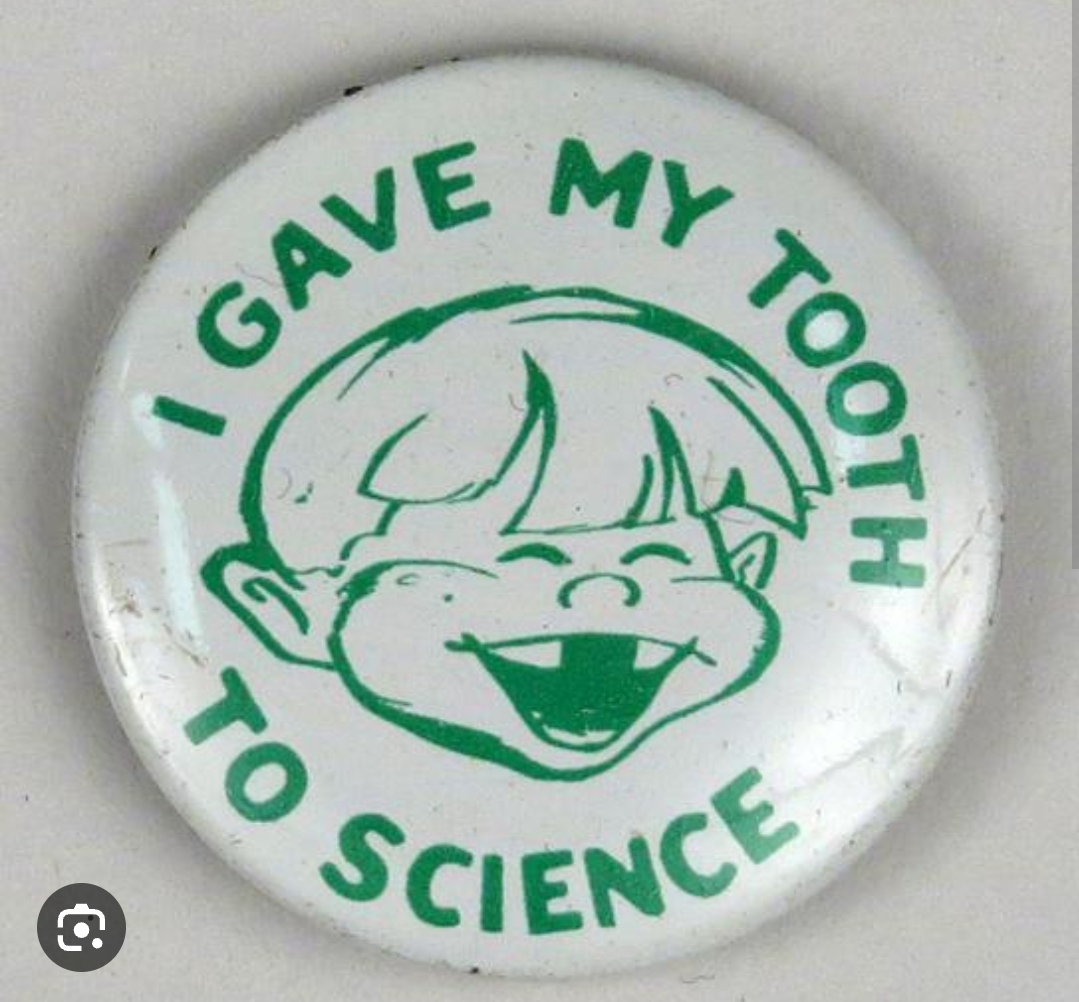
McCane wore an “I Gave My Tooth to Science” button as a child, thanks to her mom and activists like Yvonne Logan.
“Don’t even get me started on how much better the world might be, if women had been making the decisions,” said McCane. “And women of the 1960s were much more likely to take action on behalf of their children’s health than their spouses.
“It’s still true,” said McCane. “Think of recent organizations like Mothers Against Drunk Driving, Moms Demand Action, Just Moms St. Louis. Women still take the lead, but these organizations do welcome men.”
 Environmental Echo